
LSA-1976
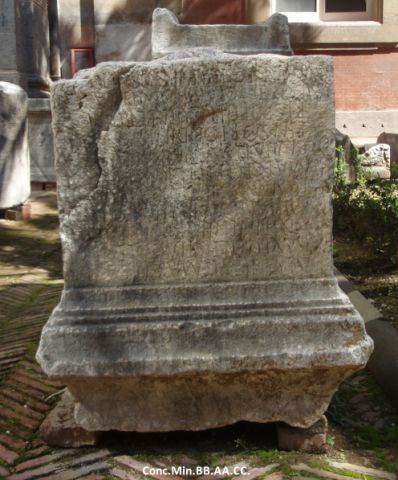
Base for statue of Maecius Felix, defensor of Venafrum and governor of Samnium. From Venafrum (Samnium). Later fourth century.
Record details
Photographs
Inscription
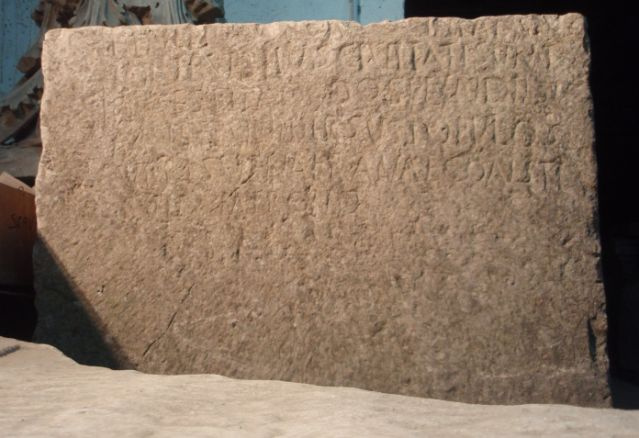
Maec̣ị Felicis, v(iri) p(erfectissimi). / Aequitate magnific̣ọ, / benivolentia colendo, / abstinentia continenṭịaq(ue) /(5) mirando, virtute cons/tantiaque conspicuo, / Maecio Felic̣ị, ̣v(iro) p(erfectissimo), / civitatis Venafranae [d]e/fensori, ordinis pos[ses]so/ris (!) populique, rectori /(11) provinciaẹ Samṇịị, ad / iniunctivae ṿịc̣ịs ̣ṃẹrito / ob insignia eius in rem / publicam bene gesta et /(15) ob recordationem omnium / beneficioruṃquae a ma/ioribus eius civitati sunt / `si`praestita, ordo splendidis/mus et universus populos (sic, for ‘populus’) /(20) urbis Venafranaẹ consti/tuit patrono.
Inscription translation
Statue of Maecius Felix, of perfectissimus rank. To him who is magnificent through his justice, who must be honoured for (his) benevolence; for his abstinence and reticency he must be admired; through virtue and steadfastness he is conspicuous. To Maecius Felix, of perfectissimus rank, defender of the city of Venafrum, of the class of landowners, and of the people, governor of the province of Samnium; with the intention to inflict recompensation to merit; because of his outstanding benefactions towards the common wealth, and as a memory of all the benefactions which by his forefathers have been bestowed on the city, the most splendid ordo and the entire people of the city of Venafrum set this up to the patron.
Bibliography
- Corpus Inscriptionum Latinarum; , X, 4863
- Capini, S., Molise. Repertorio delle Iscrizioni Latine. VII: Venafrum, Campobasso 1999, n. 27
Discussion
INSCRIPTION
In 21 lines
Maec̣ị Felicis, v(iri) p(erfectissimi). / Aequitate magnific̣ọ, / benivolentia colendo, / abstinentia continenṭịaq(ue) /(5) mirando, virtute cons/tantiaque conspicuo, / Maecio Felic̣ị, v(iro) p(erfectissimo), / civitatis Venafranae [d]e/fensori, ordinis pos[ses]so/ris (!) populique, rectori /(11) provinciaẹ Samṇịị, ad / iniunctivae ṿịc̣ịs ̣ṃẹrito / ob insignia eius in rem / publicam bene gesta et /(15) ob recordationem omnium / beneficioruṃquae a ma/ioribus eius civitati sunt / `si`praestita, ordo splendidis/mus et universus populos (sic, for ‘populus’) /(20) urbis Venafranaẹ consti/tuit patrono.
'Statue of Maecius Felix, of perfectissimus rank. To him who is magnificent through his justice, who must be honoured for (his) benevolence; for his abstinence and reticency he must be admired; through virtue and steadfastness he is conspicuous. To Maecius Felix, of perfectissimus rank, defender of the city of Venafrum, of the class of landowners, and of the people, governor of the province of Samnium; with the intention to inflict recompensation to merit; because of his outstanding benefactions towards the common wealth, and as a memory of all the benefactions which by his forefathers have been bestowed on the city, the most splendid ordo and the entire people of the city of Venafrum set this up to the patron.'
Letter height not recorded by CIL.
DESCRIPTION
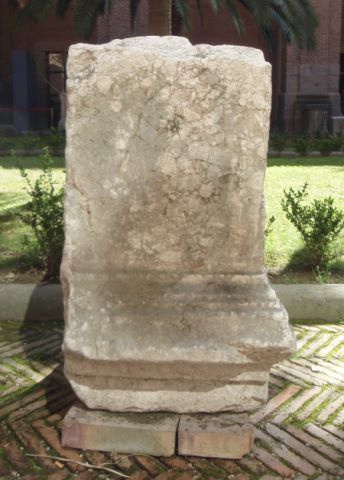
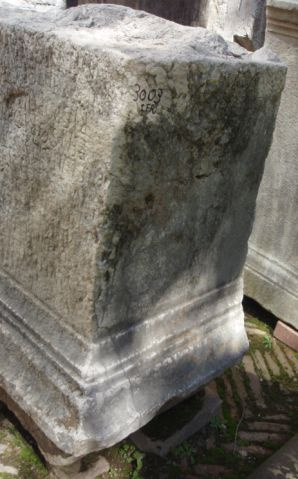
Rectangular marble statue base moulded at top, H 87, W 77, D 47 cm. The base is horizontally broken (see below, 'Provenance and Current Location').
PROVENANCE AND CURRENT LOCATION
The inscription was first recorded in the centre of Venafri, on the piazza 'la Cialaffella', the location of the forum of ancient Venafrum (http://pleiades.stoa.org/places/433185).
The base is now in the National Museum of Naples, inv. no. 3003. The upper part is standing upside down in the courtyard of the museum, the lower part is in the storerooms.
HONORAND, AWARDER AND DATE
Maecius Felix, the honorand, was provincial governor (rector, line 10) of the province of Samnium (line 11) (PLRE I, 333 Maecius Felix 9). He was of equestrian (perfectissimus) rank. Samnium did not exist as a separate province before the mid-4th century. This suggests a date in the later 4th century for our inscription.
Maecius Felix is praised for his virtues in office. Moreover, he was patron of the city of Venafrum (line 21), and he was probably of local origin (lines 15-18 recording benefactions by his forebearers).
The inscription was set up by the civic institutions (council and people, ordo et populus, lines 18-19) of Venafrum.
Discussion references
- Jones, A. H. M. et al., The Prosopography of the Later Roman Empire. Vol. I 260-395, Cambridge et al. 1971 (1975), 333
Cite: Last Statues of Antiquity, LSA-1976 (Ulrich Gehn and Carlos Machado (preliminary discussion page added 10/14)).