
LSA-1980
Base for statue of Licinius or Maximinus Daia, emperor. Tarraco (Tarraconensis). 311-312
Record details
Photographs
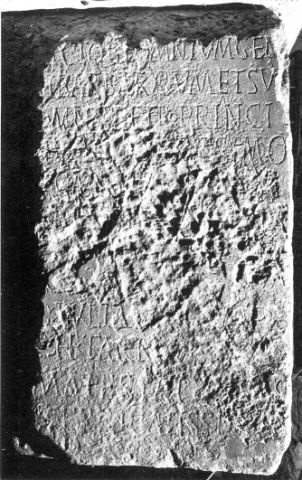
Inscription
Devictori omnium gen/tium barbararum et su/per omnes retro princi/pes providentissimo / imp(eratori), Caes(ari) [[[Val(erio) Lici]]]/[[[niano Licinio]]], p(io), f(elici), / invic(to) Aug(usto), p(ontifici) m(aximo), t(ribunicia) pot(estate), / (5) p(atri) p(atriae), co(n)s(uli) II, proc(onsuli). / Val(erius) Iulianus, v(ir) p(erfectissimus), / p(raeses) p(rovinciae) H(ispaniae) Tarrac(onensis), numi/ni maiestatiq(ue) eius / semper dicatissimus.
Inscription translation
To the conquerer of all barbarian peoples and, above all former emperors, most provident emperor, Caesar Valerius Licinianus Licinius, pious, fortunate and unconquered Augustus, highest priest, holder of tribunician power, father of the fatherland, twice consul, proconsul. Valerius Iulianus, of perfectissimus rank, governor (praeses) of the province of Hispania Tarraconensis, always most devoted to his divine spirit and majesty, [set this up].
Bibliography
- Corpus Inscriptionum Latinarum; , II 4105
- Alföldy, G., Die römischen Inschriften von Tarracco, Berlin 1975, 53-4 no. 94
Discussion
INSCRIPTION
In eight lines:
Devictori omnium gen/tium barbararum et su/per omnes retro princi/pes providentissimo / imp(eratori), Caes(ari) [[[Val(erio) Lici]]]/[[[niano Licinio]]], p(io), f(elici), / invic(to) Aug(usto), p(ontifici) m(aximo), t(ribunicia) pot(estate), / (5) p(atri) p(atriae), co(n)s(uli) II, proc(onsuli). / Val(erius) Iulianus, v(ir) p(erfectissimus), / p(raeses) p(rovinciae) H(ispaniae) Tarrac(onensis), numi/ni maiestatiq(ue) eius / semper dicatissimus.
'To the conquerer of all barbarian peoples and, above all former emperors, most provident emperor, Caesar Valerius Licinianus Licinius, pious, fortunate and unconquered Augustus, highest priest, holder of tribunician power, father of the fatherland, twice consul, proconsul. Valerius Iulianus, of perfectissimus rank, governor (praeses) of the province of Hispania Tarraconensis, always most devoted to his divine spirit and majesty, [set this up].'
Letter height: 4 cm.
We reproduce the inscription here with the completions proposed by Alföldy 1975 (see also below, 'Honorand, Awarder, and Date').
DESCRIPTION (from Alföldy 1975 and the published photo)
Rectangular statue base of grey limestone (piedra de santa Tecla): H 88, W 59, D 55 cm. Chips on top; the left margin and lower left corner are broken off. The central part of the inscription is badly damaged, additionally the name of the honorand in line 3 has been erased.
Our inscription is the second re-use of the base. It is carved on the back of a base first used for an inscription to a local magistrate of the late 1st/early 2nd century (Alföldy 1975 no. 171). In its first re-use, a dedication to the emperor Carus (282-3) was carved on the left side, in the process turning the block upside down (Alföldy 1975 no. 89; dated 283). When our inscription was carved, the original inscription, now on the back side, was still upside down. The base was later used for a fourth time for a dedication to Constantine I, carved on the right side of the block which was now again turned on end so that the first-use inscription was again the right way up (LSA-1981).
PROVENANCE AND CURRENT LOCATION
This base is first recorded in the 15th or 16th century in the cathedral of Tarragona, probably built into the altar of the chapel of Santa Tecla. It therefore probably came from the shrine for the imperial cult, which was situated in this general area, on the uppermost terrace of the ancient city.
Today it is in the Archaeological Museum of Tarragona (without published inv. no.).
HONORAND, AWARDER AND DATE
The name of the honorand has been deliberately erased. The inscription is later than 288, when the province was still conventionally called Hispania Citerior (LSA-1979), and before 337, since the block was re-used for a dedication to Constantine (LSA-1981). The honorand is styled 'twice consul' (consul II, line 5) which allows us to narrow the date further: the only emperors who celebrated their second consulship as Augusti (not as Caesars) between 288 and 337 are Maximinus Daia in 311, Licinius in 312, and Constantine I also in 312. Of these, Constantine can of course be excluded. Hübner in 1869 (for CIL II) had argued that the emperor honoured was most probably Licinius whose name was repeatedly erased after his wars with Constantine in 314 and 323-4. This attribution was accepted by Alfödly 1975, and is indeed the most probable, since Daia was emperor in the East.
The honorand Valerius Iulianus, governor (praeses) of the province of Hispania Tarraconensis, is known only from this inscription (PLRE I, 480, Iulianus 40).
Discussion references
- Jones, A. H. M. et al., The Prosopography of the Later Roman Empire. Vol. I 260-395, Cambridge et al. 1971 (1975), 480 Iulianus 40
Cite: Last Statues of Antiquity, LSA-1980 (Christian Witschel).