
LSA-1981
Base for statue of Constantine I, emperor. Tarraco (Tarraconensis). 324-337, probably 324-326
Record details
Photographs
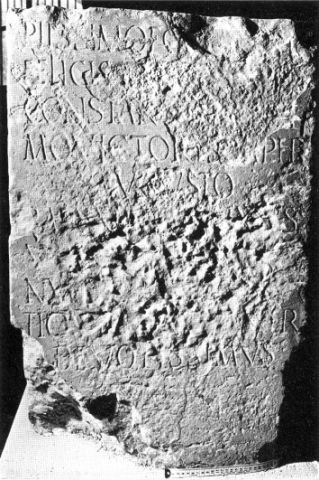
Inscription
Piissimo, fortissimo, / felicissimo, d(omino) n(ostro) / Constantino, maxi/mo victori, semper / (5) Augusto. / Badius Macrinus, / v(ir) p(erfectissimus), p(raeses) p(rovinciae) H(ispaniae) Tarr(aconensis), / numini maiesta/tique eius semper / devotissimus.
Inscription translation
To the most pious, most powerful, most fortunate, our lord Constantinus, the greatest victor, forever Augustus. Badius Macrinus, of perfectissimus rank, governor (praeses) of the province of Hispania Tarraconensis, always most devoted to his divine spirit and majesty, [set this up].
Bibliography
- Corpus Inscriptionum Latinarum; , II 4106
- Alföldy, G., Die römischen Inschriften von Tarracco, Berlin 1975, p. 54 no. 95
Discussion
INSCRIPTION
In ten lines:
Piissimo, fortissimo, / felicissimo, d(omino) n(ostro) / Constantino, maxi/mo victori, semper / (5) Augusto. / Badius Macrinus, / v(ir) p(erfectissimus), p(raeses) p(rovinciae) H(ispaniae) Tarr(aconensis), / numini maiesta/tique eius semper / devotissimus.
'To the most pious, most powerful, most fortunate, our lord Constantinus, the greatest victor, forever Augustus. Badius Macrinus, of perfectissimus rank, governor (praeses) of the province of Hispania Tarraconensis, always most devoted to his divine spirit and majesty, [set this up].'
Letter height: 4 - 5 cm.
DESCRIPTION (from Alföldy 1975 and the published photo)
Rectangular statue base of grey limestone (piedra de Santa Tecla): H 88, W 55, D 59 cm. The upper right and lower left corner are broken off. On the upper right side of the epigraphic field a layer of stone has flaked or been chipped off, the lower half of the inscription is badly damaged.
Our inscription is the third re-use of the base. It is carved on the right side of the first-use inscription to a local magistrate of the late 1st/early 2nd century (Alföldy 1975 no. 171). In its first re-use, a dedication to the emperor Carus (282-3) was carved on the left side, in the process turning the block upside down (Alföldy 1975 no. 89; dated 283). In its second re-use, a dedication to Licinius or Maximinus Daia was carved on the back of the original inscription which was still upside down (LSA-1980). When our inscription was carved on the right side of the block, it was again turned on end, so that the first-use inscription was once more the right way up.
PROVENANCE AND CURRENT LOCATION
This base is first recorded in the 15th or 16th century in the cathedral of Tarragona, probably built into the altar of the chapel of S. Tecla. It therefore probably came from the shrine for the imperial cult, which was situated in this general area, on the uppermost terrace of the ancient city.
Today it is in the Archaeological Museum of Tarragona (without published inv. no.).
HONORAND, AWARDER, AND DATE
The honorand, Constantine I, was Augustus 306-37. The victor title used in our inscription (instead of the standard tetrarchic epithet invictus) dates the inscription to after the defeat of Licinius in 324.
The awarder Badius Macrinus, governor (praeses) of Hispania Tarraconensis (PLRE I, 529, Badius Macrinus 2), is otherwise known only from a further inscription in Tarraco, to Constantius II as Caesar, 324-37 (LSA-1982).
Two further inscriptions to Constantinian emperors are known from Tarraco, one to Constantius II Caesar (LSA-1982), and one, where the imperial name is erased, most probably to Crispus (LSA-1983). Constantius II was Caesar 324-37, while Crispus was Caesar from 317 until his execution in 326. Hübner in 1869 (for CIL II) and subsequently Alföldy 1975 have argued that all three bases (these two, and ours to Constantine) were contemporaneous and hence datable to 324-6. This is supported by the fact that the formula in the dedications to the two Caesars are identical. However, our inscription and the dedication to Constantius II Caesar were by Badius Macrinus, governor of Hispania Tarraconensis, whereas the one to Crispus was by Septimius Acindynus, vicarius of the Spanish provinces (PLRE I, 11, Septimius Acindynus 2), so they may be of slightly different dates, although almost certainly displayed as a single group. The outer dates for our inscription are therefore 324 (when Constantine assumed the title of 'victor', as used in our inscription), and 337 (when he died), while there is a strong possibility that it dates from approximately 324-6.
Discussion references
- Jones, A. H. M. et al., The Prosopography of the Later Roman Empire. Vol. I 260-395, Cambridge et al. 1971 (1975)
Cite: Last Statues of Antiquity, LSA-1981 (Christian Witschel).