
LSA-1982
Base for statue of Constantius II, emperor. Tarraco (Tarraconensis). 324-337, probably 324-326
Record details
Photographs
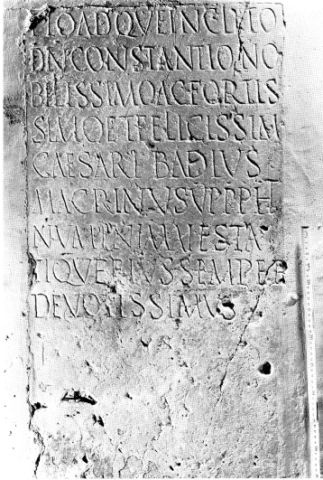
Inscription
Pio adque (sic) inclyto / d(omino) n(ostro), Constantio, no/bilissimo, ac fortis/simo et felicissimo / (5) Caesari. Badius / Macrinus, v(ir) p(erfectissimus), p(raeses) p(rovinciae) H(ispaniae) T(arraconensis), / numini maiesta/tique eius semper / devotissimus
Inscription translation
To our pious and venerable lord, Constantius, the most noble and powerful and fortunate Caesar. Badius Macrinus, of perfectissimus rank, governor (praeses) of the province of Hispania Tarraconensis, always most devoted to his divine spirit and majesty, [set this up].
Bibliography
- Corpus Inscriptionum Latinarum; , II 4108
- Alföldy, G., Die römischen Inschriften von Tarracco, Berlin 1975, 54-5 no. 96
Discussion
INSCRIPTION
In nine lines:
Pio adque (sic) inclyto / d(omino) n(ostro), Constantio, no/bilissimo, ac fortis/simo et felicissimo / (5) Caesari. Badius / Macrinus, v(ir) p(erfectissimus), p(raeses) p(rovinciae) H(ispaniae) T(arraconensis), / numini maiesta/tique eius semper / devotissimus.
'To our pious and venerable lord, Constantius, the most noble and powerful and fortunate Caesar. Badius Macrinus, of perfectissimus rank, governor (praeses) of the province of Hispania Tarraconensis, always most devoted to his divine spirit and majesty, [set this up].'
Letter height: 4 - 5 cm.
DESCRIPTION (from Alföldy 1975 and the published photo)
Rectangular statue base of grey limestone (piedra de Santa Tecla): H 93, W 48 cm. Surface and inscription are well preserved.
PROVENANCE AND CURRENT LOCATION
The inscription was first recorded in the late 15th century; in the 16th century it was in the cloister of the cathedral. It therefore probably came from the shrine for the imperial cult, which was situated in this general area, on the uppermost terrace of the ancient city.
The block is today built into a wall of the bishop's palace.
HONORAND, AWARDER AND DATE
The honorand, Constantius II, was Caesar 324-37.
The awarder Badius Macrinus, governor (praeses) of Hispania Tarraconensis (PLRE I, 529, Badius Macrinus 2) is known from a further inscription in Tarracco, to Constantine I, for which the outer dates are 324-37 (LSA-1981).
Two further inscriptions to Constantinian emperors are known from Tarraco, one Macrinus' dedication to Constantine (LSA-1981), and one, where the imperial name is erased, most probably to Crispus, Caesar from 317 until his execution in 326 (LSA-1983). Hübner in 1869 (for CIL II) and subsequently Alföldy 1975 argued that all three bases (these two, and ours to Constantius II) were contemporaneous and hence datable to 324-6. This is supported by the fact that the formula in the dedications to the two Caesars are identical. However, our inscription and the dedication to Constantine were by Badius Macrinus, governor of Hispania Tarraconensis, whereas the one to Crispus was by Septimius Acindynus, vicarius of the Spanish provinces (PLRE I, 11, Septimius Acindynus 2), so they may be of slightly different dates, although almost certainly displayed as a single group. The outer dates for our inscription are therefore 324 (when Constantius II became Caesar), and 337 (when he was elevated to Augustus), while there is a strong possibility that it dates from approximately 324-6.
Cite: Last Statues of Antiquity, LSA-1982 (Christian Witschel).