
LSA-1983
Lost base for statue, probably of Crispus, emperor. Tarraco (Tarraconensis). 317-326, probably 324-326
Record details
Photographs
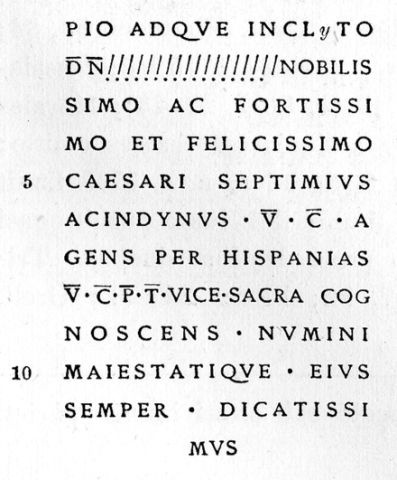
Inscription
Pio adque (sic) inclyto / d(omino) n(ostro), [[[Crispo]]], nobilis/simo, ac fortissi/mo et felicissimo / (5) Caesari. Septimius / Acindynus, v(ir) c(larissimus), a/gens per Hispanias / Ṿ c̣(um) p̣(rovincia) Ṭ(ingitana), vice sacra cog/noscens, numini / (10) maiestatique eius / semper dicatissi/mus.
Inscription translation
To our pious and venerable lord, Crispus [name erased], the most noble and powerful and fortunate Caesar. Septimius Acyndinus, of clarissimus rank, administering the five provinces of Hispania together with the province of Tingitana, judge representing the emperor (vice sacra cognoscens), always most dedicated to his divine spirit and majesty, [set this up].
Bibliography
- Corpus Inscriptionum Latinarum; , II 4107
- Alföldy, G., Die römischen Inschriften von Tarracco, Berlin 1975, 55 no. 97
Discussion
INSCRIPTION
In twelve lines:
Pio adque (sic) inclyto / d(omino) n(ostro), [[[Crispo]]], nobilis/simo, ac fortissi/mo et felicissimo / (5) Caesari. Septimius / Acindynus, v(ir) c(larissimus), a/gens per Hispanias / Ṿ c̣(um) p̣(rovincia) Ṭ(ingitana), vice sacra cog/noscens, numini / (10) maiestatique eius / semper dicatissi/mus.
'To our pious and venerable lord, Crispus [name erased], the most noble and powerful and fortunate Caesar. Septimius Acyndinus, of clarissimus rank, administering the five provinces of Hispania together with the province of Tingitana, judge representing the emperor (vice sacra cognoscens), always most dedicated to his divine spirit and majesty, [set this up].'
Letter height not recorded.
The inscription is known only from early transcriptions. The first four letters of line 8 were apparently hardly legible (CIL: 'omnino corruptae'). Hübner in 1869 (for CIL II), followed by Alföldy 1975, therefore proposed to emend and read these letters as follows: ...vic(es) p(raefectorum) p(raetorio).... We have preferred to stick with the original reading and interpret the phrase as 'Hispanias V c(um) p(rovincia) T(ingitana), the five (provinces of) Hispania with the province of Tingitana' (Mauretania Tingitania being the neighbouring province in Africa).
The interpretation of the erased imperial name in line 2 as that of Crispus depends on the layout of the inscripton given by the 15th century editor I. Strada, which was followed by CIL and Alföldy 1975. A careful survey by J. C. Saquete has however shown that other scholars of the 15th to early 19th century document different dispostions of the lines, so that it remains possible that the erased name was that of Constantine II, Caesar 317-37, another Constantinian ruler who fell from grace and suffered damnatio memoriae (Saquete 2000, 284-5 n. 17).
DESCRIPTION
There are no description, measurements, or published image of the stone. We agree with Alföldy 1975, 97 that it was a statue base.
PROVENANCE AND CURRENT LOCATION
The inscription was first recorded in the 15th century; in the 16th century it was in the cathedral of Tarragona, by the altar of Santa Barbara, on the northern side of the building. It therefore probably came from the shrine for the imperial cult, which was situated in this general area, on the uppermost terrace of the ancient city.
The inscription is now lost.
HONORAND, AWARDER, AND DATE
The honorand, Crispus, eldest son of Constantine I, was Caesar from 317 until his execution in 326.
The awarder, Septimius Acindynus, was vicar of the Spanish provinces and judge of the highest appeal when he set up the dedication in Tarracco (PLRE 1, 11, Septimius Acindynus 2). In his later career he advanced to be praetorian prefect of the East in 338-40, and consul in 340.
The formula of the dedication reappears with a striking similarity on another inscription in Tarraco, set up by Badius Macrinus, governor of Hispania Tarraconensis (PLRE I, 529 Badius Macrinus 2), to Constantius II Caesar in 324/37 (LSA-1982). Hübner in 1869 (for CIL II) and Alföldy 1975 therefore assumed that both dedications were contemporaneous. This would raise the terminus post quem for our inscription to 324. However, it should be noted that the awarders of these two bases were different men: the provincial governor for that to Constantius II (LSA-1982), an acting vicar for our inscription base. It is therefore possible that they were set up at different times, though clearly intended to complement each other. So, while a tighter dating of 324-6 is probable, the safest outer date-range is the reign of Crispus as Caesar, 317-26 (unless the honorand was Constantine II, which would extend the terminus ante quem to 337).
Discussion references
- Jones, A. H. M. et al., The Prosopography of the Later Roman Empire. Vol. I 260-395, Cambridge et al. 1971 (1975)
Cite: Last Statues of Antiquity, LSA-1983 (Christian Witschel).