
LSA-1984
Fragmentary plaque, perhaps from statue base, with dedication to unknown emperor, possibly Licinius. Tarraco (Tarraconensis). Late third to early fourth century
Record details
Photographs
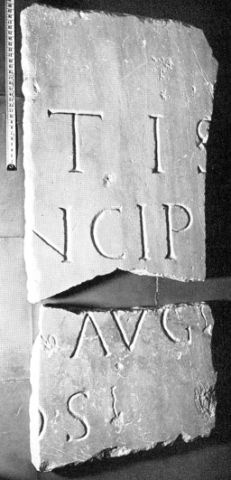
Inscription
[For]tis[simo ac ---] / [pri]ncip[i ---] / [---] Aug(usto) / [p(ontifici) m(aximo) t(ribunicia) p(otestate) p(atri) p(atriae) co(n)s(uli) proc]o(n)s(uli) [ivy leaf] / ------?
Inscription translation
To the most powerful and ... emperor ... Augustus, highest priest, holder of tribunician power, father of the fatherland, consul, proconsul ...
Bibliography
- Alföldy, G., Die römischen Inschriften von Tarracco, Berlin 1975, pp. 56-7 no. 98
Discussion
INSCRIPTION
In four surviving lines:
[For]tis[simo ac ---] / [pri]ncip[i ---] / [---] Aug(usto) / [p(ontifici) m(aximo) t(ribunicia) p(otestate) p(atri) p(atriae) co(n)s(uli) proc]o(n)s(uli) [ivy leaf] / ------?
'To the most powerful and ... emperor ... Augustus, highest priest, holder of the tribunician power, father of the fatherland, consul, proconsul ... .'
Large letters, 8 - 11 cm high.
We reproduce the inscription with the completions proposed by Alföldy 1975.
DESCRIPTION (from Alföldy 1975 and the published photo)
Three non-adjoining fragments of a marble plaque. Only two of the fragments (a & b) bear parts of the inscription, while the third (fragment c, constituted from two small pieces) is blank. Measurements are as follows: Fragment (a) H 53, W 40 cm; fragment (b): H 28, W 37 cm; fragment (c): H 10, W 26 cm; thickness of all the fragments, 4 cm. On fragment (a), the upper rim of the inscription is preserved, on fragment (b), the lower rim. The surface is smoothly finished and, apart from a few chips, well preserved.
The plaque could be from a large statue base built in a different material. The size of the letters, and the reconstructable shape of the slab, show that it was long and comparatively low (around 60 cm high); therefore, if it was from a statue base, this was almost certainly an equestrian monument.
It has been used twice; there is another inscription on the back of ours (LSA-1985), which from its letter-forms is the later of the two (Alföldy 1975, with whom we agree).
PROVENANCE AND CURRENT LOCATION
Fragments (a) and (b) were found in 1969 in the amphitheatre of Tarraco where they had been re-used (LSA-1985). In 1969 fragment (c) was already in the store-rooms of the Archaeological Museum, probably brought there in 1954 (Alföldy 1975). Today all the fragments are in the Archaeological Museum of Tarraco (without published inv. no.)
HONORAND, AWARDER AND DATE
From the extant remains of the inscription it is clear that the honorand was an Augustus (lines 2-3, '[pri]ncip[i ---] / [---] Aug(usto)'). Of the formula, an epithet in the superlative, preceding the imperial name, probably '[for]tis[simo..., the most powerful', is still partially legible; this points to a date in the late 3rd century or later. The form of the letters additionally speaks in favour of a late 3rd/early 4th century date.
The plaque was later turned over and re-used for an inscription to a later emperor, probably of the 4th century (LSA-1985); this was attributed to Constantine I by Alföldy 1975. If so, our inscription is likely to have been to Licinius, whose memory was frequently erased after his defeat at the hands of Constantine, and may be evidence of an equestrian statue to Licinius appropriated by his rival and conqueror. There is another dedication in Tarraco, possibly originally to Licinius, that was later re-used for Constantine I (LSA-1980, LSA-1981).
About the awarder no information is preserved, and it is not clear from the disposition of the surviving fragements whether an awarder's name was ever included in the inscription.
Cite: Last Statues of Antiquity, LSA-1984 (Christian Witschel).