
LSA-1985
Fragmentary plaque, perhaps from statue base, with dedication to unknown emperor, possibly Constantine I. Tarraco (Tarraconensis). Fourth century
Record details
Photographs
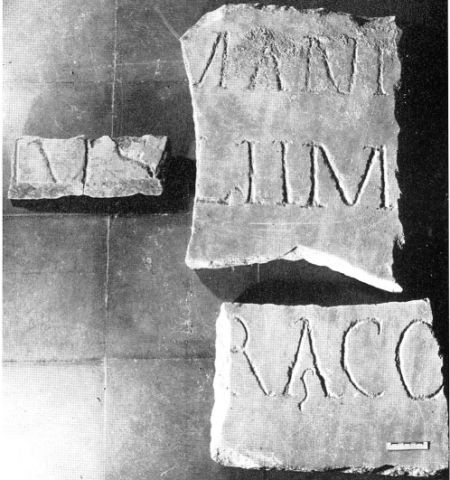
Inscription
Bono generis hu]mani n[ato] / [ac venerabi]li(?) im[p(eratori) d(omino) n(ostro)] / [------] / [Tar]raco[n(ensium) devotus n(umini) m(aiestati)q(ue) e]ius.
Inscription translation
To our lord the venerable emperor, born for the good of humanity. The ... of the Tarraconenses, devoted to his divine spirit and majesty, [set this up].
Bibliography
- Alföldy, G., Die römischen Inschriften von Tarracco, Berlin 1975, pp. 56-7 no. 99
Discussion
INSCRIPTION
In three lines:
Bono generis hu]mani n[ato] / [ac venerabi]li(?) Im[p(eratori) d(omino) n(ostro)] / [------] / [Tar]raco[n(ensium) devotus n(umini) m(aiestati)q(ue) e]ius
'To our lord the venerable emperor, born for the good of humanity. The ... of the Tarraconenses, devoted to his divine spirit and majesty, [set this up].'
Large letters, 11 - 13 cm high.
We reproduce the inscription with the completions proposed by Alföldy 1975.
DESCRIPTION
Three non-adjoining fragments (a, b, c) of a marble plaque; fragment (c) is composed from two small pieces. Fragment (a): H 53, W 40 cm; fragment (b): H 28, W 37 cm; fragment (c): H 10, W 26 cm; thickness of all the fragments, 4 cm. On fragment (a), the upper rim of the inscription is preserved, on fragment (b), the lower rim. The surface is smoothly finished and, apart from some damage to the first line of fragment (a), it is well preserved. This inscription is carved on the back of an earlier one from the late 3rd / early 4th century (LSA-1984).
Enough survives of the inscription to suggest that it comes from a statue base dedicated to an emperor, probably by the governor of the province of Tarraconensis (see below 'Honorand, Awarder, and Date'). The size of the letters, and the reconstructable shape of the slab, show that it was long and comparatively low (around 60 cm high). If it was from a statue base, this was almost certainly an equestrian monument.
PROVENANCE AND LOCATION
Fragments (a) and (b) were found in 1969 in the amphitheatre of Tarraco. In 1969, fragment (c) was already in the store-rooms of the Archaeological Museum, probably brought there in 1954 (Alföldy 1975). Today all the fragments are in the Archaeological Museum of Tarraco (without published inv. no.)
HONORAND, AWARDER, AND DATE
Of the honorand, an imperial title is partly preserved, im[p(eratori)], together with letters that may form part of the usual dedicatory formula for emperors of the tetrarchic and Constantinian period, [ ... devotus n(umini) m(aiestati)q(ue) e]ius. Alföldy 1975 completes the formula in lines 1 and 2 as [Bono generis hu]mani n[ato] / [ac venerabi]li(?) im[p(eratori) d(omino) n(ostro)].... As he points out, for the adjective that ends -li in line 2, there are only two possibilities, triumphali and venerabili, of which the latter is characteristic (though not exclusively) for Constantine I (Alföldy 1975, 56). Likewise, bono generis humani nato reoccurs in Constantinian inscriptions (and is, as far as we are aware, so far not known from other periods). On the basis of these indicators, Alföldy 1975 has argued that our honorand is most likely Constantine I.
The awarder, as indicated by [Tar]raco[n(ensium) in line 4 of the inscription, must have been either the city of Tarraco, or - perhaps more probably - the governor of the province of Hispania Tarraconensis.
We suggest a very broad outer date-range, because, as Alföldy 1975, 56 points out, the epithet venerabilis is also known as late as an inscription to Theodosius I and Arcadius of the very end of the 4th century (CIL III 6587).
Cite: Last Statues of Antiquity, LSA-1985 (Christian Witschel).