
LSA-1988
Base for statue of emperor, probably Maximian. Barcino (Tarraconensis). 286-305
Record details
Photographs
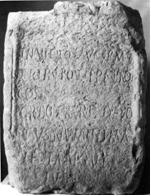
Inscription
[[[Imp(eratori) Caes(ari) Aur(elio)]]] / [[[Val(erio) Maximia]nọ]], / invicto Aug(usto), p(ontifici) m(aximo), / trib(unicia) pot(estate), p(atri) p(atriae), pro/co(n)s(uli). / (6) Ordo Barc(inonensium), devo/tus numini ma/iestati(que) / eius.
Inscription translation
To the emperor Caesar Aurelius Valerius Maximianus, the unconquered Augustus, highest priest, holder of tribunician power, father of the fatherland, proconsul. The council (ordo) of the Barcinonenses, devoted to his divine spirit and majesty, [set this up].
Bibliography
- Corpus Inscriptionum Latinarum; , II 4507
- Fabre, G., Mayer, M. & I. Rodà, Inscriptions Romaines de Catalogne. IV. Barcino, Paris 1997, p. 86-7 no. 27
Discussion
INSCRIPTION
In eight lines:
[[[Imp(eratori) Caes(ari) Aur(elio)]]] / [[[Val(erio) Maximia]nọ]], / invicto Aug(usto), p(ontifici) m(aximo), / trib(unicia) pot(estate), p(atri) p(atriae), pro/co(n)s(uli). / (6) Ordo Barc(inonensium), devo/tus numini ma/iestati(que) / ẹius.
'To the emperor Caesar Aurelius Valerius Maximianus, the unconquered Augustus, highest priest, holder of tribunician power, father of the fatherland, proconsul. The council (ordo) of the Barcinonenses, devoted to his divine spirit and majesty, [set this up].'
The first two lines, with the name of the imperial honorand, have been erased, and are presented here following the suggested completion by Fabre et al. 1997.
Letter height: 3.4 - 6.2 cm
DESCRIPTION (from Fabre et al. 1997 and the published photo)
Limestone statue base: H 81.6, W 59, D 56 cm. The top right corner is broken off, and all edges are chipped. At the left and right margins, parts of the frame of the epigraphic field are preserved. The epigraphic field appears to have been worked back through the erasure of an earlier inscription.
PROVENANCE AND CURRENT LOCATION
The inscription was recorded in the 18th century by the gate leading to the so called 'collegio' (18th-century source quoted by Fabre et al. 1997: 'cerca de la Puerta para donde se va al Collegio'). It had perhaps been reused as a building block within the Roman city wall.
Now in the Barcelona Archaeological Museum, inv. no. 7553.
HONORAND, AWARDER AND DATE
The honorand's name is erased, but his titles show that he was an emperor of the rank of Augustus, while the dedicatory formula in lines 6-7 suggests a date in the tetrarchic or Constantinian periods. Augusti of that period whose names have often been erased are Maximian, Galerius, Maximinus Daia, and Licinius. The name was restored by Fabre and his colleagues to Maximian, from the letters '-NO', read with difficulty in line 2, the only indicators of the imperial name (Fabre et al. 1997, 87). Of the two candidiates whose names would fit these letters, Maximian and Maximinus Daia (309-13), Maximian (Augustus 286-305) is indeed the more likely.
The dedication was set up by the councillors (ordo) of the city of Barcino.
Cite: Last Statues of Antiquity, LSA-1988 (Christian Witschel).