
LSA-1989
Base for statue of Nummius Aemilianus Dexter, erected by the province of Asia to their former governor. Barcino (Tarraconensis). 379-387
Record details
Photographs
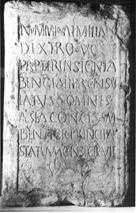
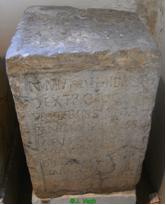
Inscription
Nummio (ivy leaf) Aemiliano / Dextro, (ivy leaf) v(iro) c(larissimo), / propter insignia / bene gesti proconsu/latus, (ivy leaf) omnes (sic) / (6) Asia, concessam / beneficio principali, / statuam consecravit. / (four ivy leaves)
Inscription translation
To Nummius Aemilianus Dexter, of clarissimus rank, because of the distinguished deeds he accomplished during the good exercise of his governorship (proconsulatus). The whole [province of] Asia dedicated this statue, which was granted by imperial favour (concessam beneficio principali).
Bibliography
- Corpus Inscriptionum Latinarum; , II 4512
- Fabre, G., Mayer, M. & I. Rodà, Inscriptions Romaines de Catalogne. IV. Barcino, Paris 1997, pp. 100-2 no. 36
Discussion
INSCRIPTION
In eight lines of text:
Nummio (ivy leaf) Aemiliano / Dextro, (ivy leaf) v(iro) c(larissimo), / propter insignia / bene gesti proconsu/latus, (ivy leaf) omnes (sic) / (6) Asia, concessam / beneficio principali, / statuam consecravit. / (four ivy leaves)
'To Nummius Aemilianus Dexter, of clarissimus rank, because of the distinguished deeds he accomplished during the good exercise of his governorship (proconsulatus). The whole [province of] Asia dedicated this statue, which was granted by imperial favour (concessam beneficio principali).'
Letter height: 6.4 (with a few letters as small as 1.9 cm).
DESCRIPTION (from Fabre et al. 1997 and the published photo)
Rectangular statue base of limestone (possibly piedra de santa Tecla): H 96, W 60.5, D 51 cm. The epigraphic field is framed on all four sides. Major chips at top, bottom, and upper right corner. The epigraphic field has been worked back, probably through the erasure of an earlier inscription. The sides are polished; the back is finished and has a rectangular hole which must have served to connect it with the wall it was standing against. A cavitiy on the top surface must have served to fix a crowning element, or the statue itself.
PROVENANCE AND CURRENT LOCATION
The inscription was first recorded in the 16th century in the calle de la Puerta del Angel in Barcelona (Fabre et al. 1997, 100). Now in the Barcelona Archaeological Museum, inv. no. 7563.
HONORAND, AWARDER AND DATE
The honorand, Nummius Aemilianus Dexter, was governor (proconsul) of Asia some time between 379 and 387 (PLRE I, 251, Nummius Aemilianus Dexter 3). An inscription set up to him in Ephesus says that he was holding office under Theodosius I, which provides a terminus post quem of 379 for his proconsulship (and hence for our inscription). The terminus ante quem, for both his governorship and our base, is the year 387 when he is recorded in the higher office of comes rerum privatarum. Later in his career, in 395, he ascended to the praetorian prefecture of Italy. This inscription, similar to others set up in the home towns of governors (above all in Rome), shows, beyond reasonable doubt, that Dexter was a citizen of Barcino. He is known to have been a zealous Christian.
The statue was awarded by 'omnes Asia', which is poor Latin for either 'all Asia, omnis Asia', or 'all the people of Asia, omnes Asiae'. It was presumably decreed and paid for by the assembly of the province of Asia.
The wording and context of the inscription suggest that it was erected very soon after Dexter's governorship of Asia, and certainly before he held any more elevated office (since this would otherwise have been mentioned).
FURTHER DISCUSSION ****LINKS NEEDED****
The apparent reference to imperial permission to set up the statue ('concessam beneficio principali statuam') associates our inscription with a group studied by Premerstein 1912 and Feissel 1984 (e.g. LSA-XXX, XXX). It suggests that the statue was in bronze, not marble, since in the late 4th century the erection of a bronze statue required imperial permission.
Discussion references
- Feissel, D. 'Notes d' Épigraphie chrétienne', Bulletin de Correspondance Hellénique 108, 545-579, Paris 1984
- Jones, A. H. M. et al., The Prosopography of the Later Roman Empire. Vol. I 260-395, Cambridge et al. 1971 (1975)
- Premerstein, A. v., 'Griechisch-Römisches aus Arkadien', Jahreshefte des Österreichischen Archäologischen Instituts 15, 197 - 218, Wien 1912
Cite: Last Statues of Antiquity, LSA-1989 (Christian Witschel).