
LSA-1990
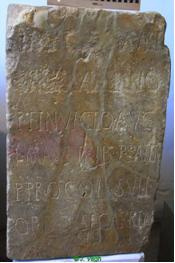
Base for statue of Maximian, emperor. Sigarra (Tarraconensis). 286-305
Record details
Photographs
Inscription
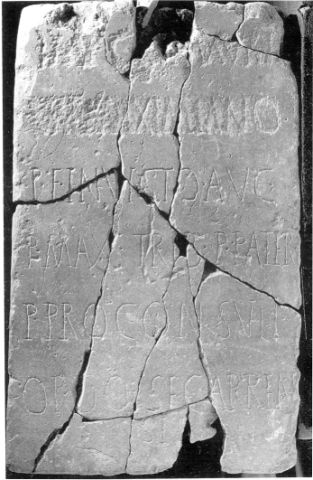
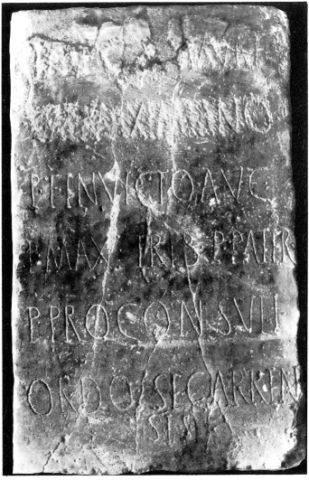
[[Imp(eratori) C[ae(sari)] M(arco) Aurelio]] / [[Val(erio) Maximiano]], / p(io), f(elici), invicto Aug(usto), / p(ontifici) max(imo), trib(unicia) p(otestate), pater (sic) /(5) p(atriae), proconsuli. / Ordo Segarren/sis.
Inscription translation
To the emperor, Caesar Marcus Aurelius Valerius Maximianus, pious, fortunate and unconquered Augustus, highest priest, holder of tribunician power, father of the fatherland, proconsul. The council (ordo) of the city of Segarra [set this up].
Bibliography
- Hispania epigraphica, Madrid, 12 (2006) p. 27 no. 72
- Fabre, G., Mayer, M. & I. Rodà, Inscriptions romaines de Catalogne. V. Suppléments aux Volumes I-IV et instrumentum inscriptum, Paris 2002, pp. 16-17 ad IRC, I 18
Discussion
INSCRIPTION
In seven lines:
[[Imp(eratori) C[ae(sari)] M(arco) Aurelio]] / [[Val(erio) Maximiano]], / p(io), f(elici), invicto Aug(usto), / p(ontifici) max(imo), trib(unicia) p(otestate), pater (sic) /(5) p(atriae), proconsuli. / Ordo Segarren/sis.
'To the emperor, Caesar Marcus Aurelius Valerius Maximianus, pious, fortunate and unconquered Augustus, highest priest, holder of tribunician power, father of the fatherland, proconsul. The councillors (ordo) of the city of Segarra [set this up].'
Letter height: 4.9 - 8 cm.
The imperial name in lines 1-2 has been erased, but is still largely visible.
DESCRIPTION (from Fabre et al. 1984, and the published photos)
The inscription is on a thick slab of limestone (piedra de Santa Tecla): H 97, W 60, D 34 cm, now broken into 21 conjoining pieces. At the top, a piece with some letters of the imperial name is now missing, as is a piece at the bottom with part of the last letter of the inscription. The corners and edges are chipped. The surface is smoothly finished with only a few superficial chips.
Our inscription was carved on the back of a base with an earlier inscription, to a local notable of the 2nd century (Fabre et al. 1984 no. 23); when reused for our inscription the block was turned upside down (Fabre et al. 2002, 16). At an unknown date the base was sawn in two, separating the two inscribed faces from each other.
PROVENANCE AND CURRENT LOCATION
The first-use inscription was recorded as the support for an altar in the church of S. Pere in the 18th century, and is today in the vestibule of the parish church in Els Prats de Rei (Fabre et al. 1984, 60 no. 23). Our inscription was considered lost by Fabre et al. 1984, and was only recently re-discovered in bits in the store-rooms of the Barcelona Archaeological Museum (Hispania epigraphica 12; Fabre et al. 2002). Today, reassembled, it is in the Archaeological Museum of Barcelona, inv. no. 34050.
HONORAND, AWARDER AND DATE
The honorand, Maximian, was Augustus 286-305. Presumably his name was erased on his fall from power in 305.
The statue was set up by the council (ordo) of the city of Sigarra.
Discussion references
- L'année épigraphique. , Paris
- Fabre, G., Mayer, M. & I. Rodà, Inscriptions romaines de Catalogne. I. Barcelone (sauf Barcino), Paris 1984, p. 53-5 no. 18
Cite: Last Statues of Antiquity, LSA-1990 (Christian Witschel).