
LSA-1991
Lost plaque from base for statue of Constantine I, emperor. Bracara (Gallaecia). 312-324
Record details
Photographs
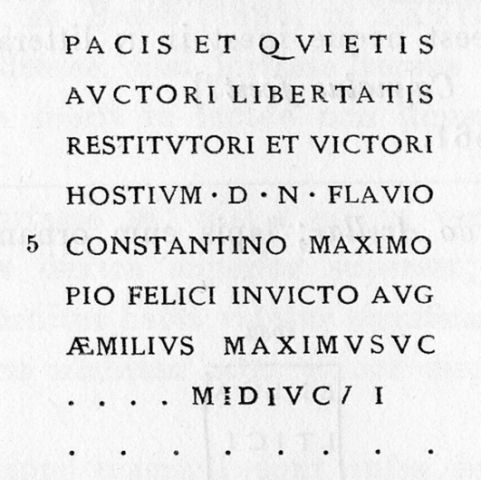
Inscription
Pacis et quietis / auctori, libertatis / restitutori, et victori / hostium, d(omino) n(ostro) Flavio / (5) Constantino, maximo, / pio, felici, invicto Aug(usto). / Aemilius Maximus, v(ir) c(larissimus), / [---]MIDIVCV.I[---].
Inscription translation
To the founder of peace and tranquility, restorer of freedom, and victor over [all] enemies, our lord Flavius Constantinus the most powerful, pious, fortunate and unconquered Augustus. Aemilius Maximus, of clarissimus rank ... [set this up].
Bibliography
- Hübner, E., Additamenta nova ad Corporis volumen II, Ephemeris Epigraphica. Corporis Inscriptionum Latinarum Supplementum. Vol. VIII, Berlin 1899, p. 403 no. 117
Discussion
INSCRIPTION
In eight lines:
Pacis et quietis / auctori, libertatis / restitutori, et victori / hostium, d(omino) n(ostro) Flavio / (5) Constantino, maximo, / pio, felici, invicto Aug(usto). / Aemilius Maximus, v(ir) c(larissimus), / [---]MIDIVCV.I[---].
'To the founder of peace and tranquility, restorer of freedom, and victor over [all] enemies, our lord Flavius Constantinus the most powerful, pious, fortunate and unconquered Augustus. Aemilius Maximus, of clarissimus rank ... [set this up].'
Letter height not recorded.
The end of the inscription was clearly lost before it was recorded, and the last few recorded letters 'MIDIVCV.I' are garbled (or badly transcribed) beyond satisfactory interpretation. Grünewald 1990, 191 no. 66 reasonably, but hypothetically, suggested the following end to the inscription '[p(raeses) p(rovinciae) Call(aeciae)?] d(evotus) n(umini) m(aiestati)q(ue) ei[us], governor of the province of Gallaecia, devoted to his divine spirit and majesty'.
DESCRIPTION (from Hübner 1899)
Stone plaque, H 100, W 90 cm. No published image. Presumably it was originally built into a base constructed of other materials.
PROVENANCE AND CURRENT LOCATION
The inscription was found in the region of the church of St. Martin in Braga ('fronteiro ao palacete de Sr. Conde de S. Martinho'). There is no recent record of its location; it is probably lost.
HONORAND, AWARDER AND DATE
The honorand, Constantine I, was Augustus 306-337. The opening formula of the inscription takes up the wording used on the Arch of Constantine in Rome, set up after his victory over Maxentius in 312. It also styles the emperor maximus, thereby using an epithet granted him by the Senate in 312 (Barnes 1982, 24). This provides a terminus post quem of 312 for our inscription; according to Grünewald 1990, 86-92, in epigraphy maximus was used regularly only from 315 onwards, which would raise the terminus post quem to that date. Our inscription does not, however, include the title victor which Constantine adopted after his defeat of Licinius in 324; the inscription must therefore predate that event.
The awarder, Aemilius Maximus, is known only from this inscription (PLRE I, 586, Aemilius Maximus 31). His office is not certain, because the end of the inscription is lost; but enough survives to show that he was of clarissimus rank (line 7), so he was probably the provincial governor of Gallaecia.
Discussion references
- Grünewald, T., Constantinus Maximus Augustus. Herrschaftspropaganda in der zeitgenössischen Überlieferung, Stuttgart 1990
- Jones, A. H. M. et al., The Prosopography of the Later Roman Empire. Vol. I 260-395, Cambridge et al. 1971 (1975)
Cite: Last Statues of Antiquity, LSA-1991 (Christian Witschel).