
LSA-1994
Lost base for statue of Constantius I or Constantine I, emperor. Corduba (Baetica). 305-337, probably 305-315
Record details
Photographs
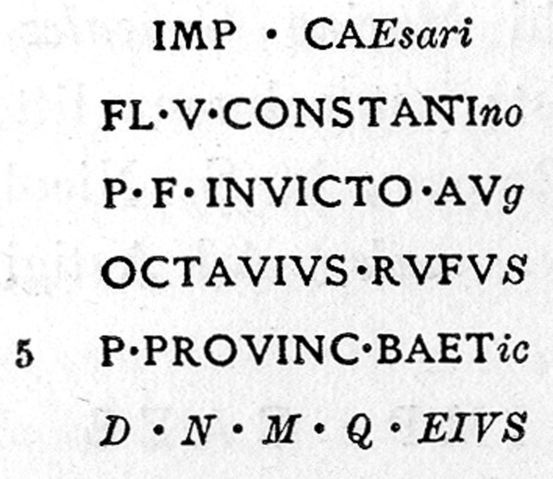
Inscription
Imp(eratori) Cae[s(ari)] / F(lavio) V(alerio) Constanti[o], / p(io), f(elici), invicto Au[g(usto)]. / Octavius Rufus, / (5) p(raeses) provin(ciae) Baet(icae), / d(evotus) n(umini) m(aiestati)q(ue) eius.
Inscription translation
To the emperor Caesar Flavius Valerius Constantius, pious, fortunate, unconquered Augustus. Octavius Rufus, governor (praeses) of the province of Baetica, devoted to his divine spirit and majesty, [set this up].
Bibliography
- Corpus Inscriptionum Latinarum; , II 2204
- Corpus Inscriptionum Latinarum; , II²/7, 261
Discussion
INSCRIPTION
In six lines:
Imp(eratori) Cae[s(ari)] / F(lavio) V(alerio) Constanti[o], / p(io), f(elici), invicto Au[g(usto)]. / Octavius Rufus, / (5) p(raeses) provin(ciae) Baet(icae), / d(evotus) n(umini) m(aiestati)q(ue) eius.
'To the emperor Caesar Flavius Valerius Constantius, pious, fortunate, unconquered Augustus. Octavius Rufus, governor (praeses) of the province of Baetica, devoted to his divine spirit and majesty, [set this up].'
Letter height not recorded.
We reproduce the text here according to CIL II²/7, 261. Hübner in 1869 (for CIL II) proposed an alternative reading of the imperial name in line 2: F(lavio) V(alerio) Constanti[no], 'to Flavius Valerius Constantinus'. We can see no convincing reason to exclude this reading (see below, 'Honorand, Awarder, and Date').
DESCRIPTION (from CIL II)
Block of bluish-white marble (piedra de jaspe blanquiaziul). No measurements are given. There is no published image.
PROVENANCE AND CURRENT LOCATION
The inscription was found in the area of the so-called Forum Coloniae in Corduba. It was still recorded as extant in its findspot by Hübner in 1869 (for CIL II). It is now lost. There is no published image.
HONORAND, AWARDER AND DATE
Constantius I, full name Flavius Valerius Constantius, was Augustus 305-6; his son Constantine I, full name Flavius Valerius Constantinus, 306-37. The attribution, and therefore the dating, of the inscription depend on how the lost ending of the imperial name is completed.
If Constantine I is the honorand, then the inscription is probably before the defeat of Licinius in 324, when Constantine assumed the title victor, thereafter present in most inscriptions, replacing the epithet invictus that appears on our inscription. Moreover, in the titulature of Constantine I, maximus became a standard epithet from 315 onwards (Grünewald 1990); its absence from our inscription perhaps lowers the terminus ante quem to that year.
The awarder, Octavius Rufus, governor (praeses) of the province of Baetica, is known only from this inscription (PLRE I, 785, Rufus 9).
Discussion references
- Grünewald, T., Constantinus Maximus Augustus. Herrschaftspropaganda in der zeitgenössischen Überlieferung, Stuttgart 1990, pp. 86-92
- Jones, A. H. M. et al., The Prosopography of the Later Roman Empire. Vol. I 260-395, Cambridge et al. 1971 (1975)
Cite: Last Statues of Antiquity, LSA-1994 (Christian Witschel).