
LSA-1996
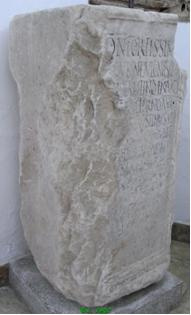
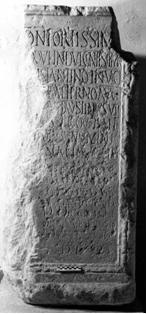
Base for statue of Constantine I or Constantine II, emperors. Corduba (Baetica). 306-340
Record details
Photographs
Inscription
D(omino) n(ostro), fortissimo / adque (sic) indulgentissimo / [Co]nstantino, invicto / [adq]ue aeterno Aug(usto), / (5) [---]s Faustinus, v(ir) p(erfectissimus), / [prae]s(es) prov(inciae) Ba(eticae), / [dev]otus numini / [mai]estatique eius.
Inscription translation
To our lord, the most powerful and most kindly Constantinus, unconquered and eternal Augustus. ...s Faustinus, of perfectissimus rank, governor (praeses) of the province of Baetica, devoted to his divine spirit and majesty, [set this up].
Bibliography
- Corpus Inscriptionum Latinarum; , II 2205
- Corpus Inscriptionum Latinarum; , II²/7, 264
Discussion
INSCRIPTION
In eight lines:
D(omino) n(ostro), fortissimo / adque (sic) indulgentissimo / [Co]nstantino, invicto / [adq]ue aeterno Aug(usto), / (5) [---]s Faustinus, v(ir) p(erfectissimus), / [prae]s(es) prov(inciae) Ba(eticae), / [dev]otus numini / [mai]estatique eius.
'To our lord, the most powerful and most kindly Constantinus, unconquered and eternal Augustus. ...s Faustinus, of perfectissimus rank, governor (praeses) of the province of Baetica, devoted to his divine spirit and majesty, [set this up].'
Letter height not recorded.
DESCRIPTION
Marble statue base, with moulding at the bottom. The base is broken and lost at the back and on the left side, as well as at the top right corner. H 128, W 59, D 55 cm. The epigraphic field is framed on all sides.
PROVENANCE AND CURRENT LOCATION
The inscription was found in the region of the so-called Forum Coloniae in Corduba. Today in the Archaeological Museum of Córdoba (Museo Arqueológico y Etnológico), inv. no. D/4.
HONORAND, AWARDER AND DATE
The honorand is either Constantine I, Augustus 306-37, or his son Constantine II, Augustus 337-40. If it is Constantine I, and late in his reign (as suggested by a possible identification of the awarding governor - see below), the titles used for the emperor are unusual, because after 324 victor replaced invictus as a standard epithet for this emperor (Grünewald 1990).
A law of 337 (Codex Theodosianus, XI, 9, 2a), issued by Constantius II, is addressed to Egnatius Faustinus, governor (praeses) of Baetica. This governor could well be the same man as the awarder of our inscription, '...s Faustinus' (PLRE I, 328, Faustinus 9).
The precise date of this inscription depends on whether one puts more weight on the titles used to describe the emperor (which suggest a date before 324), or on the idenfication of our Faustinus with a governor active in 337.
Discussion references
- Grünewald, T., Constantinus Maximus Augustus. Herrschaftspropaganda in der zeitgenössischen Überlieferung, Stuttgart 1990, pp. 86-92; pp. 191-2 no. 71 with n. 7
- Jones, A. H. M. et al., The Prosopography of the Later Roman Empire. Vol. I 260-395, Cambridge et al. 1971 (1975)
Cite: Last Statues of Antiquity, LSA-1996 (Christian Witschel).