
LSA-1998
Base for statue of Constantius II, emperor. Corduba (Baetica). 337-361
Record details
Photographs
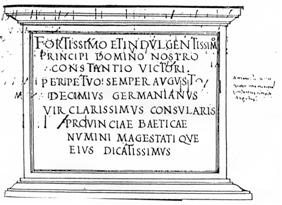
Inscription
Fortissimo, indulgentissimo / principi, domino nostro / Constantio, victori / perpetuo, semper Augusto, / (5) Decimius Germanianus, / vir clarissimus, consularis / provinciae Baeticae, / numini maiestatique / eius dicatissimus.
Inscription translation
To the most powerful and most kindly emperor, our lord Constantius, always victorious and forever Augustus. Decimius Germanianus, of clarissimus rank, governor (consularis) of the province of Baetica, most dedicated to his divine spirit and majesty, [set this up].
Bibliography
- Corpus Inscriptionum Latinarum; , II 2206
- Corpus Inscriptionum Latinarum; , II²/7, 265
Discussion
INSCRIPTION
In nine lines:
Fortissimo, indulgentissimo / principi, domino nostro / Constantio, victori / perpetuo, semper Augusto, / (5) Decimius Germanianus, / vir clarissimus, consularis / provinciae Baeticae, / numini maiestatique / eius dicatissimus.
'To the most powerful and most kindly emperor, our lord Constantius, always victorious and forever Augustus. Decimius Germanianus, of clarissimus rank, governor (consularis) of the province of Baetica, most dedicated to his divine spirit and majesty, [set this up].'
Letter height not recorded.
DESCRIPTION (from the published drawing)
Statue base with mouldings at top and bottom; H 120, W 60 cm. The epigraphic field is framed on all sides.
PROVENANCE AND CURRENT LOCATION
The inscription is said to come from the region of the so-called Forum Coloniae. Today it is built into the north wall of the church of San Nicolás de la Villa in Córdoba.
HONORAND, AWARDER AND DATE
The honorand, Constantius II, was Augustus 337-61.
The awarder, Decimius Germanianus, was praetorian prefect of Gaul in 363-6, and possibly acting vicar there already in 361 (PLRE I, 392, Germanianus 4). It is probable that he held his governorship in Baetica not long before these higher offices, therefore probably in the 350s. He held his governorship after it had been elevated to the rank of a consularis, with the status of clarissimus, whereas earlier the governor of Baetica had been a mere praeses, with the status of perfectissimus (LSA-1996). The change in rank and status may have occurred after Constantius II's defeat of the usurper Magnentius in 353. The only hard evidence to date Germanianus' governorship, however, remains the years of Constantius' II reign, 337-61.
Discussion references
- Jones, A. H. M. et al., The Prosopography of the Later Roman Empire. Vol. I 260-395, Cambridge et al. 1971 (1975)
Cite: Last Statues of Antiquity, LSA-1998 (Christian Witschel).