
LSA-1999
Base for statue of Aelia Vitalis, wife of a deputy to the praetorian prefects. Corduba. (Baetica) Late third to early fourth century
Record details
Photographs
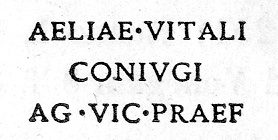
Inscription
Aeliae Vitali, / coniugi [[[---]]](?) / ag(entis) vic(es) praef(ectorum) [praetorio]
Inscription translation
To Aelia Vitalis, wife of ... acting deputy of the praetorian prefects
Bibliography
- Corpus Inscriptionum Latinarum; , II 2209
- Corpus Inscriptionum Latinarum; , II²/7, 270
Discussion
INSCRIPTION
Aeliae Vitali, / coniugi [[[---]]](?) / ag(entis) vic(es) praef(ectorum) [praetorio]
'To Aelia Vitalis, wife of ... acting deputy of the praetorian prefects'
Letter height not recorded.
The name of Aelia Vitalis' husband is not recorded, possibly (as suggested in the completion we offer) it had been deliberately erased.
DESCRIPTION
Tall block of whitish stone with black veins, probably marble: H 167, W 63, D 42 cm. The shape and size of the block suggest a statue base. According to the description in CIL II², an earlier inscription was erased to make way for ours.
PROVENANCE AND CURRENT LOCATION
The inscription was first recorded in 1627 close to the city gate in the wall of the 'huerta del alcazar'. Today it is lost. There is no published image.
HONORAND, AWARDER AND DATE
The honorand Aelia Vitalis (PLRE I, 970, Aelia Vitalis 4) was the wife of a deputy of the praetorian prefects in Spain, whose name is not recorded (PLRE I, 1016, Anonymus 64). The office of her husband points to a time when praetorian prefectures and vicariats had not yet been assigned fixed roles, which suggests a date in the late 3rd/ early 4th century (Noethlichs 1982).
FURTHER DISCUSSION
As the inscription lacks the name of an awarder, it may come from a funerary context rather than being an honorific inscription set up in a public space. The size and shape of the block on which it was recorded would well suit a statue base (as would the use of the dative for the honorand); but a public statue to the wife of a deputy praetorian prefect would be highly unusual.
Discussion references
- Jones, A. H. M. et al., The Prosopography of the Later Roman Empire. Vol. I 260-395, Cambridge et al. 1971 (1975)
Cite: Last Statues of Antiquity, LSA-1999 (Christian Witschel).