
LSA-2
Base for statue of Theodorus, governor of Achaea. Athens (Achaea). 379-395
Record details
Photographs
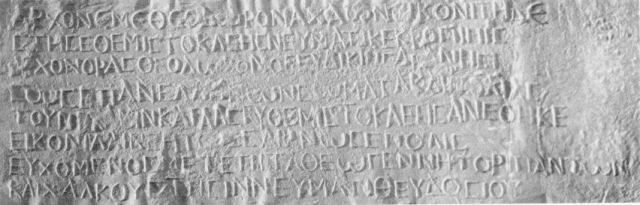
Inscription
ἀρχὸν ἐμὲ Θεόδωρον Ἀχαῶν εἰκόνι τῇδε /
στῆσε Θεμιστοκλέης, νεύματι Κεκροπίηις (sic). //
ἀρχὸν ὁρᾷς Θεόδωρον, ὅς εὐδικίῃσ’ ἀγανῇσι /
σῶσε Πανελλήνων σώματα καὶ πόλιας. /
τοὒνεκά μιν κατὰ ἄστυ Θεμιστοκλέης ἀνέθηκε /
εἰκόνι λαϊνέῃ’, τ`ως [ γ]ὰρ ἄνω [ γ]ε πόλις’, /
εὐχόμενος μετέπιτα θεῷ γεννήτορι πάντων, /
καὶ χαλκοῦ στήσιν νεύματι Θευδοσίου. /
Inscription translation
Theodorus, the ruler of the people of Achaea; Themistocles set me up in this statue. with the consent of Athens.
You see Theodorus, the ruler who with his gentle justice saved the people and cities of all the Greeks. That is why Themistocles set him up in a stone portrait statue in the city; for this was the decree of the city. Thereafter he made a vow to god, the creator of everything, to set up also a bronze statue with the consent of Theodosius
Textual evidence
Bibliography
- Inscriptiones Graecae, II/III(2) 13276
Discussion
INSCRIPTION
Two verse inscriptions in eight lines. The first poem consists of one distich, the second one of three distichs:
ἀρχὸν ἐμὲ Θεόδωρον Ἀχαῶν εἰκόνι τῇδε
στῆσε Θεμιστοκλέης, νεύματι Κεκροπίηις (sic).
ἀρχὸν ὁρᾷς Θεόδωρον, ὅς εὐδικίῃσ’ ἀγανῇσι
σῶσε Πανελλήνων σώματα καὶ πόλιας.
τοὒνεκά μιν κατὰ ἄστυ Θεμιστοκλέης ἀνέθηκε
εἰκόνι λαϊνέῃ’, τ`ως [γ]ὰρ ἄνω[γ]ε πόλις’,
εὐχόμενος μετέπιτα θεῷ γεννήτορι πάντων,
καὶ χαλκοῦ στήσιν νεύματι Θευδοσίου.
'Theodorus, the ruler of the people of Achaea; Themistocles set me up in this statue with the consent of Athens.'
'You see Theodorus, the ruler who with his gentle justice saved the people and cities of all the Greeks. That is why Themistocles set him up in a stone portrait statue in the city; for this was the decree of the city. Thereafter he made a vow to god, the creator of everything, to set up also a bronze statue with the consent of Theodosius'
Letter height 1 - 3 cm.
The reference to 'god, the creator of everything (θεῷ γεννήτορι πάντων)', may be Christian, but is not unambiguously so.
DESCRIPTION (from Sironen)
Cylindrical re-used statue base of light grey marble. Our text is cut between two earlier inscriptions, to the left and right. The base is currently used as the support for the altar of the church of Agia Ekaterini, so its top is concealed (see below, 'Provenance and Current Location'). The text, unusually, consists of two discrete, self-contained poems, each of which mentions both honorand and awarder. As Sironen recognizes, both poems are carved by the same hand.
PROVENANCE AND CURRENT LOCATION
The base is placed under the altar table of the church of Agia Ekaterini in the Plaka. The church was built in the 11th century on the site of an earlier Christian basilica. A column and an architrave of the latter are still visible in the cloister. There is no information on how the base arrived in the church.
HONORAND, AWARDER AND DATE
Theodorus was governor (proconsul) of Achaea in 379/95 (PLRE I 898, Theodorus 16). This date-range is given by the reign of Theodosius I mentioned in our inscription. Two further honorific inscriptions, in Corinth (LSA-18) and in Troizen (LSA-600) probably also refer to him.
Nothing is known of our awarder, Themistocles, but the fact that he was implementing a 'decree of the city' suggests that he was a civic official.
Groag considered Theodorus to be identical with Libanius' friend of the same name (PLRE I 899, Theodorus 17). This led him to suggest a date of 393/5 for his governorship, which is followed by Feissel 1984. However, our honorand could be another Theodorus of the later 4th century, who was urban prefect of Constantinople in 385 or 387 (PLRE I, 899 Theodorus 18; cf. LSA-877). If so, his urban prefecture, which ranked higher than the proconsulship of Achaea, provides a terminus ante quem for our inscription.
FURTHER DISCUSSION
As Sironen (1994, 32) points out, the explicit reference to imperial authorisation for a bronze statue, whereas a stone statue could be erected with the consent of the city alone (lines 6-8) is a striking feature of the text. For similar inscriptions, see Feissel 1984; and for the late antique legislation concerning the erection of statues in different materials, see Premerstein 1912.
The unusual reference to another statue for the same honorand, this time in bronze, suggests that the bronze statue really existed. The second poem (though carved by the same hand) may be a secondary addition. If so, it was presumably added after permission for the erection of the bronze statue was obtained (see LSA-423).
ACKNOWLEDGEMENT
We are very grateful for the help of Denis Feissel in translating and interpreting this inscription.
Discussion references
- Feissel, D. 'Notes d' Épigraphie chrétienne', Bulletin de Correspondance Hellénique 108, 545-579, Paris 1984, 545-558
- Groag, E., Die Reichsbeamten von Achaia in spätrömischer Zeit, Budapest 1946, 62-4
- Jones, A. H. M. et al., The Prosopography of the Later Roman Empire. Vol. I 260-395, Cambridge et al. 1971 (1975), 898, Theodorus 16
- Premerstein, A. v., 'Griechisch-Römisches aus Arkadien', Jahreshefte des Österreichischen Archäologischen Instituts 15, 197 - 218, Wien 1912, 215-218
- Robert, L., Epigrammes du Bas-Empire (Hellenica IV), Paris 1948, 22-3
- Sironen, E., The late Roman and early Byzantine inscriptions of Athens and Attica, Dissertation - University of Helsinki 1997, 70-2 no. 14
- Sironen, E. , 'Life and administration of late Roman Attica in the light of public inscriptions'
P. Castrén, Post-Herulian Athens : aspects of life and culture in Athens, A.D. 267-529 , Helsiniki 1994, 15-62, 31 no. 15
Cite: Last Statues of Antiquity, LSA-2 (Ulrich Gehn).