
LSA-200
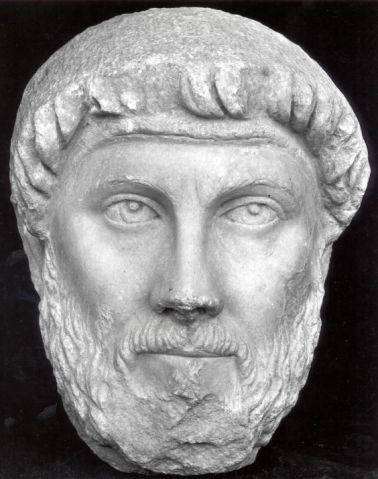
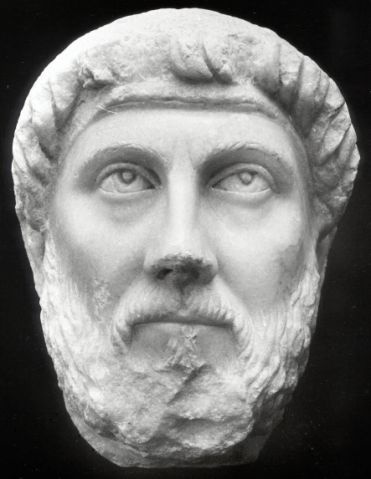
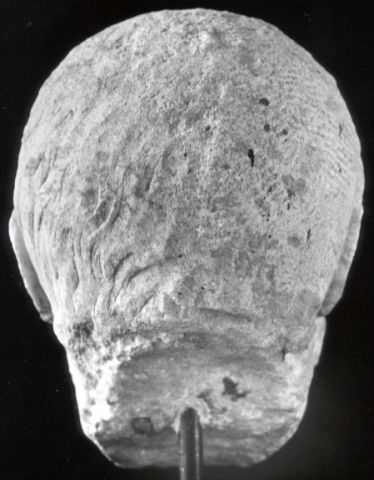
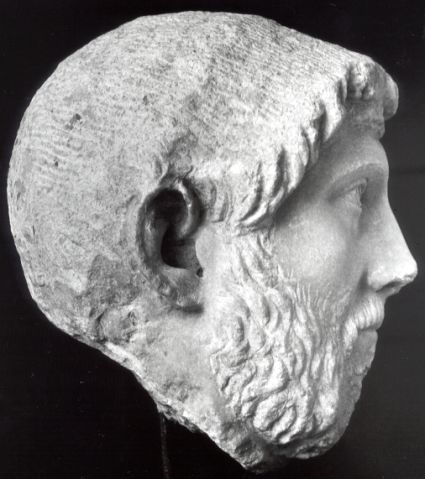
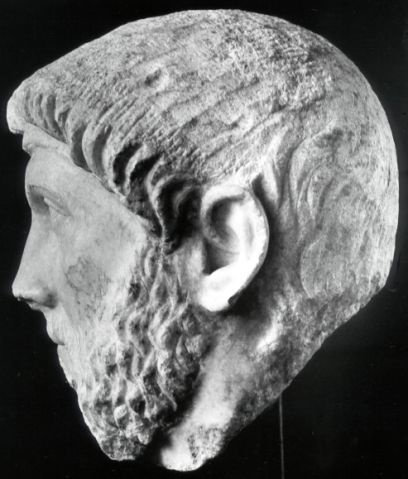
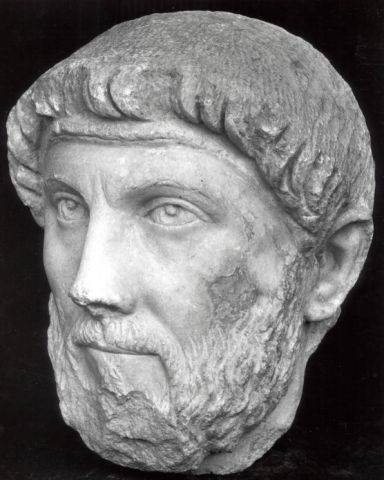
Re-cut portrait of bearded man with hair-line of previous portrait prominently visible. Aphrodisias (Caria). Fifth century.
Record details
Photographs
Bibliography
- Inan, J. & E. Alföldi-Rosenbaum, Römische und frühbyzantinische Porträ̈tplastik aus der Türkei : neue Funde, Mainz 1979, 229-230, no. 200, pl. 261.1-2 (Erim: second quarter of fifth century)
Discussion
DESCRIPTION (Object)
Over life-size head. H: 28, W: 22, D: 24 cm. Fine- grained white marble.
The head is broken through neck. The front of the chin is broken.
The head has been re-cut from an earlier portrait. This is visible at the brow, ears (especially left), and back of head. The left side of the back of the head preserves the longer locks of an earlier portrait, and the right side preserves the lines of a claw chisel.
The new fringe is separated by drill channels. The beard is rendered with the flat chisel. The irises are marked by fine engraved lines; they are greater than semi-circular. A U- shaped, deeply drilled channel, defines the inner pupil. The ends of the U touch the upper lids.
PROVENANCE
Found in 1972 in the northwest corner of Tetrastoon.
DESCRIPTION (Subject)
The head shows a mature man with a full beard. He has a brushed forward hairstyle. Between the fringe and brow is a large ridge that indicates the depth of the earlier portrait.
DATE
The combination of hairstyle and technique of the eyes suggests a fifth century date. The hairstyle is already visible on the obelisk of Theodosius at the end of the fourth century. The rendering of the eyes, however, seems slightly later. It is related to that of both the so-called magistrates from Aphrodisias (LSA-169 and LSA-170) and the statue of Pytheas, LSA-147 which is dated with good probability to the end of the fifth century.
Cite: Last Statues of Antiquity, LSA-200 (R.R.R. Smith).