
LSA-2001
Lost base for statue of Constantius I, emperor. Hispalis (Baetica). 293-305
Record details
Photographs
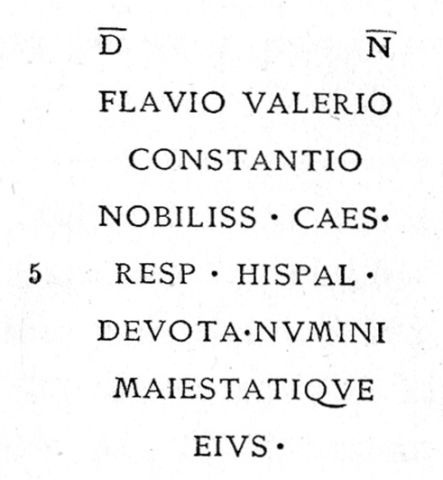
Inscription
D(omino) n(ostro) / Flavio Valerio / Constantio, / nobiliss(imo) Caes(ari), / (5) res p(ublica) Hispal(ensis), / devota numini / maiestatique / eius.
Inscription translation
To our lord Flavius Valerius Constantius, the most noble Caesar. The community (res publica) of Hispalis, devoted to his divine spirit and majesty, [set this up].
Bibliography
- Corpus Inscriptionum Latinarum; , II 1171
- González Fenández, J., Corpus de Inscripciones latinas de Andalucia. Volumen II: Sevilla. Tomo I. La Vega (Híspalis), Sevilla 1991, pp. 28-9 no. 13
Discussion
INSCRIPTION
In eight lines:
D(omino) n(ostro) / Flavio Valerio / Constantio, / nobiliss(imo) Caes(ari), / (5) res p(ublica) Hispal(ensis), / devota numini / maiestatique / eius.
'To our lord Flavius Valerius Constantius, the most noble Caesar. The community (res publica) of Hispalis, devoted to his divine spirit and majesty, [set this up].'
Letter height not recorded.
The wording of the inscription, opening with the name of the honorand in the dative, followed by that of the awarder in the nominative, and closing with a standard formula ('devoted to his divine spirit and majesty'), displays all the common features of a Latin statue-base inscription of the tetrarchic period.
DESCRIPTION
Known only from its publication in CIL (from 1869). There are no published descriptions, measurements, or images. The wording of the inscription suggests it was on a statue base, or on a plaque from such a base.
PROVENANCE AND CURRENT LOCATION
The inscription was first recorded in the 18th century, in the calle Valenzuela of Sevilla ('calle Valenzuela, junto a la del Correal del Rey y la posada de Baviera'); in the early 19th century it was tranferred to the law courts (González Fernández 1991, 28-9). It is now lost.
HONORAND, AWARDER AND DATE
The honorand, Constantius I, was Caesar 293-305.
The inscription was set up by the city of Hispalis.
Cite: Last Statues of Antiquity, LSA-2001 (Christian Witschel).