
LSA-2002
Fragment of plaque, probably from base for statue, with dedication to emperor, probably Maximian. Italica (Baetica). Probably 300-302
Record details
Photographs
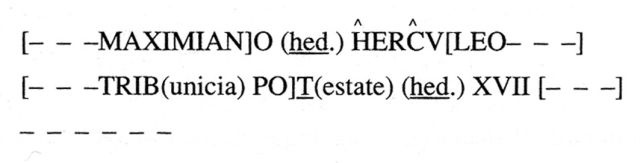
Inscription
[Imp(eratori) Caes(ari) M(arco) Aur(elio) Val(erio) Maximian]o [ivy leaf] Hercu[leo], / [p(io), f(elici), inv(icto) Aug(usto), pont(ifici) max(imo), trib(unicia) po]t(estate) [ivy leaf] XVII[-?], [co(n)s(uli)] / ------
Inscription translation
To the emperor Caesar Marcus Aurelius Valerius Maximianus Herculius, pious, fortunate, unconquered Augustus, highest priest, holder of tribunician power for the 17th time, consul ...
Bibliography
- Hispania epigraphica, Madrid, 1, 1989 no. 536
- González Fernández, J., Corpus de Inscripciones latinas de Andalucia. Volumen II: Sevilla. Tomo II. La Vega (Itálica), Sevilla 1991, pp. 46-7 no. 374
Discussion
INSCRIPTION
In two surviving lines:
[Imp(eratori) Caes(ari) M(arco) Aur(elio) Val(erio) Maximian]o (ivy leaf) Hercu[leo], / [p(io), f(elici), inv(icto) Aug(usto), pont(ifici) max(imo), trib(unicia) po]t(estate) (ivy leaf) XVII[-?], [co(n)s(uli)] / ------
'To the emperor Caesar Marcus Aurelius Valerius Maximianus Herculius, pious, fortunate, unconquered Augustus, highest priest, holder of tribunician power for the 17th time, consul ...'
Letter height 4 cm.
We reproduce the text with the completions proposed by González Fernández 1991. In line 2, the number recording the honorand's tribunician power can be either XVII or XVIII, since the plaque is broken at this point (see below, 'Honorand, Awarder and Date').
DESCRIPTION (from González Fernández 1991)
Small fragment of a white marble plaque, broken and lost on left, right and bottom. The original upper edge is partially preserved. H 14, W 11, D 2 cm. There is no published image. Not enough of the inscription survives for us to be certain that the plaque came from a statue base, though this is probable, since statue inscriptions on plaques are common in Iberia and just enough of the inscription survives to show that the honorand was addressed in the dative (as normal in Latin-language statue dedications).
PROVENANCE AND CURRENT LOCATION
Found in Italica (http://www.trismegistos.org/place/26248), probably in the 'Zona de La Vegueta', the large necropolis in the region of the theatre (González Fernández 1991, 46). Today in the Archaeological Museum of Sevilla (without published inv. no.).
HONORAND AND DATE
The honorand, of whom a part of the name 'Herculius' is preserved, was very probably Maximian, since he is the only one of the imperial Herculii who held office long enough to reach 17 or 18 renewals of his tribunician power (line 2).
Maximian's 17th or 18th holding of tribunician power dates our inscription to between 10 Dec 300 and 10 Dec 302 (see, for Maximian's tribuniciae potestates, Barnes 1982, 26).
Discussion references
- Barnes, T. D., The New Empire of Diocletian and Constantine, Cambridge (Mass.) 1982
Cite: Last Statues of Antiquity, LSA-2002 (Christian Witschel).