
LSA-2006
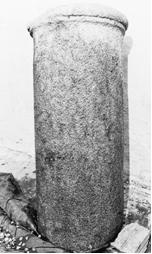
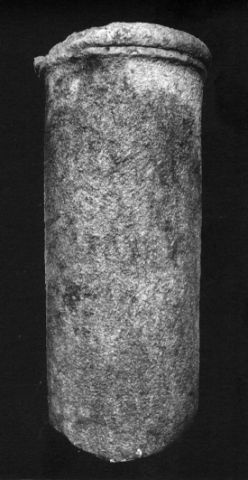
Columnar block with painted dedication to Licinius. Singili Barba (Baetica). 308-324
Record details
Photographs
Inscription
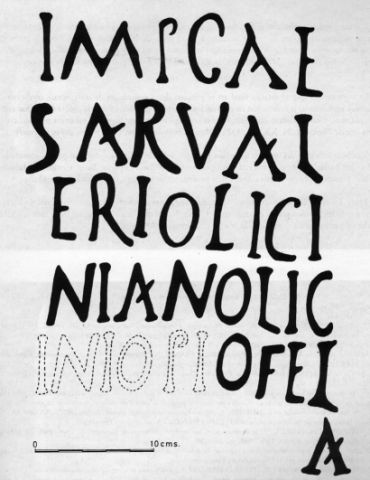
Imp(eratori) Cae/sar(i) Val(erio) Lici/niano Lic/[icinio, p]io fel(ici) / [invicto] A/[ugusto ---]
Inscription translation
To the emperor Caesar Valerius Licinianus Licinius, the pious and fortunate invincible Augustus ...
Bibliography
- Corpus Inscriptionum Latinarum; , II²/5, 778
- Hispania epigraphica, Madrid, 2, 1990, no. 471
- L'Année épigraphique, , 1989, no. 422
- Serrano Ramos, E. & P. Rodriguez Oliva, Tres Nuevas Inscripciones de Singilia Barba (El Castillon, Antequera, Malaga), Baetica 11, 237-56, Malaga 1988, pp. 252-6 no. 3
Discussion
INSCRIPTION
In six surviving lines:
Imp(eratori) Cae/sar(i) Val(erio) Lici/niano Lic/[icinio, p]io, fel(ici), / [invicto] A/[ugusto ---]
'To the emperor Caesar Valerius Licinianus Licinius, pious, fortunate, unconquered Augustus ...'
Letter height 5.5 - 6 cm. The inscription is not carved, but painted. Presumably, like the other columnar bases in Barba (LSA-2004, LSA-2005), it once closed with the name of the awarder (probably the city of Barba).
DESCRIPTION (from Serrano Ramos & Rodriguez Oliva 1988, and the published images)
Columnar block of reddish marble, moulded at the top, broken and lost at the bottom: H 73, diameter 33 cm.
PROVENANCE AND CURRENT LOCATION
Found in 1986 during excavations in the forum area of Barba (map in CIL II²/5 p. 212). Today in the Municipal Museum of Antequera (without published inv. no.).
HONORAND, AWARDER AND DATE
The honorand, Licinius, was Augustus 308-24.
FURTHER DISCUSSION
It is uncertain whether this block, and two similar ones in Barba (LSA-2004, LSA-2005), carried statue, or whether they were simply columnar dedications. On the one hand, both the wording of the inscriptions and their location in the forum of the city are typical of statue bases. On the other hand, the columnar form is unusual, and one of these blocks, also in the forum of Barba, whose top can be seen in the published photograph, shows no evident signs of fixings for a statue on top of it (LSA-2004). A close inspection of these three blocks might perhaps clarify the issue.
Two of the dedications from Barba are carved (LSA-2004, LSA-2005), but our one is rendered only in paint (a medium that will generally not survive in the archaeological record). This alerts us to the fact that other painted dedications, perhaps in large numbers, may once have existed.
Cite: Last Statues of Antiquity, LSA-2006 (Christian Witschel).