
LSA-2009
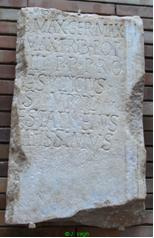
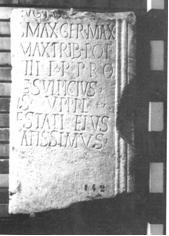
Fragmentary plaque from base for statue of tetrarchic emperor, possibly Maximian. Emerita Augusta (Lusitania). 293-296
Record details
Photographs
Inscription
[Imp(eratori) Caes(ari) M(arco) Aur(elio) Val(erio)] / [Maximiano, pio, fel(ici)], / [semper] Aug(usto), pont(ifici) max(imo), / [Per]s(ico) max(imo), Ger(manico) max(imo), / (5) [Sarm(atico)] max(imo), trib(unicia) pot(estate) / [X(?), co(n)s(uli)] IIII, p(atri) p(atriae), pro/[co(n)s(uli)], G(aius) Sulpicius / [---]us, v(ir) p(erfectissimus), p(raeses) p(rovinciae) L(usitaniae), / [mai]estati eius / [semp(er) di]catissimus.
Inscription translation
To the emperor Caesar Marcus Aurelius Valerius Maximianus, pious, fortunate, forever Augustus, highest priest, greatest victor over the Persians, greatest victor over the Germans, greatest victor over the Sarmatians, holder of tribunician power for the 10th time, consul for the 4th time, father of the fatherland, proconsul. Gaius Sulpicius ...us, of perfectissimus rank, governor (praeses) of the province of Lusitania, always most dedicated to his majesty [set this up].
Bibliography
- Corpus Inscriptionum Latinarum; , II 48
- Ramírez Sádaba, J. L., Catálogo de las inscripciones imperiales de Augusta Emerita, Mérida 2003, no. 60
Discussion
INSCRIPTION
In eight lines:
[Imp(eratori) Caes(ari) M(arco) Aur(elio) Val(erio)] / [Maximiano, pio, fel(ici)], / [semper] Aug(usto), pont(ifici) max(imo), / [Per]s(ico) max(imo), Ger(manico) max(imo), / (5) [Sarm(atico)] max(imo), trib(unicia) pot(estate) / [X(?), co(n)s(uli)] IIII, p(atri) p(atriae), pro/[co(n)s(uli)], G(aius) Sulpicius / [---]us, v(ir) p(erfectissimus), p(raeses) p(rovinciae) L(usitaniae), / [mai]estati eius / [semp(er) di]catissimus.
'To the emperor Caesar Marcus Aurelius Valerius Maximianus, pious, fortunate, forever Augustus, highest priest, greatest victor over the Persians, greatest victor over the Germans, greatest victor over the Sarmatians, holder of tribunician power for the 10th time, consul for the 4th time, father of the fatherland, proconsul. Gaius Sulpicius ...us, of perfectissimus rank, governor (praeses) of the province of Lusitania, always most dedicated to his majesty [set this up].'
Letter height not recorded.
DESCRIPTION (from the photo)
Fragment from the lower right side of a thick marble plaque, broken and lost at top, left and bottom. The frame to the inscription is partly preserved on the right. The wording of the inscription, and the reconstructable shape of the plaque, suggest this was from a statue base (whose inscriptions in Iberia are often on plaques, rather than monolithic bases).
PROVENANCE AND LOCATION
The fragment was built into a wall of the 18th century Patio of the Hospital de los Hermanos de Jésus (today Parador Nacional de Turismo). It is now in the Museo Nacional de Arte Romano in Mérida, inv. no. 142.
HONORAND, AWARDER AND DATE
The extant formula clearly reveals that the honorand was an emperor, although his name is not preserved. The preserved victory titles and the numbered consulship can perhaps help with the identification and dating. Our honorand was certainly Germanicus Maximus. Of two further victory titles, however, no more than the partially surviving final letter of the one preceding Germanicus Maximus is preserved. This appears to be an 'S', which can most plausibly be interpreted as the final inscribed letter of 'Pers(icus)'. This would fit all emperors of the first tetrarchy (and none of their successors). The tetrarchs adopted the title Persicus Maximus probably between 293 and 295 (Barnes 1982, 255 table 5 with note 2). It was the third such title they adopted, following that of Germanicus Maximus and Sarmaticus Maximus. In 296 they adopted a fourth title, that of Britannicus Maximus, which does not appear on our inscription. The outer dates for our dedication would therefore appear to be 293 and 296.
The outer dates suggested by the victory titles, combined with the number of imperial consulships recorded on the inscription, suggest that our honorand was Maximian who held his 4th consulship in 293, and not Diocletian (whose 4th consulship occurred too early, in 290). However, some doubts about the precise dating of the inscription, and therefore about the emperor it honoured, must remain: Persicus was the third victory title the Tetrarchs adopted and therefore should appear third in any list (and not first as it seems to on our inscription) - 'victory titles always appear in the order in which they were assumed first' (Barnes 1982, 27 with n. 24). There is therefore some doubt as to whether the partially surviving 'S' can really be completed as 'Pers(ico)', and therefore over the precise attribution of our inscription.
The awarder, Caius Sulpicius [---]us, governor (praeses) of the province of Lusitania, is otherwise unknown (PLRE I, 1002, C. Sulpicius ...s).
Discussion references
- Jones, A. H. M. et al., The Prosopography of the Later Roman Empire. Vol. I 260-395, Cambridge et al. 1971 (1975)
Cite: Last Statues of Antiquity, LSA-2009 (Christian Witschel).