
LSA-2011
Fragmentary plaque, possibly from statue base, with dedication to Constantine II, Constantius II, and Constans, emperors Emerita Augusta (Lusitania). 337-340.
Record details
Photographs
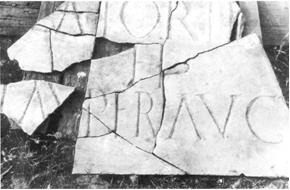
Inscription
[Ddd(ominis) nn]n(ostris) Flavi[o Claudio Con]stanti[no, maximo debel]latori e[t victori] / [gentium barbararum, et Flavi]o [Iulio Constantio], et / [F]lav[io Iulio Co]ns[tanti, victoribus fortissimisque sem]per Augu[stis].
Inscription translation
To our lords, Flavius Claudius Constantinus, the greatest conqueror and victor over the barbarian tribes, Flavius Iulius Constantius, and Flavius Iulius Constans, victorious and most powerful, forever Augusti.
Bibliography
- L'Année épigraphique, , 1975, 473
- Ramírez Sádaba, J. L., Catálogo de las inscripciones imperiales de Augusta Emerita, Mérida 2003, no. 64
Discussion
INSCRIPTION
In three lines:
[Ddd(ominis) nn]n(ostris) Flavi[o Claudio Con]stanti[no, maximo debel]latori e[t victori] / [gentium barbararum, et Flavi]o [Iulio Constantio], et / [F]lav[io Iulio Co]ns[tanti, victoribus fortissimisque sem]per Augu[stis].
'To our lords, Flavius Claudius Constantinus, the greatest conqueror and victor over the barbarian tribes, Flavius Iulius Constantius and Flavius Iulius Constans, victorious and most powerful, forever Augusti.'
Large letters, 17-19 cm high.
We reproduce the text with the completions proposed by Chastagnol 1976, 268-71. The third line of the inscription is almost certainly the final line of text, which suggests that it never included the name of a dedicator.
DESCRIPTION (from Chastagnol 1976 and the published photo)
Seven fragments, only partially conjoining, of a whitish marble plaque: H (combined) 71, W (combined) 100, thickness 5 cm. The lower edge is clearly original. The large letters and considerable size of this inscription show that it must have come from a substantial monument, not a conventional statue base. Possibly it came from a large base, carrying statues of all three emperors.
PROVENANCE AND CURRENT LOCATION
The inscription was found in the carceres of the circus of Emerita Augusta, during the excavations of 1920-5. It is now in the National Archaeological Museum of Mérida (without published inv. no.).
HONORAND AND DATE
Enough survives of the inscription to make it certain that it was part of a dedication to the Augusti Constantine II, Constantius II, and Constans, the three surviving sons of Constantine I, who all adopted the title of Augustus on their father's death in 337, and who ruled, respectively, until 340, 361 and 350. The terminus ante quem for our inscription is therefore provided by Constantine II's death in 340.
Discussion references
- Chastagnol, A., Les inscriptions constantiniennes du Cirque de Mérida, Mélanges de l'Ecole française de Rome. Antiquité vol. 88, N°1, pp. 259-276., Paris 1976, pp. 268-71
Cite: Last Statues of Antiquity, LSA-2011 (Christian Witschel).