
LSA-2012
Fragment of plaque with dedication to Constantine I or Constantine II, emperor, probably from statue base. Emerita Augusta (Lusitania). 306-340
Record details
Photographs
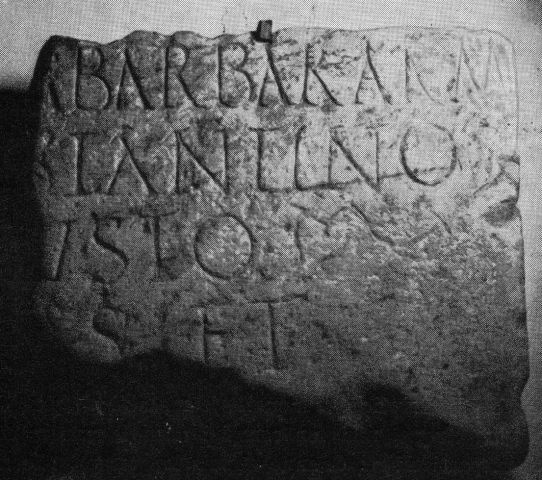
Inscription
[Debellatori gentiu]m barbararum, / [d(omino) n(ostro) Flavio Claudio Co]nstantino, / [max(imo), semper Aug]usto, / [column?]as et [---]
Inscription translation
To the conqueror of the barbarian tribes, our lord Flavius Claudius Constantinus, the most powerful, forever Augustus, the columns (?) ...
Bibliography
- Corpus Inscriptionum Latinarum; , II 482
- L'Année épigraphique, , 1975, 474
- Ramírez Sádaba, J. L., Catálogo de las inscripciones imperiales de Augusta Emerita, Mérida 2003, no. 65
Discussion
INSCRIPTION
In four survivng lines:
[Debellatori gentiu]m barbararum, / [d(omino) n(ostro) Flavio Claudio Co]nstantino, / [max(imo), semper Aug]usto, / [column?]as et [---]
'To the conqueror of the barbarian tribes, our lord Flavius Claudius Constantinus, the most powerful, forever Augustus, the columns (?) ...'
Letter height: 4.6 - 5.1 cm.
We reproduce the text here with the completions proposed by Chastagnol 1976 to suit Constantine II. Hübner in 1869 (for CIL II) proposed an alternative reading, suitable for Constantine I:
[Devictori gentiu]m barbararum, / [d(omino) n(ostro) Fl(avio) Val(erio) Co]nstantino, / [pio, fel(ici), semper Aug]usto, / S FL,
'To the victor over the barbarian tribes, our lord Flavius Valerius Constantinus, pious, fortunate, forever Augustus ...'
Both completions are possible for the imperial name (see below, 'Honorand, Awarder, and Date'), though the photograph shows that Hübner's reading of the last surviving letters was certainly wrong.
DESCRIPTION (from Chastagnol 1976 and the published photo)
Fragment of a white marble plaque, broken and lost on three sides, the original right edge preserved; H 33.8, W 40.5, thickness 6.4 cm. At the lower right corner part of the surface is lost.
PROVENANCE AND CURRENT LOCATION
The inscription was recorded in 1869 (when CIL II was compiled) built into the pavement of a private house in Mérida. It was believed that it came from the Roman theatre in whose vicinity the house lay; there is, however, as Chastagnol (1976, 271) points out, no good evidence for this assumption. It was transferred to the National Archaeological Museum of Mérida before 1894 (inv. no. 143; Chastagnol 1976, 272).
HONORAND AND DATE
Our inscription was certainly dedicated to an Augustus called Constantinus (lines 2- 3). Chastagnol 1976 reconstructed the text to match another inscription from Emerita Augusta, on which he believed Constantine II was styled debellator gentium barbararum (LSA-2011), and he argued that both inscriptions were from the circus and related to building activities there in 337/40. If our honorand was Constantine II (full name Flavius Claudius Constantinus), it dates to the period 337-40, when he held the title of Augustus. However the short passage of surviving text could equally well be attributed to Constantine I, Augustus 306-37, and we see no good reason to choose between one or other of the Constantines.
FURTHER DISCUSSION
Chastagnol argued that this was a building inscription and completed part of line 4 to read '[column]as, columns'; but alternative completions (for instance, [statu]as) are possible, and the wording and overall shape of the inscription would suit a statue base.
Discussion references
- Chastagnol, A., Les inscriptions constantiniennes du Cirque de Mérida, Mélanges de l'Ecole française de Rome. Antiquité vol. 88, N°1, pp. 259-276., Paris 1976, pp. 271-3
Cite: Last Statues of Antiquity, LSA-2012 (Christian Witschel).