
LSA-2014
Fragment of base for statue, possibly of Septimius Acindynus, vicarius of Spain. Emerita Augusta (Lusitania). 324-326 ?
Record details
Photographs
Inscription
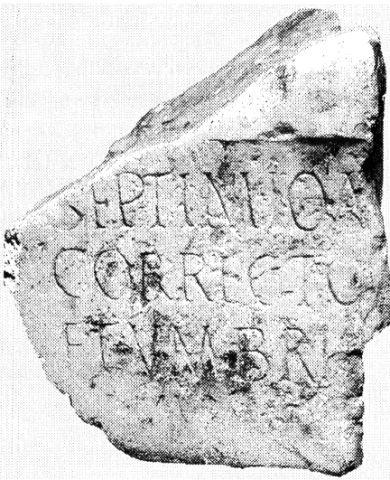
Septimio A[cindyno(?), v(iro) c(larissimo)], / correcto[ri Tusciae] / et Umbri[ae, pont(ifici) maio]/[r]i, X̣Ṿ [vi]ṛ[o s(acris) f(aciundis), agenti(?)] / (5) [per Hispanias vices(?)] / [praef(ectorum) praet(orio), vice s(acra) c(ognoscenti)(?), ---] / ------
Inscription translation
To Septimius Acindynus, of clarissimus rank, governor (corrector) of [the province of] Tuscia et Umbria, high priest, member of the priestly college of the 15 men, acting deputy of the praetorian prefects in the Spanish provinces (agenti per Hispanias vices praefectorum praetorio), judge representing the emperor (vice sacra cognoscenti), ...
Bibliography
- Hispania epigraphica, Madrid, 10, 2004 no. 55
Discussion
INSCRIPTION
In four surviving lines:
Septimio A[cindyno(?), v(iro) c(larissimo)], / correcto[ri Tusciae] / et Umbri[ae, pont(ifici) maio]/[r]i, X̣Ṿ [vi]ṛ[o s(acris) f(aciundis), agenti(?)] / (5) [per Hispanias vices(?)] / [praef(ectorum) praet(orio), vice s(acra) c(ognoscenti)(?), ---] / ------
'To Septimius Acindynus, of clarissimus rank, governor (corrector) of [the province of] Tuscia et Umbria, high priest, member of the priestly college of the 15 men, acting deputy of the praetorian prefects in the Spanish provinces (agenti per Hispanias vices praefectorum praetorio), judge representing the emperor (vice sacra cognoscenti), ...'
Letter height: 3.6 - 5 cm.
We reproduce the text here with the extensive completions proposed by Saquete (2000, 285), which are hypothetical from line 5 onwards and depend on Saquete's identification of the honorand.
DESCRIPTION (from Saquete 2000 and the published photo)
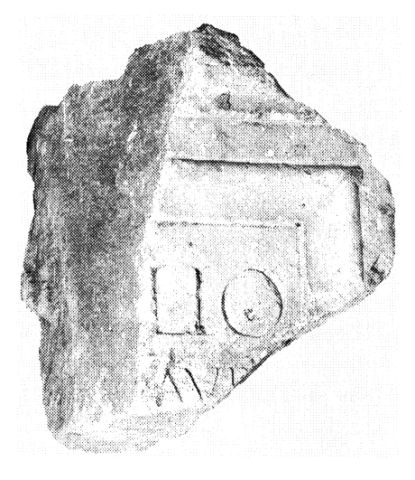
Fragment of a statue base in local marble, probably from the Portuguese quarries of Borba (Estremoz): H 45, W 36, D 44 cm. The fragment is broken and lost on all sides; it preseves the beginnings of four lines of the inscription, of which line 4 is hardly legible. Above line 1, a piece of moulding survives. Our inscription is written on the back of an earlier one ([---]lio / [---]Aur[-] / ------) from the 1st/3rd century (Saquete 2000, 281-2).
PROVENANCE AND LOCATION
The exact site and circumstances of the discovery of this inscription are not known. It was first recorded in 1994 when confiscated by police in an operation directed against the illegal antiquities-trade, and was probably found during building work in Mérida (Saquete 2000, 281 with n. 1). Today it is in the store-rooms of Mérida's National Museum of Roman Art (without published inv. no).
HONORAND AND DATE
Saquete 2000 proposed a plausible identification of the honorand ('Septimius A...') as Septimius Acindynus, vicarius of the Spanish provinces (PLRE I, 11 Acindynus 2), who is known from a statue inscription he set up to a Constantinian Caesar in Tarraco (LSA-1983). This inscription in Tarraco has an outer date range of 317 to 337, but may well be of the period 324-6.
Septimius Acindynus was vicar of the Spanish provinces and judge of highest appeal when he set up the dedication in Tarraco (PLRE 1, 11, Acindynus 2). In his later career he advanced to be praetorian prefect of the East in 338-4 and consul in 340. If our honorand is indeed Acindynus, as Saquete proposes, our inscription adds to his cursus honorum the office of governor (corrector) of Tuscia and Umbria, and, possibly, membership of the priesthood of the 15 men (though the reading of the inscription here is difficult and tentative). These XV viri sacris faciundis constituted one of the four senatorial priestly colleges.
Discussion references
- Jones, A. H. M. et al., The Prosopography of the Later Roman Empire. Vol. I 260-395, Cambridge et al. 1971 (1975)
- Saquete, J. C., Septimius Acindynus, corrector Tusciae et Umbriae. Notes on a new inscription from Augusta Emerita (Mérida, Spain), Zeitschrift für Papyrologie und Epigraphik 129, 281-286., Bonn, 2000
Cite: Last Statues of Antiquity, LSA-2014 (Christian Witschel).