
LSA-2017
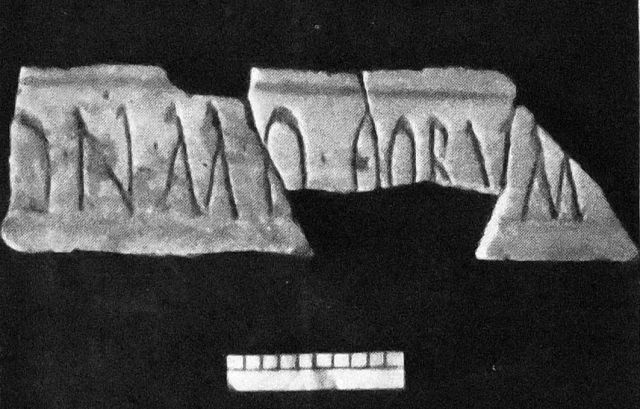
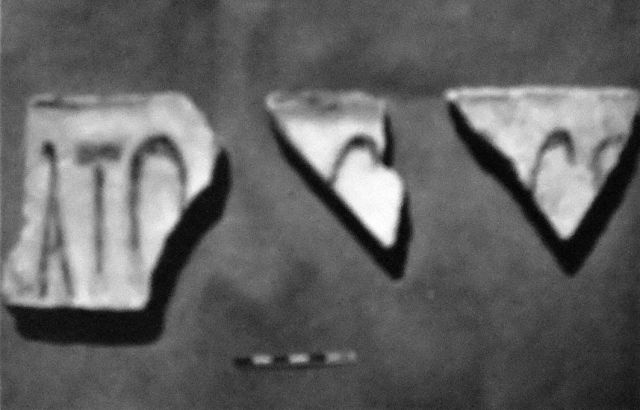
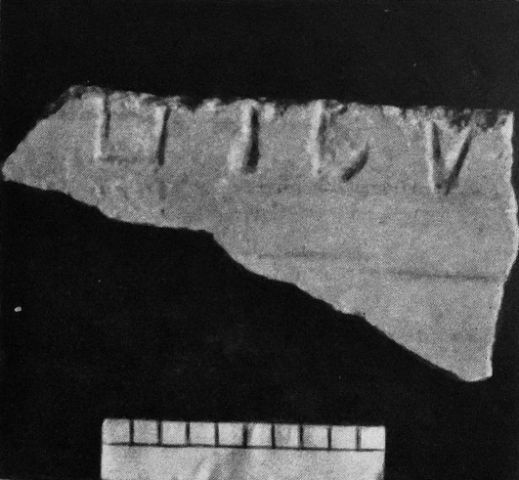
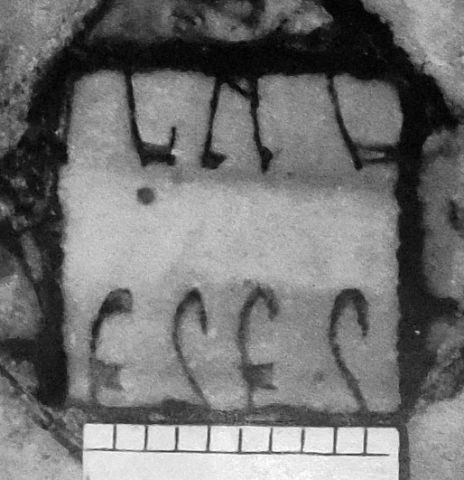
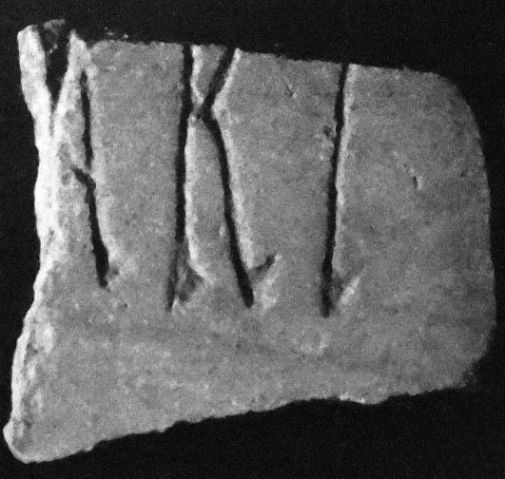
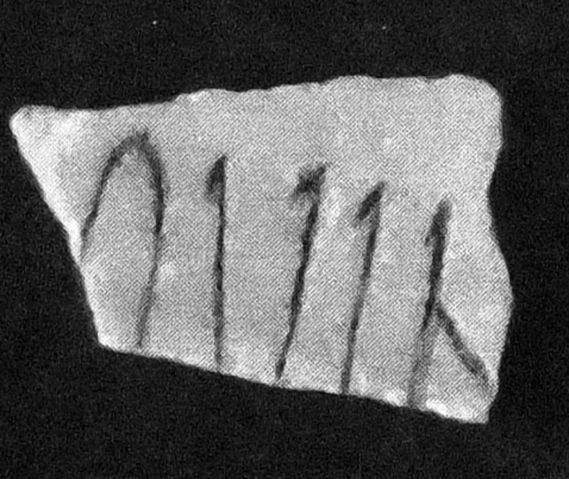
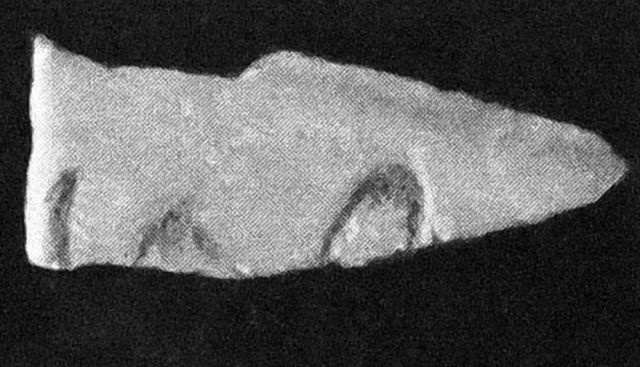
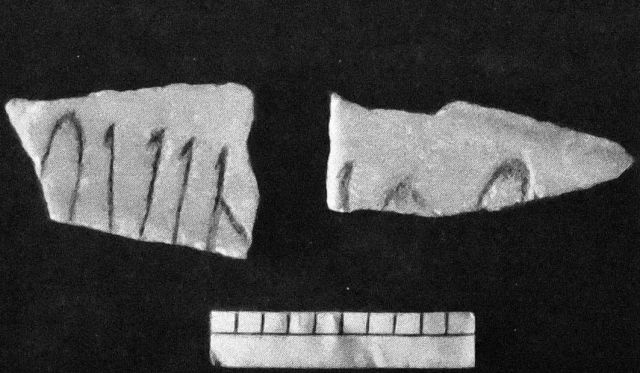
13 fragments of plaque, grouped into nine pieces, possiby from statue base, with dedicatory inscription to Diocletian and Galerius. Salamis (Cyprus). 293-305
Record details
Photographs
Inscription
[Domi]ni[s nostris] / [Dio]cl[etiano] / (3) [pio fe]l(ici) semper Augusto / [victo]ri (vacat) [et] / [nobilissim]o Cae[s]ari [V](alerio) / (6) [Maximiano pra]eses / [p]rovin[ciae Cypri] / [Antisti]us S[abinus v] p(erfectissimus) / (9) d(evotus) n(umini) m(aiestati)q(ue) eorum
Inscription translation
Antistius Sabinus, of perfectissimus rank, governor (praeses) of the province of Cyprus [set this up to] our lords Diocletian, the pious and fortunate Augustus, the victor, and to the most noble Caesar Valerius Maximianus, devoted to their divine spirit and majesty
Bibliography
- Mitford, T. B. & I. K. Nicolaou, Salamis Vol. 6. The Greek and Latin inscriptions from Salamis, Nicosia 1974, pp. 61-2 no. 39
Discussion
INSCRIPTION
In 9 lines:
[Domi]ni[s nostris] / [Dio]cl[etiano] / (3) [pio fe]l(ici) semper Augusto / [victo]ri (vacat) [et] / [nobilissim]o Cae[s]ari [V](alerio) / (6) [Maximiano pra]eses / [p]rovin[ciae Cypri] / [Antisti]us S[abinus v] p(erfectissimus) / (9) d(evotus) n(umini) m(aiestati)q(ue) eorum
'Antistius Sabinus, of perfectissimus rank, governor (praeses) of the province of Cyprus (set this up to) our Lords Diocletian the pious and fortunate Augustus, the victor, and to the most noble Caesar Valerius Maximianus, devoted to their divine spirit and majesty'
Letter height 5-6 cm.
We reproduce the inscription as reconstructed and completed by Mitford & Nicolaou 1974.
DESCRIPTION (from Mitford and Nicolaou 1974)
13 fragments of a slab of blue-streaked white marble, of which two and again four join to form one piece each. This creates nine separate pieces ((a) -(i)), of which (a) and (b) are made up of conjoined elements, and (c)-(i) isolated. Piece (a): H 8.5, W 19.5 cm; (b:) H 10, W 35 cm; (c): H 7, W 8 cm; (d): H 8, W 17 cm; (e): H 11, W 11 cm; (f): H 9, W 9. 5 cm; (g): H 6, W 1 cm; (h): H 4, W 11 cm; (i): H 6, W 4 cm.
The slab was cut into small pieces and used in the paving of the gymnasium of Salamis at a post-tetrarchic date (see also LSA-864, LSA-867, LSA-2018, and LSA-2019).
PROVENANCE/ LOCATION
The fragments were uncovered 1954 during excavations in the gymnasium of Salamis. Fragment (e) is recorded in situ by Mitford & Nicolaou 1974, while all other fragments were brought to the Famagusta District Museum (without published inv. no.).
HONORAND, AWARDER, AND DATE
Diocletian, the first honorand, was Augustus 284-305; Galerius, the other honorand (here styled Valerius Maximianus from his full name, Caius Galerius Valerius Maximianus), was Caesar 293-305. If the completion by Mitford & Nicolaou is correct, then the common reign of the two emperors provides the outer dates for this inscription, 293-305.
It is very likely that an honorific inscription to the tetrarchs was set up by the incumbent provincial governor, and the governor Antistius Sabinus is securely known from two other inscriptions to tetrarchs, which he set up in the theatre of Salamis (PLRE I, 792 Antistius Sabinus 9; LSA-865, LSA-866; see also LSA-864, LSA-867, LSA-2019, LSA-2020). His association with our inscription, however, is hypothetical, based on the surviving letters '...us s...' that may be from his name, Antisti<b>us S</b>abinus, and on the evidence of the theatre inscriptions which show that he had 'an eagerness to find favour with these masters' (Mitford and Nicolaou 1974, 62).
FURTHER DISCUSSION
We are unconvinced by the reconstruction, and hence attribution, of these fragments proposed by Mitford & Nicolau, but have included it for completion and for ease of reference for anyone interested in the vexed question of how to complete the fragments of inscription found re-used in the pavement of the gymnasium of Salamis.
See also LSA-2018 and LSA-2019, 'Further Discussion'.
Discussion references
- Jones, A. H. M. et al., The Prosopography of the Later Roman Empire. Vol. I 260-395, Cambridge et al. 1971 (1975)
Cite: Last Statues of Antiquity, LSA-2017 (Ulrich Gehn).