
LSA-2018
Nine fragments of an inscription on a plaque, possiby from a statue base with dedicatory inscription to Constantius II and Constans. Salamis (Cyprus). 337-350
Record details
Photographs
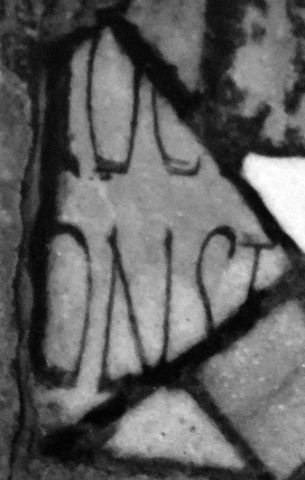
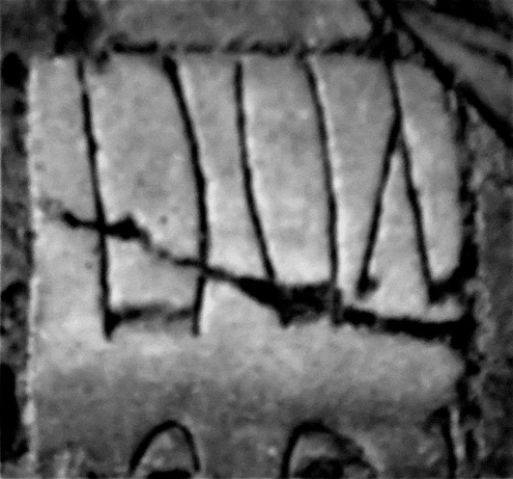
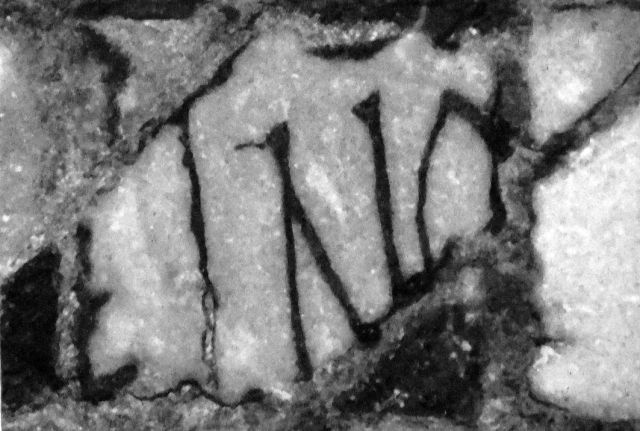
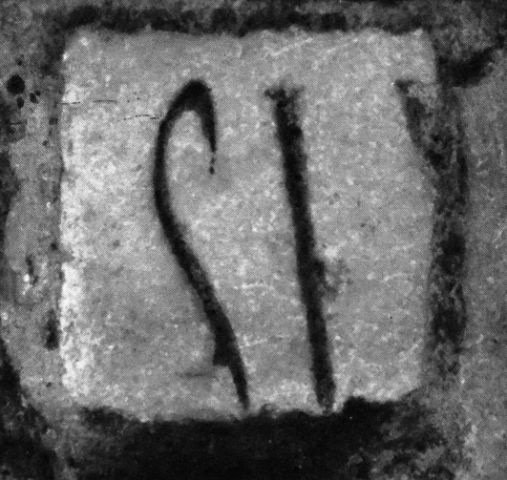
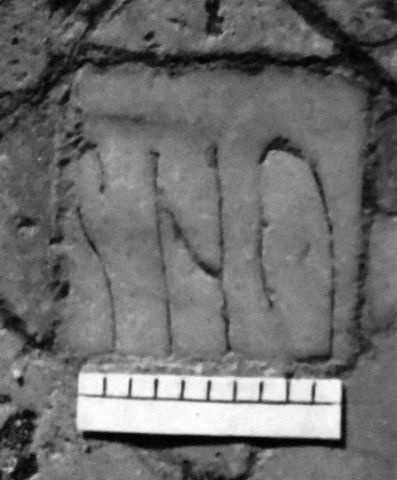
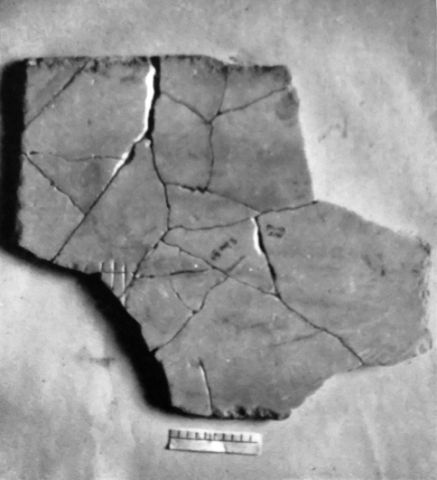
Inscription
Dom[ini]s no[stri]s Iu[lio] / Con[stant]io e[t] / [Fl(avio) Iulio C]onst[anti] / [victo]ri[bus sem]pe[r Augg(ustis)] / [Salam]eino[rum (sic) civitas] / [statuas erexit] ah[eneas] / cu[rante Ofel]lio Ṣ[ancto] / antis[tite urbis]
Inscription translation
The city of the Salamians set up bronze statues to our Lords Iulius Constantius and Flavius Iulius Constans, the victors and always Augusti. Ofellius Sanctus, the bishop of the city, took charge
Bibliography
- Mitford, T. B. & I. K. Nicolaou, Salamis Vol. 6. The Greek and Latin inscriptions from Salamis, Nicosia 1974, pp.67-9 no. 42
Discussion
INSCRIPTION
Dom[ini]s no[stri]s Iu[lio] / Con[stant]io e[t] / [Fl(avio) Iulio C]onst[anti] / [victo]ri[bus sem]pe[r Augg(ustis)] / (5) [Salam]eino[rum (sic) civitas] / [statuas erexit] ah[eneas] / cu[rante Ofel]lio Ṣ[ancto] / antis[tite urbis]
'The city of the Salamians set up bronze statues to our Lords Iulius Constantius and Flavius Iulius Constans, the victors and always Augusti. Ofellius Sanctus, the bishop of the city, took charge'
Letter height 5-9 cm.
We reproduce the inscription as restored and completed by Mitford & Nicolaou 1974.
DESCRIPTION
Nine pieces (a - i) of a white, grey steaked marble plaque. Fragment (a) is made up of 14 smaller fragments. Fragment (a) H 17.5 cm, W 9.5 cm; (b) 11.5 cm, W 11.5 cm; (c) H 11 cm, W 10.5 cn; (d) H 7.5 cm W 7.6 cm; (e) H 21 cm W 12.5 cm; (f) H 7.5 cm, W 6.2 cm; (g) H 9.5 cm, W 10 cm; (h) an (i) are joining fragments together H 12. 9 cm, W 8.7 cm. D of the plaque ca. 2 cm.
The inscription is carved on the backside of an earlier inscription to Septimius Severus (Mitford & Nicolaou 1974 no. 18). At a later time, the plaque was cut into pieces used for the pavement of the gymnaisum in Salamis (see also LSA-2017).
PROVENANC/ LOCATION
The fragments were uncovered 1954 during excavations in the gymnasium of Salamis. Fragments b, c, g are recorded in situ by Mitford & Nicolaou 1974, while all other fragments were brought to the Famagusta District Museum (without published inv. no.).
HONORANDS, AWARDER, AND DATE
Constantius II (full Name Flavius Iulius Constantius) was Augustus 337-361, his brother Constans 337-350.
The statues, according to the text as restored by Mitford & Nicolaou, were set up by the city of Salamis, the bishop (antistes) taking charge.
As Mitford & Nicolaou 1974, 66 point out, the city of Salamis was so devastated by the earthquakes of 332 and 342 that it was levelled and refunded at a smaller scale by Constantius II under the name Constantia. The city was conceded a four year period of remitted taxation 342-6. According to Mitford & Nicolaou, our inscription must have been set up by the end of that period of recovery.
FURTHER DISCUSSION
Given the fragmentary state of preservation, the proposal by Mitford & Nicolaou can not overcome a series of doubts.
The fragment (d) with the 14th-16th letters of line 1, read ...IVL... here, has been turned upside down and read ...MIS... by Pouilloux et al. 1987, attributing it to a standard introductory formula for imperial inscriptions of the late 3rd/ 4th century (pissiMIS or similar) (LSA-864). This is in accordance with the usual formula of imperial honorific inscriptions of the tetrarchic and constantinan period where a sequence of standard epithets precedes the formula d(omino) n(ostro), dd(ominis) nn(ostris) etc. (hardly ever <dominis nostris, as proposed here) and the imperial name. Moreover, the doubtful fragment is the only piece of evidence provided by the text itself to attribute it to these two sons of Constantine I who both bore the nomen Iulius (which none of the earlier emperors of the period, including Constantine I, did).
The preserved sequence of letters ... ANTIS ... (line 8), here assigned to the bishop-title of the awarder, would well fit in the name of the governor (praeses) Antistius Sabinus of the tetrarchic period who stands out in Salamis with dedications to emperors (LSA-864, LSA-865, LSA-866, LSA-867, LSA-2017,LSA-2019, LSA-2020). The usual agent to set up honorific monuments in provincial cities was the governor who signed with his name, whereas the bishop would be unparalleled in this charge.
The person of Ofellius Sanctus (line 7) is otherwise unknown. The authers somewhat boldly construct his name from another, likewise fragmentary inscription (Mitford & Nicolaou 1974 no. 41) where on a fragment the sequence ...OF̣EL... is preserved, and from the fragmentary sequence ...LIO Ṣ... in our inscription (line 7).
The city of Salamis was reconstructed under the name of Constantia after the earthquakes in the earlier 4th century (see above, 'Honorands, Awarder, and Date'). A honorific inscription to the emperor who lend his name to the restored city would certainly flatter him by awarding the statue under this new name (line 5).
These are just a few objections that might be risen against the restored text. We document it here despite the fact that we are not convinced that the text as reconstructed by Mitford & Nicolaou ever existed, nor that the fragments testify to a base for bronze statues for Constans and Constantine II.
Cite: Last Statues of Antiquity, LSA-2018 (Ulrich Gehn).