
LSA-202
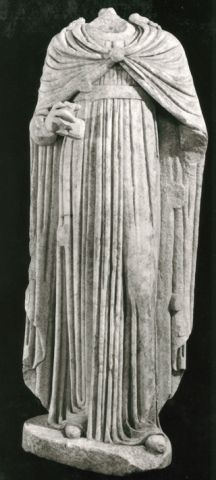
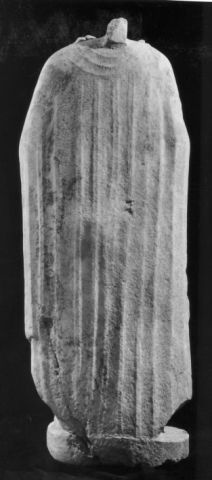
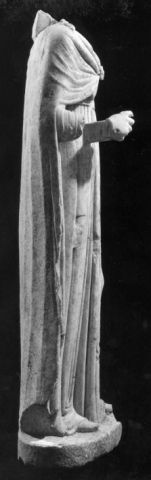
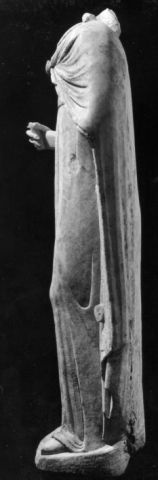
Statue of (woman as?) Muse with double flutes (headless). Aphrodisias (Caria). Fourth to fifth century.
Record details
Photographs
Bibliography
- Smith, R.R.R., "Late Roman philosopher portraits from Aphrodisias", JRS 80 (1990), pl. 5.4
Discussion
DESCRIPTION (Object)
Life-size statue with plain plinth. H: 157, W: 61, D: 30 cm. H (of plinth): 8 cm. Large-grained white marble.
Missing: head, both long flutes, left forearm. The head was supported by a wide (8 cm) neck pillar. The back has only schematically rendered, ‘columnar’ drapery.
PROVENANCE
Excavated in 1982 in the Atrium House, north of the Sebasteion, in a small courtyard on the western perimeter of the house with the cuirassed statue, LSA-201.
DESCRIPTION (Subject)
The figure is of a Muse wearing a long, high-belted chiton, and a long cloak fastened over the centre of the chest. She wears closed, pointed shoes and two, long, wavy locks of hair escape onto her shoulders, one to each side of the neck pillar.
The Muse originally held two long pipes, one in each hand, each supported by two large struts. The strut at her right wrist survives complete. These attributes and this reconstruction are secure. The figure belongs to a standing Muse type, well-known, for example, on third-century sarcophagi.
DATE
The small scale, the refined surface technique, the handling of the thin delicate figures, and the character of the sketched columnar drapery (like that, for example, of Oecumenius, LSA-150) suggest a date in the late fourth or fifth century.
HONORAND
The subject may have been simply a Muse. Given the apparent pairing in the house with the cuirassed statue of the commander (LSA-201), the statue may also have carried a portrait, for example, of the commander’s wife. Presentation as a Muse had been common for local women on Aphrodisian sarcophagi since the third century.
Cite: Last Statues of Antiquity, LSA-202 (R.R.R. Smith).