
LSA-2023
Inscription to Gratian and Valentinian II, possibly on a base for statue. Thyatira (Lydia). 378-383
Record details
Photographs
Inscription
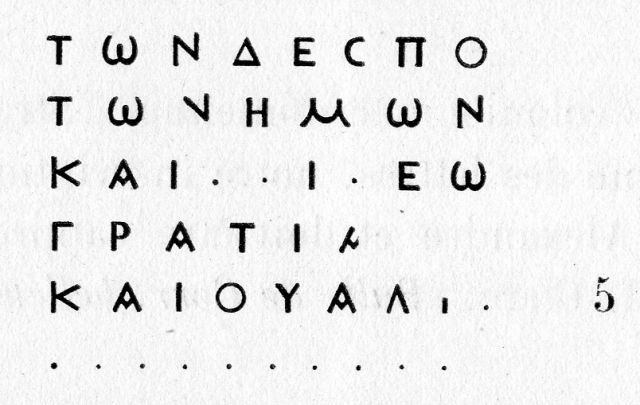
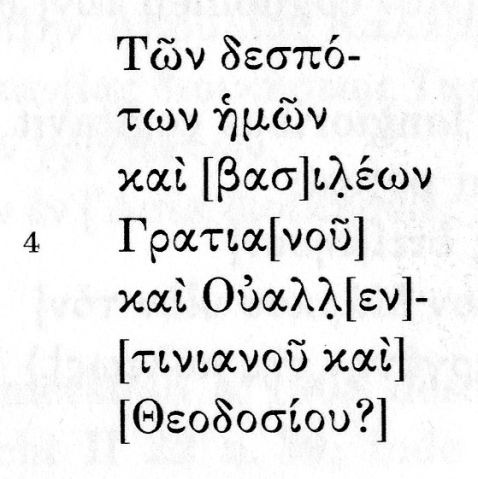
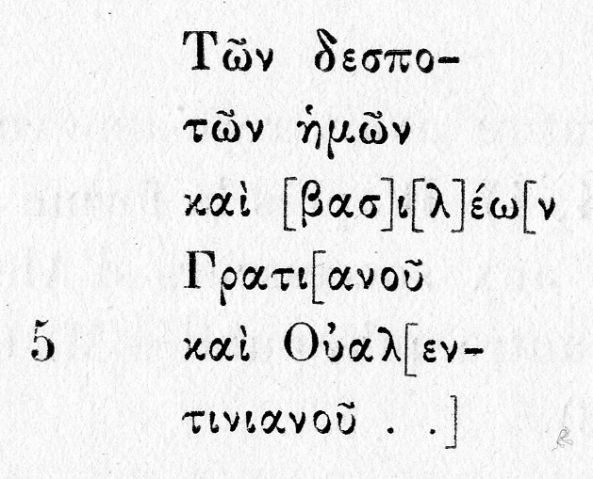
Τῶν δεσπό/των ἡμῶν / καὶ [βας]ιλ ̣έων /(4) Γρατια[νοῦ] / καὶ Οὐαλλ ̣[εν]/[τινιανοῦ ---]
Inscription translation
Of our lords and emperors Gratian and Valentinian ...
Bibliography
- Herrmann, P. (ed.), Tituli Asiae Minoris, V. Tituli Lydiae, linguis Graeca et Latina conscripti, Vienna 1981 and 1989, Fasciculus II (1989) p. 337 no. 916
Discussion
INSCRIPTION
In five preserved lines:
Τῶν δεσπό/των ἡμῶν / καὶ [βας]ιλ ̣έων / Γρατια[νοῦ] / καὶ Οὐαλλ ̣[εν]/[τινιανοῦ]
'Of our lords and emperors Gratian and Valentinian'.
Letter height 2 - 4 cm.
We reproduce the text here with the completions proposed by Radet 1887. Herrmann 1989 proposed an extended reading (see below, 'Honorands and Date'): Τῶν δεσπό/των ἡμῶν / καὶ [βας]ιλ ̣έων / Γρατια[νοῦ] / καὶ Οὐαλλ ̣[εν]/[τινιανοῦ καὶ] / [Θεοδοσίου?]
The formula with the honorands in the Greek genitive is very unusual, though not unparalleled, for a statue base; it occurs, for instance, on two inscriptions, to Theodosius I and Arcadius, in Rhodos (LSA-936, LSA-937).
DESCRIPTION (from Herrmann 1989)
Rectangular block of dark marble with red stains, with moulding at the top, the lower portion lost: H 52, W 44, D 47 cm. Our inscription is on the right side of the original front, which carries an earlier inscription to the agonthetes (provider of games) Metrodorus, son of Metrodorus (Herrmann 1989 no. 993; 2nd/3rd century?).
PROVENANCE AND CURRENT LOCATION
The inscription was recorded by Radet 1887 in the house of Eskidji-Ibrahim in the quarter of Hémetly in Akhisar; Herrmann 1989 recorded it in the courtyard of a modern house in Akhisar; this is the area of ancient Thyatira (http://www.trismegistos.org/place/3526)
HONORANDS AND DATE
Gratian, the first honorand, was Augustus 367-83; his younger half-brother, Valentinian II, Augustus 375-92.
The inscription is from a date when Gratian was senior Augustus and hence named first in the inscription, that is after the death of his uncle Valens in 378.
Herrmann suggested that the name of Theodosius I (Augustus 379-95) should be added after that of Valentinian II; this is possible, but not inevitable, since the inscription may date from the reign of the two brothers alone in 378/9.
FURTHER DISCUSSION
We are very uncertain as to whether this was a statue base: the shape of the block is suitable; but the use of the genitive for the honorands is anomalous (see above, 'Inscription'). If it was a statue base, it was presumably accompanied by another base (or perhaps two more), for statues of the other emperor or emperors.
ADDENDUM 2015
I have become aware in the meantime of a similar inscription, likewise from Thytira, using a similar formula, including the use of the genitive (LSA-2877). This inscription is carved on a marble statue base. Moreover, it preserves the name of a third honorand, the emperor Theodosius I who joined the imperial college in 379. In the light of this inscription I now think that my doubts as to whether our inscription is indeed from a statue base, are probably unjustified. Moreover, I think it is well possible that both inscriptions are from a statue group set up for all three members of the imperial college, Gratian, Valentinian II, and Theodosius I, in 379/83.
Discussion references
- Radet, G., Inscriptions de Lydie, Bulletin de Correspondance Hellénique 11, 1887, 445-84, p. 465 no. 30
Cite: Last Statues of Antiquity, LSA-2023 (Ulrich Gehn).