
LSA-2024
Unfinished dedication to Diocletian, emperor, probably on milestone (just possibly statue base). Laodicea Combusta (Pisidia). 285-305
Record details
Photographs
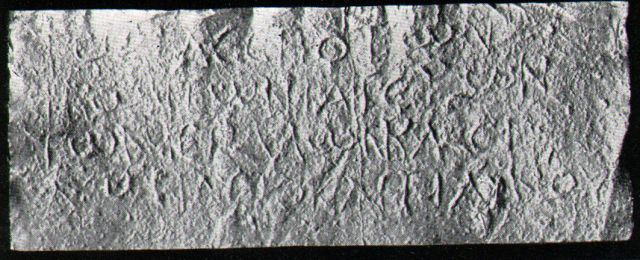
Inscription
τῶν δεσπότων / ἡμῶν, τῶν πατέρων, / τῶν μεγάλων βασι/λέων, Δειοκλητιανοῦ
Inscription translation
Of our lords, the fathers, the powerful emperors, Diocletian
Bibliography
- Calder, W., Monumenta Asiae Minoris antiqua, Vol. I, London 1928, p. 13 no. 18
Discussion
INSCRIPTION
Unfinished inscription in four lines:
τῶν δεσπότων / ἡμῶν, τῶν πατέρων, / τῶν μεγάλων βασι/λέων, Δειοκλητιανοῦ.
'Of our lords, the fathers, the powerful emperors, Diocletian'
Letter height 1.5 – 3 cm.
On the other side of the same pillar, upside down, an earlier Latin inscription in three preserved lines:
M(arco) Aurel(io) Pro/bo, pio, fel(ici), [in]/ victo Aug(usto).
'To (or 'Under') Marcus Aurelius Probus, pious, fortunate, unconquered Augustus.'
DESCRIPTION (from Calder 1928)
Round column of bluish limestone with a moulding at the top, H 92, diameter 105 cm.
PROVENANCE AND CURRENT LOCATION
The inscription was recorded by Calder 1928 in the village of Meidan, in the area of Lâdik, 'in a sheepfold’; this is the region of ancient Laodicea Combusta (http://www.trismegistos.org/place/16168). There is no recent record on its location.
HONORAND AND DATE
Diocletian, the honorand, was Augustus 284-305. The inscription, however, was intended to name a plurality of emperors; the terminus post quem is therefore 285 when Maximian became co-emperor.
FURTHER DISCUSSION
The formula, with the honorand in the genitive and no awarder named, is very unusual for statue dedications. We think it is a milestone, rather than a statue base (an interpretation supported by its rural findspot). But there is no definitive proof that it was a milestone (for instance a carved mileage on either of its two inscriptions), and it is just possible that it once carried a statue.
From the unfinished state of the tetrarchic inscription, it is possible that it was never set up.
Cite: Last Statues of Antiquity, LSA-2024 (Ulrich Gehn).