
LSA-2057
Base for reerected statue of Amphinomos and Anapius, legendary heroes. Catina (Sicilia). Late fifth to early sixth century.
Record details
Photographs
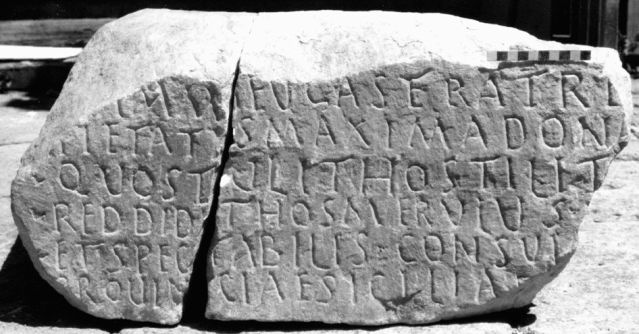
Inscription
[Fl]ammifugas fratre[s], / pietatis maxima dona, / quos tulit hostilit[as], / reddidit hos Merulus, ṿ(ir) [c(larissimus)] /(5) et spectabilis, consul[aris] / provinciae Siciliae.
Inscription translation
These flame-fleeing brothers, the greatest gift of piety, which an enemy had removed, Merulus, of clarissimus and spectabilis rank, governor of Sicily, gave back.
Bibliography
- Korhonen, K., Le iscrizioni del Museo civico di Catania : storia delle collezioni, cultura epigrafica, edizione , Helsinki 2004, n. 12
- L'Année épigraphique, , 1956, 259
- Mazzarino, S., Antico, tardoantico ed èra costantiniana, Bari, 1974-1980, II, 355-61
Discussion
DESCRIPTION (OBJECT)
Statue-base with metric inscription. H: 29, W: 60, D: 47 cm. Marble.
The base is preserved in two fragments. The surface is roughly polished. Smooth left side. The epigraph is inscribed on the rear of an older inscription of the 1st–2nd century AD.
PROVENANCE AND CURRENT LOCATION
Found in 1951 in the Theatre, in the central sector of the lower seat rows. The inscription is now in the courtyard of the Museo Civico at Catania.
INSCRIPTION IN 6 LINES:
“[fl]amm[i]fugas fratre[s] / pietatis maxima dona / quos tulit hostilit[as] / reddidit hos Merulus [v.c.] / et spectabilis consul[aris / p]rouinciae Siciliae”
“(The statues) of the Flame-fleeing Brohers, whom an act of hostility carried-off, have been restored – very fine gifts – by Merulus, [v(ir) c(larissimus) et spectabilis, governor (consularis) of the province of Sicily”
The lines 1-4 are an elegiac distich; lines 1 and 2 are en hexameter followed by a pentameter.
The inscription records the restoration or return of the statues of the guardian heroes of Catania, the two mythical brothers (here referred to as [fla]mm[i]fug[as] fratr[es] “flame-fleeing brothers”, but more commonly known as pii fratres, “pious brothers”) who on the occasion of an eruption of the Aetna saved their aged parents carrying them on their shoulders, while all the other inhabitants of Catania strove to save their wealth. For this act of filial piety,-- the two brothers had saved their life and that of their parents-- the stream of lava is said to have parted and flowed aside so as not to harm them. Attested for the first time in 4th century B.C., the myth became a popular subject among Greek and Latin authors. The two brothers were considered a local glory and the symbol of Catania itself, and they feature on the coins issued by the local mint in the Hellenistic and Republican period. Many ancient authors mention the existence of the statue and/or the grave of the two brothers in the neighborhoods of Catania, at the place of their miraculous salvage known as Campus Piorum. Among the most detailed description is that of Claudian, who – in his c.m. 17 (De piis fratribus et de statuis eorum quae sunt apud Catinae – offers an ekphrasis of the monument: one of the youths was depicted while raising his right arm, supporting his father with the left alone, while his brother needs both hands to clasp his mother; the aged father is pointing back at the fire, while the mother prays with a terrified expression; one of the brothers resembles the father, the other his mother; one is made to appear older than the other. It seems plausible that Claudian had seen the statue for himself during his visit to Sicily in 396-397 AD. At that time, the statue was still standing on the Campus Piorum and the poem presupposes that Claudian’s audience could see, or were at least familiar with it.
However, at a certain point in the 5th century AD the statue was moved to the theatre, where its base has been discovered together with the inscribed base recording the erection, at some time between 337 and 408 AD, of a statue of the ‘Genius of the splendid city of Catina” by the vir clarissimus and consularis Facundus Porphyrius Mynatidius, LSA-2056. It is tempting to date the transfer of the two statues to the end of the 4th – early 5th century AD, when conversions took place in the theatre to enable water displays to be presented. The statues of the pii fratres and that of the Genius of the city were probably moved to the spectacle building, and possibly placed on its scaenae frons, as a part of a decoration celebrating the glory of Catina. Recent excavations have demonstrated that the theatre was still functioning at the end of the 5th century AD.
Merulus is otherwise unknown, but his rank of spectabilis (not given to consular governors before 434 AD) suggests a date no earlier than the second quarter of the 5th century and, possibly, even later. Moreover, there is a probable reference to the hostilitas mentioned in the inscription in a Vandal source. Thus, Merulus, most likely in charge during the Ostrogothic period, probably restored the statues of the pii fratres carried off during one of the Vandal attacks against Sicily of the second half of the 5th century AD (440-491). As there are no cuttings on the base for a statue, it is impossible to determine the entity of Merulus’ intervention on the statues that, on the basis of coin imagery and Claudian’s description, have been attributed to a late Hellenistic sculptor: did Merulus simply restore the monument, or replace it? However, Merulus’ inscription can be considered as an interesting piece of evidence of the survival of a feeling of civic pride down to the end of the 5th century AD, that finds a pendant in the contemporary inscription from Faventia/Faenza (LSA-1613) in which a certain Gudila is recorded has having restored a statue on its base after an earthquake.
DATE
The paleography and the mention of Merulus as a consularis and spectabilis imply a late 5th / early 6th century AD date, most likely in the Ostrogothic period.
Discussion references
- Bedon, A. 'Les pii fratres de Catane: Amphinomos et Anapias, chez Solin', Acta Classica Universitatis Scientiarum Debrecensis 40-41, 2004-2005, 339-354
- Cameron, A., Claudian: poetry and propaganda at the court of Honorius, Oxford 1970, 392-3
- Franzoni, C. 'Amphìnomos et Anapìas a Catania. Per la storia di due statue ellenistiche perdute', Kokalos 41, Palermo 1995, 209-228
- Martindale, J. R., The Prosopography of the Later Roman Empire. Vol. II A.D. 395-527, Cambridge 1980, 759, 'Merulus'
- Perassi, C. 'I pii fratres e il pius Aeneas. Problemi circa l’iconografia di monete della Sicilia e dell’età repubblicana romana, Aevum 68, Milan 1994, 59-87
- Wilson, R., Sicily under Roman Empire, Warminster 1990 , 70 and 332
Cite: Last Statues of Antiquity, LSA-2057 (Yuri Marano).