
LSA-206
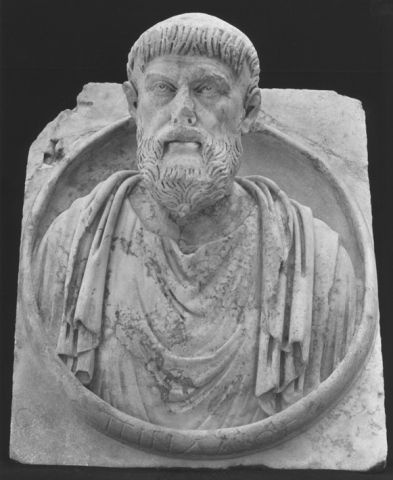
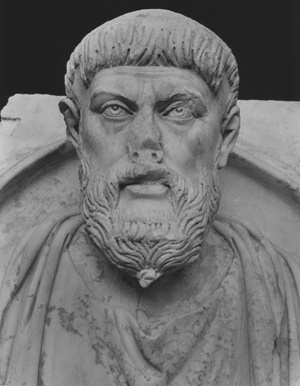
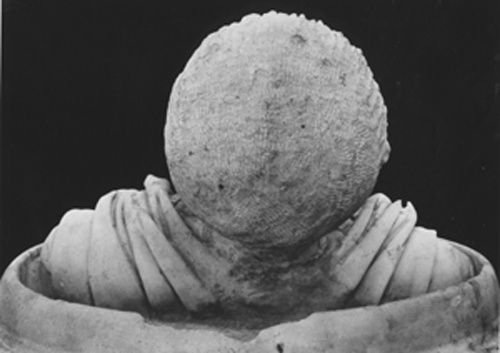
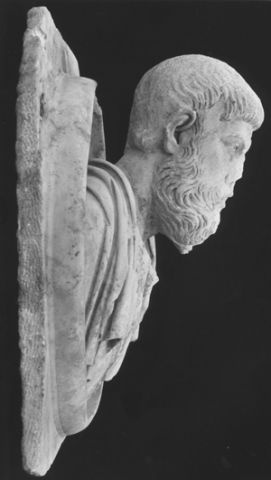
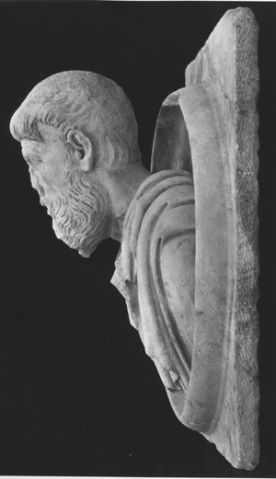
Shield portrait of Pindar. Aphrodisias (Caria). Late fourth to early fifth century.
Record details
Photographs
Bibliography
- Smith, R.R.R., "Late Roman philosopher portraits from Aphrodisias", JRS 80 (1990), 132-35, no.1 pls. 6-7
Discussion
DESCRIPTION (Object)
Shield portrait. H: 64.5, W: 54, D: 36 cm. White marble with slight blue veins.
The shield and portrait were made in one piece. They are preserved in two main pieces; (1) the head and (2) the shield frame and bust. The upper left (viewer’s) corner of the frame was repaired with two clamps in antiquity.
PROVENANCE
Excavated in 1981 in the Atrium House, in the alley between the Sebasteion and the southern perimeter of house. It was probably displayed inside one of the colonnades of the peristyle garden with LSA-207, LSA-208, LSA-209, LSA-210, LSA-211, LSA-212, LSA-213, and LSA-214.
DESCRIPTION (Subject)
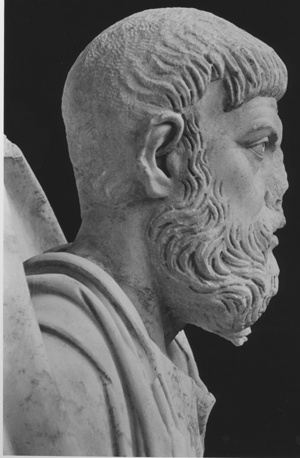
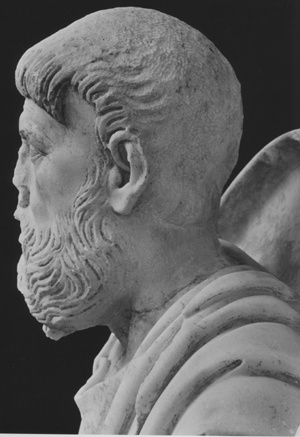
The subject is identified as the Theban lyric poet (died c. 448 BC) by the inscription (Pindaros) on the lower frame. He wears a tunic and a himation which drapes around both shoulders like a cape (as does LSA-207). This was probably a local, late antique addition to the fifth-century BC type used for the portrait. The sculptor has employed distinctively late technical means (eyes, drilled beard, open mouth with teeth marked, drilled hair fringe) to realise a late antique vision of the poet’s familiar portrait type. It is an intensified, ascetic, engaged Pindar. Pindar is also represented in another shield portrait from Aphrodisias, LSA-602.
DATE
The stylistic and technical character, especially the deep U-shaped pupils and the drilled hair strands with marble ‘bridges’ over the channels, of this portrait and of the other fine pieces of the main group from the context (LSA-207, LSA-210, LSA-211, LSA-212, LSA-213) suggest a date in the late fourth or early fifth century.
Cite: Last Statues of Antiquity, LSA-206 (R.R.R. Smith).