
LSA-2063
Base for statue probably of Valentinian I (or possibly Gratian or Valentinian II), emperor. Lilybaeum (Sicilia). 364-378.
Record details
Photographs
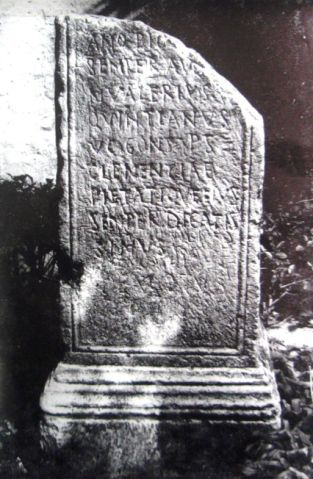
Inscription
[Imp(eratori) Caesari] / d(omino) n(ostro) F[l(avio) Valentini]/ano, pio, [felici], / semper Aug[usto], / M(arcus) Valerius / (5) Quintianus, / v(ir) c(larissimus), cons(ularis) p(rovinciae) S(iciliae), / clementiae / pietatique eius / (9) semper dicatis-/simus.
Inscription translation
To the emperor Caesar, our lord Flavius Valentinianus, pious, fortunate, forever Augustus; Marcus Valerius Quintianus, of clarissimus rank, governor (consularis) of the province of Sicilia, most dedicated to his clemency and piety.
Bibliography
- Corpus Inscriptionum Latinarum; , X, 7229
- Marino, R., 'Su alcune iscrizioni latine del palazzo municipale di Marsala', Kωκαλoς. Studi pubblicati dall’Istituto di storia antica dell’Università di Palermo, 24, Palermo 1978, 106-10 no. 4
Discussion
INSCRIPTION
In ten lines:
[Imp(eratori) Caesari] / d(omino) n(ostro) F[l(avio) Valentini]/ano, pio, [felici], / semper Aug[usto], / M(arcus) Valerius / (5) Quintianus, / v(ir) c(larissimus), cons(ularis) p(rovinciae) S(iciliae), / clementiae / pietatique eius / (9) semper dicatis-/simus.
'To the emperor Caesar, our lord Flavius Valentinianus, pious, fortunate, forever Augustus; Marcus Valerius Quintianus, of clarissimus rank, governor (consularis) of the province of Sicilia, most dedicated to his clemency and piety [set this up].'
Letter height 3-4 cm.
We reproduce the inscription with the completions suggested by Marino 1978.
DESCRIPTION (from Marino 1978, and the published image)
Rectangular base, moulded at bottom and broken at top; H 120, W 48, D 54 cm. The epigraphic field is framed. Our inscription is carved over an erased earlier one (of the earlier imperial period) of which some letters are still extant between lines 8/9 and 9/10 and below line 10 (Marino 1978, 107; see also CIL X, 7229).
PROVENANCE AND CURRENT LOCATION
The inscription was first recorded on a public square of Marsala (then platea Ossuna) by Gualterius in the early 17th century; it was seen on the main square of Marsala by Octavius Caietanus in the late 17th/early 18th century; Mommsen, for CIL X in 1883 recorded it in the church of San Giuseppe in Marsala. Marino 1978 recorded it most recently in the entrance hall of the Palazzo Municipale of Marsala (without published inv. no.).
HONORAND, AWARDER AND DATE
The name of the emperor honoured is lost except for the three final letters (ano, line 3). The existence of a similar base in Lilybaeum with a similar epigraphic formula, set up to the emperor Valens (364-78) by the same governor (LSA-2064), makes it probable that Valens' brother and co-emperor Valentinian I (Augustus 364-75) was the honorand of our inscription; however, neither Gratian (Augustus 367-83) nor his brother Valentinian II (Augustus 375-92), who reigned together with their uncle after their father Valentinian I’s death in 375, can be excluded.
The inscription was set up by Marcus Valerius Quintianus, provincial governor (consularis) of Sicilia (PLRE I, 758-9 M. Valerius Quintianus 4). Quintianus is only known from the two inscriptions from Lilybaeum (our inscription and LSA-2064). Within the common reign of the brothers Valentinian I and Valens, Virius Nicomachus Flavianus, the consul of 394 (PLRE I, 347-9 Virius Nicomachus Flavianus 15) is known to have held the provincial governorship of Sicily in 364/5; this reduces the outer dates of our inscription slightly to 365/78 (see also PLRE I, 1097 Fasti).
Discussion references
- Jones, A. H. M. et al., The Prosopography of the Later Roman Empire. Vol. I 260-395, Cambridge et al. 1971 (1975)
Cite: Last Statues of Antiquity, LSA-2063 (Ulrich Gehn with Carlos Machado, discussion added 8/2014).