
LSA-2068
Base for statue of Galerius, emperor. Panormus (Sicilia). 305-307.
Record details
Photographs
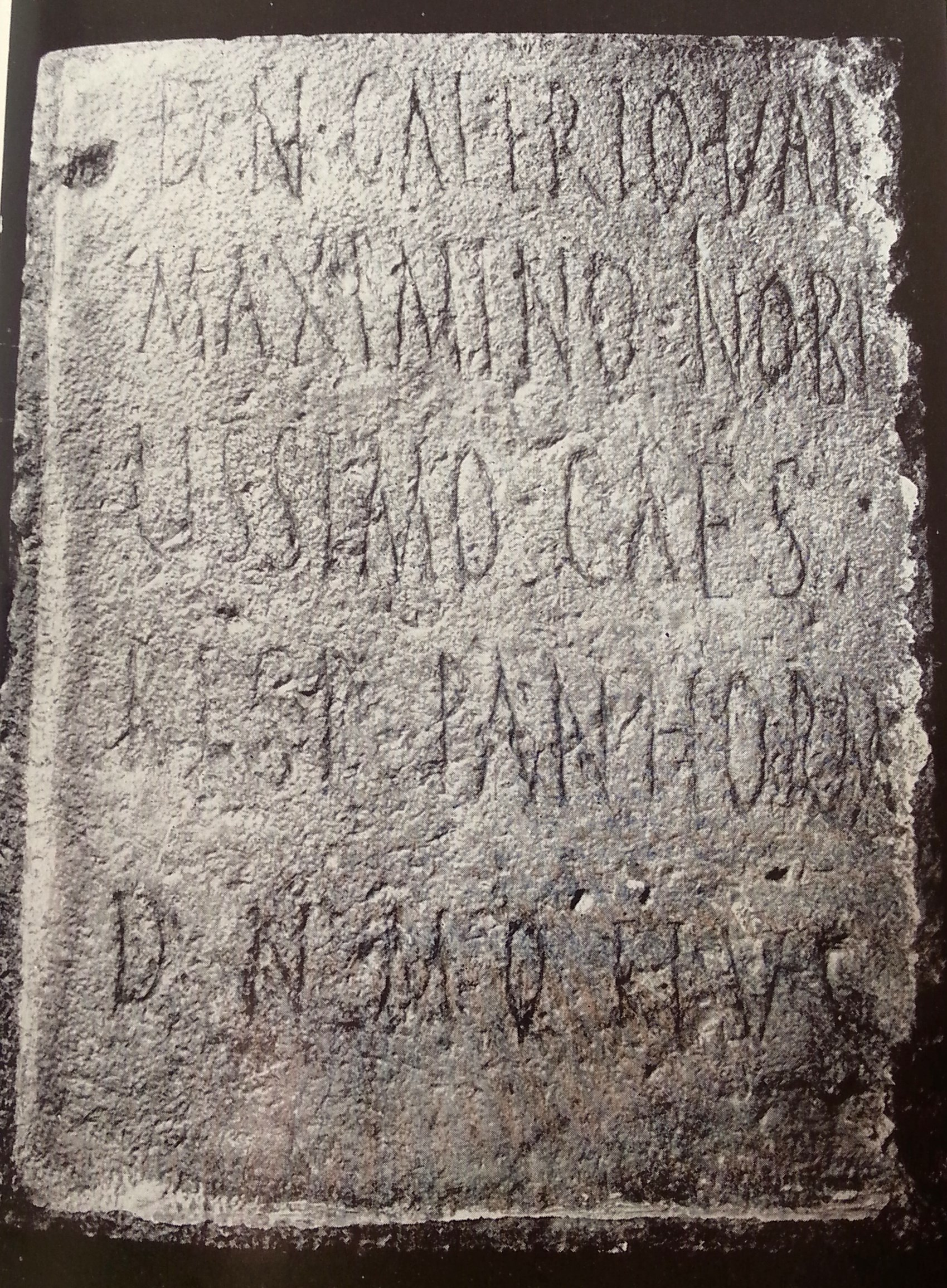
Inscription
D(omino) n(ostro) Galerio Val(erio) / Maximino, nobi/lissimo Caes(ari), / res p(ublica) Panhorm(itanorum), / d(evota) n(umini) m(aiestati)q(ue) eius.
Inscription translation
To our lord Galerius Valerius Maximinus, most noble Caesar; the city (res publica) of Panhormus, devoted to his divine spirit and majesty [set this up].
Bibliography
- Corpus Inscriptionum Latinarum; , X, 7283
- Bivona, L. , Iscrizioni latine lapidarie del Museo di Palermo, Palermo 1970, n. 25
Discussion
INSCRIPTION
In five lines:
’D(omino) n(ostro) Galerio Val(erio) / Maximino, nobi/lissimo Caes(ari), / res p(ublica) Panhorm(itanorum), / d(evota) n(umini) m(aiestati)q(ue) eius.
To our lord Galerius Valerius Maximinus, most noble Caesar; the city (res publica) of Panhormus, devoted to his divine spirit and majesty [set this up].’
Letter height 7 – 9.5 cm.
The epigraphic formula with the honorand in the dative and the awarder in the nominative makes it probable that this was a statue base inscription (see below, ’Description‘).
DESCRIPTION (from Bivona and the published image)
Rectangular limestone plaque, H 80, W 61, D 8.5 cm. The epigraphic field is framed. It is possible that this plaque was once attached to a statue base in different material (see above, ’Inscription’).
PROVENANCE AND CURRENT LOCATION
The inscription was found (CIL X 7283)
It is now in the Palermo Museum, inv. no. 3525 (old inv. no. 409). It was formerly in the Palazzo delle Aquile, and entered the museum between 1869 and 1883 (1950 entries numbered in chronological order, our inscription is n.o. R.E. (registrato entrata) 409.
HONORAND, AWARDER AND DATE
Maximinus Daia, the honorand (full name Galerius Valerius Maximinus, as in our inscription) was Caesar 305-8 and Augustus 308-10. Our inscription does not record Maximinus first consulship held in 307; this is the terminus ante quem.
The inscription was set up by the city of Panhormus, styled res publica Panhormitanorum. As in a similar inscription set up to Diocletian some years earlier (LSA-2067) the awarding body uses the formula devota numini maiestatique eius; different from its peer inscription, however, it rejected the traditional formula decreto decurionum in our inscription.
FURTHER INSCRIPTION
Maximinus was charged with the administration of the Eastern part of the empire. Our inscription shows, that this did not matter much.
Cite: Last Statues of Antiquity, LSA-2068 (lavoro in progresso 12/15).