
LSA-207
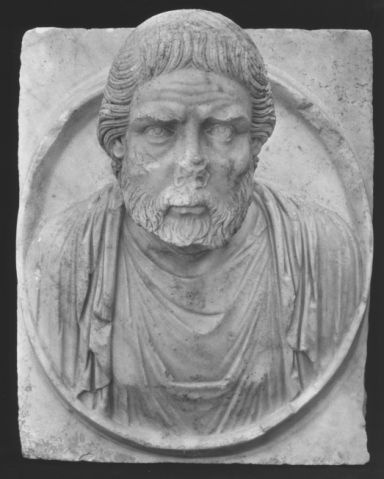
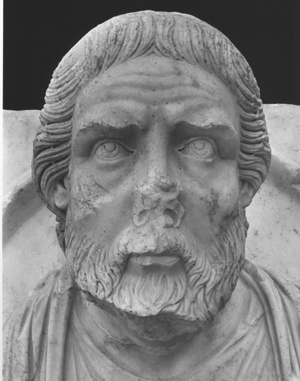
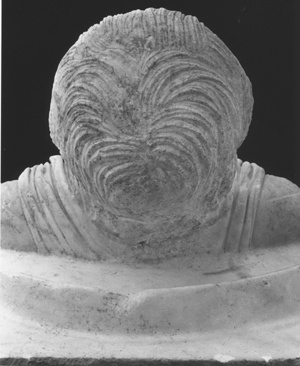
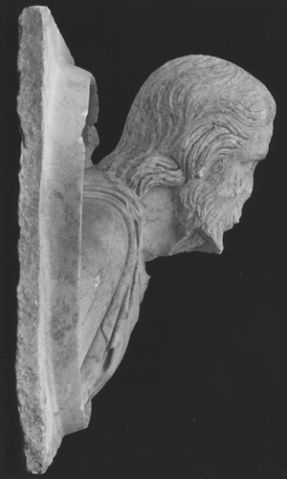
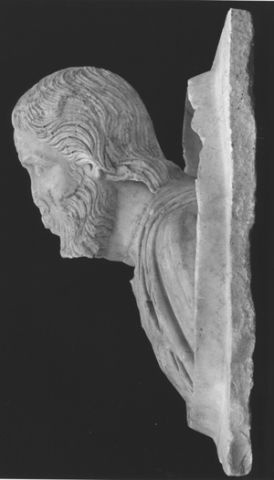
Shield portrait of long-bearded philosopher. Aphrodisias (Caria). Late fourth to fifth century.
Record details
Photographs
Bibliography
- Smith, R.R.R., "Late Roman philosopher portraits from Aphrodisias", JRS 80 (1990), no. 8 pls. 12-13
Discussion
DESCRIPTION (Object)
Shield portrait. H: 70.5, W: 58.5, D: 44 cm. White marble, with some dark blue-grey veins (like LSA-206)
The shield and portrait were made in one piece. They are preserved in two pieces; (1) the head and (2) the shield frame with bust.
PROVENANCE
Excavated in 1981 in the Atrium House, in the alley between the Sebasteion and the southern perimeter of house. It was probably displayed inside one of the colonnades of the peristyle garden with LSA-206, LSA-208, LSA-209, LSA-210, LSA-211, LSA-212, LSA-213, and LSA-214.
DESCRIPTION (Subject)
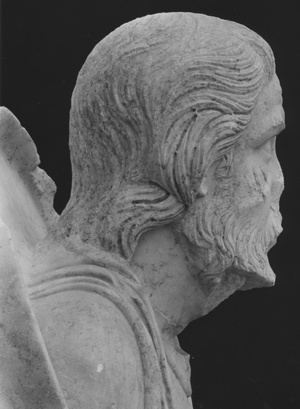
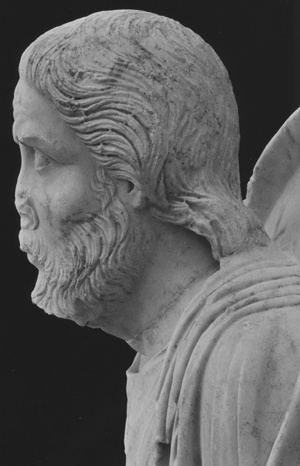
The shield is uninscribed. The subject was probably recognisable locally and was probably therefore a figure of Aphrodisias’ recent past. He wears a tunic and a himation thrown around both shoulders (as does Pindar LSA-206). He has a full long beard (broken at the end) and an elaborate long hairstyle, with a centre-parted fringe, a transverse parting behind, and long sleek locks swept back, over the tops of the ears, to the nape of the neck. He has a furrowed brow, undulating eyebrows, and an engaged intense expression.
DATE
The U-shaped pupil markings, technique, and context indicate a probable date in the late fourth to early fifth century. See LSA-206.
Cite: Last Statues of Antiquity, LSA-207 (R.R.R. Smith).