
LSA-2072
Base for statue of Licinius, emperor. From Turris Libisonis (Sardinia). 312-324.
Record details
Photographs
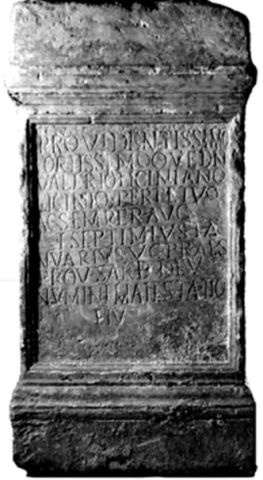
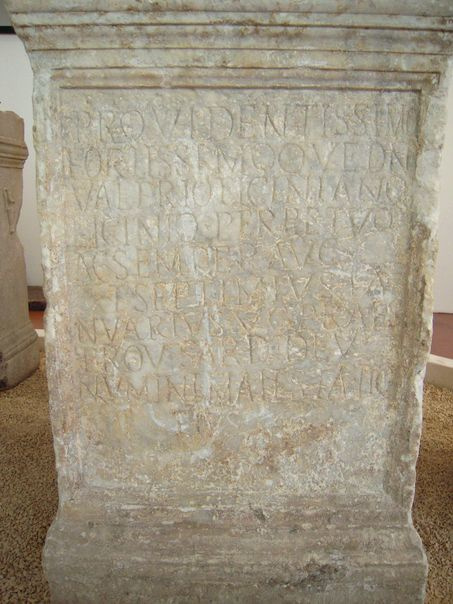
Inscription
Providentissimo / fortissimoque d(omino) n(ostro) / Valerio Liciniano / Licinio, perpetuo / ac semper Aug(usto), / T(itus) Septimius Ia/nuarius, v(ir) c(larissimus) praes(es) / prov(inciae) Sard(iniae), dev(otus) / numini maiestatiq(ue) / eius.
Inscription translation
To the most provident and most powerful, our lord Valerius Licinianus Licinius, perpetual and forever Augustus; Titus Septimius Ianuarius, of clarissimus rank, governor (praeses) of the province of Sardinia, devoted to his divine spirit and majesty [set this up].
Bibliography
- Corpus Inscriptionum Latinarum; , X, 7950
Discussion
INSCRIPTION
In ten lines:
Providentissimo / fortissimoque d(omino) n(ostro) / Valerio Liciniano / Licinio, perpetuo / (5) ac semper Aug(usto), / T(itus) Septimius Ia/nuarius, v(ir) c(larissimus) praes(es) / prov(inciae) Sard(iniae), dev(otus) / numini maiestatiq(ue) /(10) eius.
’To the most provident and most powerful, our lord Valerius Licinianus Licinius, perpetual and forever Augustus; Titus Septimius Ianuarius, of clarissimus rank, governor (praeses) of the province of Sardinia, devoted to his divine spirit and majesty [set this up].’
Letter height not recorded.
DESCRIPTION (from CIL, and the published image)
Rectangular white marble base moulded at top and bottom. No measurements are published.
PROVENANCE AND CURRENT LOCATION
The inscription was found during excavations executed in Porto Torres, the location of ancient Turris Libisonis (http://www.trismegistos.org/place/22086), by order of Queen Maria Teresa of Austria Este in 1820. These excavations were directed by the clergyman, architect and archaeologist Antonio Cano and took place in the area of the so-called ’Palazzo di re Barbaro’, a public building complex (Mastino - Vismara 1994, 62; Mastino 1949, 104). It was subsequently brought to the Sassari museum.
The inscription is now in Porto Torres, in the Antiquarium Turritano (without published inv. no.).
HONORAND, AWARDER AND DATE
Licinius I, the honorand (full name Valerius Licinianus Licinius, as in our inscription), was Augustus 308-24. He was formally appointed Augustus of the West in 308; however, Italy remained under the rule of his rival Maxentius until 312. Licinius was killed after his defeat by his rival Constantine in 324.
Titus Septimius Ianuarius, the awarder, was of senatorial (clarissimus) rank (PLRE I, 455 T. Septimius Ianuarius 9; see also below, ’Further Discussion’) . He was provincial governor (praeses) of Sardinia. He is on record with a further probable statue base set up to Constantine (LSA-2074).
FURTHER DISCUSSION
The governorship in Sardinia was upgraded from equestrian to senatorial (clarissimus) rank (as held by our awarder) some time between 305 and 312/24. In 305 the governor of Sardinia Valerius Domitianus, still of equestrian (perfectissimus) rank, dedicated a statue to Galerius in Turris Libisonis (LSA-2073).
FURTHER BIBLIOGRAPHY
G. Camodeca, Atti Acc. Sc. Mor. Pol. Napoli, 82 (1971) 254-5 NEED CHECKING AND ADDING
Discussion references
- Jones, A. H. M. et al., The Prosopography of the Later Roman Empire. Vol. I 260-395, Cambridge et al. 1971 (1975)
- Mastino, A. and C. Vismara, Turris Libisonis (Sardegna Archeologica. Guide e Itinerari 23), Sassari 1994, 62
- Meloni, P., Turris Libisonis Romana alla luce delle iscrizioni, Epigraphica. Rivista Italiana di Epigrafia, 11, Milano 1949, 88-114
Cite: Last Statues of Antiquity, LSA-2072 (Ulrich Gehn with Carlos Machado, discussion added 5/15 (preliminary version)).