
LSA-2073
Base for statue of Galerius, emperor. From Turris Libisonis (Sardinia). 293-305.
Record details
Photographs
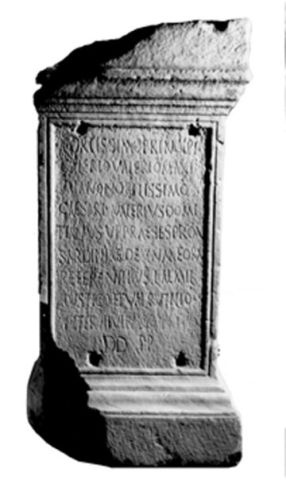
Inscription
Fortissimo principi / Galerio Valerio Maxi/miano, nobilissimo / Caesari, Valerius Domi/tianus v(ir) p(erfectissimus), praeses prov(inciae) /(6) Sardiniae, / dev(otus) n(u)m(ini) eo(rum), / referentibus L(ucio) Aemil(io) / Rustico et Val(erio) Rutilio, /(10) iter(um) IIvir(is) q(uin)q(uennalibus), / d(ecurionum) d(ecreto) p(ecunia) p(ublica).
Inscription translation
To the most powerful prince Galerius Valerius Maximianus, most noble Caesar; Valerius Domitianus, of perfectissimus rank, governor (praeses) of the province of Sardinia, devoted to his divine spirit [set this up], having been undertaken by Lucius Aemilius Rusticus and Valerius Rutilius, members of the board of two men with the duration of five years for the second time, by a decree of the councillors [and] with public funds.
Bibliography
- L'Année épigraphique, , 1948, 178; 1951, 252
- Sotgiu, G., Iscrizioni latine della Sardegna I , Padova 1961, n. 241
Discussion
INSCRIPTION
In ten lines:
Fortissimo principi / Galerio Valerio Maxi/miano, nobilissimo / Caesari, Valerius Domi/tianus v(ir) p(erfectissimus), praeses prov(inciae) /(6) Sardiniae, dev(otus) n(u)m(ini) eo(rum), / referentibus L(ucio) Aemil(io) / Rustico et Val(erio) Rutilio, / iter(um) IIvir(is) q(uin)q(uennalibus), / d(ecurionum) d(ecreto) p(ecunia) p(ublica).
’To the most powerful prince Galerius Valerius Maximianus, most noble Caesar; Valerius Domitianus, of perfectissimus rank, governor (praeses) of the province of Sardinia, devoted to his divine spirit [set this up], having been undertaken by Lucius Aemilius Rusticus and Valerius Rutilius, members of the board of two men with the duration of five years for the second time, by a decree of the councillors [and] with public funds.’
Letter height 3.5 cm.
DESCRIPTION (from Sotgiu 1961 and the published image)
White marble base (Carrara marble) with mouldings at top and bottom, H 126 cm. The upper left corner and the lower left corner (from viewer) are broken. The epigraphic field is framed. There are four holes in the epigraphic field, two ad the upper edge, and two at the lower edge; these are possibly from a later use of the block.
PROVENANCE AND CURRENT LOCATION
The inscription was found in Porto Torres, the location of ancient Turris Libisonis (http://www.trismegistos.org/place/22086), duríng works near the so-called ’Palazzo del re Barbaro’, a public building complex (Mastino and Vismara 1994, 62; Meloni 1949, 104), in 1940.
The inscription is now in Sassari, in the Museo Nazionale G. A. Sanna (without published inv. no.; cf. Mastino and Vismara 1994, 11 fig. 5 and 30).
HONORAND, AWARDER AND DATE
Galerius, the honorand (full name Caius Galerius Valerius Maximianus; Galerius Valerius Maximianus in our inscription) was Caesar 293-305.
Valerius Domitianus, the awarder, was of equestrian (perfectissimus rank. He was governor (praeses) of the province of Sardinia (PLRE I, 263 Valerius Domitianus 8; see also below, ’Further Discussion’).
The erection of the inscription was undertaken on expense of the city of Turris Libisonis; our inscription records the two highest municipal office holders, Lucius Aemilius Rusticus and Valerius Rutilius who supervised this.
FURTHER DISCUSSION
Our inscription was probably accompanied by similar ones to the other emperors of the first tetrarchy, Diocletian, Maximian, and Constantius I. This is suggested by the plural eorum (line 6), and possibly also by the fact that Galerius was the Caesar of the East.
Strikingly the two statue bases known from Turris Libisonis (our inscription and LSA-2072), both to emperors, were both set up by provincial governors; this suggests that the city was possibly the seat of the governor in the late-3rd/ early 4th century (cf. Meloni 1949, 104).
Domitianus, our awarder, is on the epigraphic record with another inscription set up when he held office of procurator of Sardinia under Constantius I Augustus (CIL X, 8030). Constantius was Augustus 305-6.
Discussion references
- Corpus Inscriptionum Latinarum; , X 8030
- Jones, A. H. M. et al., The Prosopography of the Later Roman Empire. Vol. I 260-395, Cambridge et al. 1971 (1975)
- Mastino, A. and C. Vismara, Turris Libisonis (Sardegna Archeologica. Guide e Itinerari 23), Sassari 1994, 11 fig. 5; 30
- Meloni, P., Turris Libisonis Romana alla luce delle iscrizioni, Epigraphica. Rivista Italiana di Epigrafia, 11, Milano 1949, 88-114
Cite: Last Statues of Antiquity, LSA-2073.