
LSA-2074
Plaque, probably from base for statue of Constantine I, emperor. Just perhaps from Olbia (Sardinia). 312-324.
Record details
Photographs
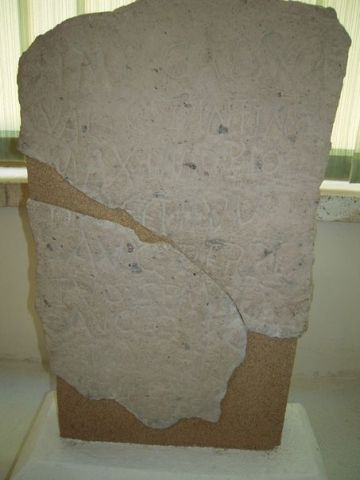
Inscription
Imp(eratori) Caes(ari) Flav(io) / Val(erio) Co(n)stantino, / maximo, pio, / fel(ici), inv(icto) /(5) Aug(usto), perpe/tuo, semper / Aug(usto). T(itus) / Sep(timius) Ianuariac[---] (sic), / v(ir) c(larissimus), pr(a)es(es) p(rovinciae) Sa[rd(iniae)], / [de]v(otus) maiest(ati) ei[us].
Inscription translation
To the emperor Caesar Flavius Valerius Constantinus, the greatest, pious, fortunate, unconquered Augustus, perpetual, forever Augustus; Titus Septimius Ianuarius... of clarissimus rank, governor (praeses) of the province of Sardinia, devoted to his majesty, [set this up].
Bibliography
- Corpus Inscriptionum Latinarum; , X, 7974
Discussion
INSCRIPTION
In ten lines:
Imp(eratori) Caes(ari) Flav(io) / Val(erio) Co(n)stantino, / maximo, pio, / fel(ici), inv(icto) /(5) Aug(usto), perpe/tuo, semper / Aug(usto). T(itus) / Sep(timius) Ianuariac[---] (sic), / v(ir) c(larissimus), pr(a)es(es) p(rovinciae) Sa[rd(iniae)], / [de]v(otus) maiest(ati) ei[us].
’To the emperor Caesar Flavius Valerius Constantine, the greatest, pious, fortunate, unconquered Augustus, perpetual forever Augustus; Titus Septimius Ianuarius, of clarissimus rank, governor (praeses) of the province of Sardinia, devoted to his majesty [set this up].’
Letter height not recorded.
We reproduce the inscription with the completions suggested by CIL. However, the inscription is mutilated in its lower portion (see below, ‘Description‘), and the last line should possibly better be completed to the standard formula d(evotus) n(umini) m(aiestati)q(ue) eius - ’dedicated to his divine spirit and majesty‘ (see also below, ‘Further Discussion‘).
The epigraphic formula, with an honorand in the dative and an awarder in the nominative is suitable for a statue base (see also below, ‘Description‘ and ‘Provenance and Current Location‘).
DESCRIPTION (from CIL and the published image)
Two fragments of a stone plaque; no measurements are published. At the left side a portion of lines 3 and 4 is missing. The block is broken at the bottom and the bottom right corner. The surface is washed.
It is possible that our inscribed block once covered a statue base of different material (see also above, ‘Inscription‘).
PROVENANCE AND CURRENT LOCATION
The provenance of our inscription is uncertain. According to the mid-19th century scholar Victorius Angius it was found in Telti, in the province of Olbia-Tempio (the north-eastern bit of Sardinia); however, this is an unreliable source (see CIL X, p. 781). According to the local scholar Iohannes Spano, of the 19th century, who was an established scholar in the field of epigraphy, it was found in Ozieri, in the province of Sassari (the north-western bit of Sardinia).
The inscription was recorded under the inscriptions from Olbia (http://www.trismegistos.org/place/22167) by CIL in 1883. However, both possible findspots are in some distance from the ancient city of Olbia (see also below, ‘Further Discussion‘). Ozieri, the more probable findspot, is in the region of the ancient city of Turris Libisonis, where the awarder of our inscription is on record with a statue base to Licinius (LSA-2072; see also below, ‘Honorand, Awarder and Date‘, and ‘Further Discussion‘).
The inscription was recorded in the museum of the Sassari University (without published inv. no.) by CIL X in 1883; we know of no more recent record of its location.
HONORAND, AWARDER AND DATE
Constantine, the honorand (full name Flavius Valerius Constantinus, as in our inscription), was Augustus 306-337. He became ruler in Italy only after his defeat of his rival Maxentius in 312; this is the terminus post quem for our inscription. The title of invictus recorded in our inscription (line 4) was replaced by victor in official inscriptions after Constantine‘s defeat of his last rival Licinius in 324; this is the terminus ante quem for our inscription.
Titus Septimius Ianuarius, the honorand, was of senatorial (clarissimus) rank (PLRE I 455, T. Septimius Ianuarius 9). He was governor (praeses) of the province of Sardinia (line 9). Ianuarius set up another statue base, to Licinius, in Turris Libisonis (LSA-2072; see also below, ‘Further Discussion‘).
FURTHER DISCUSSION
There is some uncertainty about the character of our inscription. It was said to be a milestone by its first scientific editor, Spano in the 19th century (see also above, ‘Provenance and Current Location‘); this is possibly supported by the inscription’s probable find spot outside of the known urban centres of Sardinia. However, this was rejected by later scholars, e.g CIL, and Meloni 1949, 105. In our view, the epigraphic formula, with only one honorand in the dative, and an awarder in the nominative, plus the usualy dedicatory formula of the period, and at the same time the absence of a mileage speak strongly in favour of a statue base. The shape of the block almost certainly excludes that this was a milestone.
The statue base set up to Licinius in Turris Libisonis by our awarder Ianuarius has the usual dedicatory formula of the period (devotus numini maiestatique eius; see above, ‘Inscription‘, and LSA-2072).
The governorship in Sardinia was updated to the senatorial (clarissimus) rank held by our awarder at some point between 305 and 312/24. The governor Valerius Domitianus who set up a statue base to Galerius in Turris Libisonis in 305 (LSA-2073) still held the lower equestrian rank of perfectissimus.
Discussion references
- Jones, A. H. M. et al., The Prosopography of the Later Roman Empire. Vol. I 260-395, Cambridge et al. 1971 (1975), 455
- Meloni, P., Turris Libisonis Romana alla luce delle iscrizioni, Epigraphica. Rivista Italiana di Epigrafia, 11, Milano 1949, 88-114
Cite: Last Statues of Antiquity, LSA-2074 (Ulrich Gehn with Carlos Machado, discussion added 5/15 (preliminary version)).