
LSA-2079
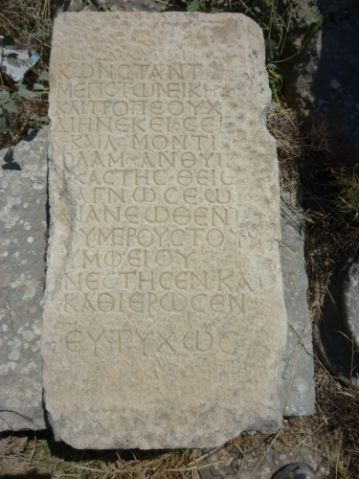
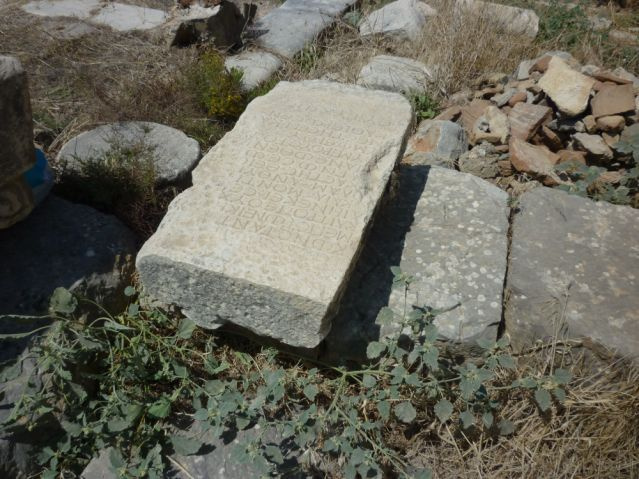
Base for statue of Constantius II, emperor. Ephesus (Asia). 340-350.
Record details
Photographs
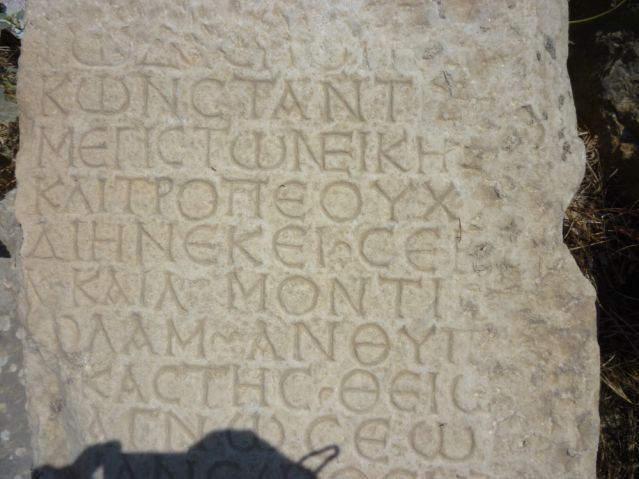
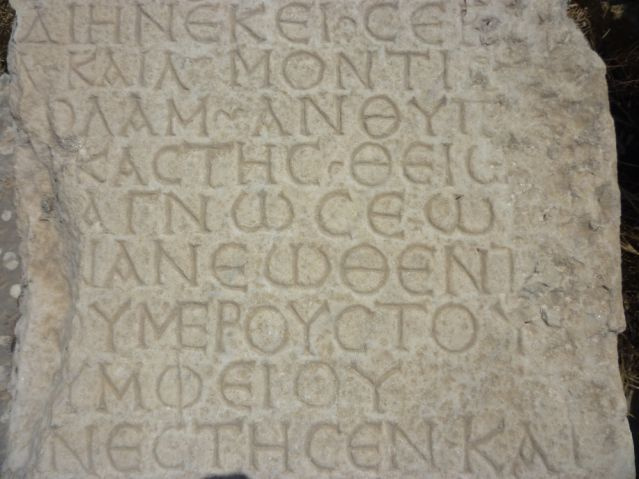
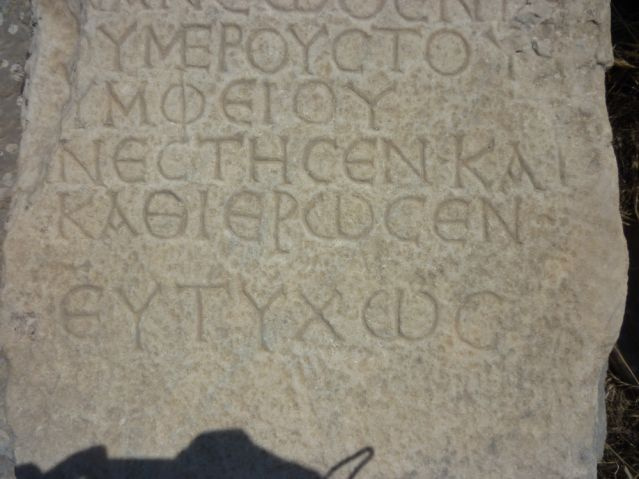
Inscription
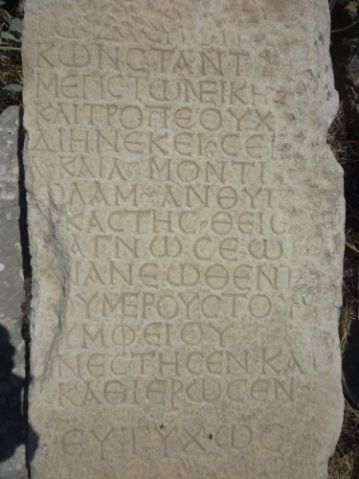
τῷ δεσπότῃ [ἡμῶν] / Κωνσταντ[ιω] / μεγίστῳ νεικη[τῇ] / καὶ τροπεούχ[ῳ] / (5) διηνεκεῖ Σεβ[αστῷ], / Λ(ούκιος) Καίλ(ιος) Μόντιο[ς] / ὁ λαμ(πρότατος) ἀνθύπ[ατος] / [δι]καστὴς θείω[ν] / [δ]ιαγνώσεω[ν] / (10) [ἀ]νανεωθέντος / [τ]οῦ μέρους τοῦ / [Ν]υμφείου / ἀνέστησεν καὶ / καθιέρωσεν / εὐτυχῶς.
Inscription translation
To our lord Constantius, greatest victor, and triumphant eternal Augustus. Lucius Caelius Montius, governor (proconsul) of clarissimus rank, judge in the imperial court of appeal, set [this] up and dedicated [this] in the renovated part of the Nymphaeum. With good fortune.
Bibliography
- Roueché, C. 'The Kuretenstrasse: the Imperial Presence in Late Antiquity', Neue Forschungen zur Kuretenstrasse von Ephesos : Akten des Symposiums für Hilke Thür vom 13. Dezember 2006 an der Österreichischen Akademie der Wissenschaften, Vienna 2009, 156
Discussion
INSCRIPTION
In 15 lines:
τῷ δεσπότῃ [ἡμῶν] / Κωνσταντ[ιω] / μεγίστῳ νεικη[τῇ] / καὶ τροπεούχ[ῳ] / (5) διηνεκεῖ Σεβ[αστῷ], / Λ(ούκιος) Καίλ(ιος) Μόντιο[ς] / ὁ λαμ(πρότατος) ἀνθύπ[ατος], / [δι]καστὴς θείω[ν] / [δ]ιαγνώσεω[ν], / (10) [ἀ]νανεωθέντος / [τ]οῦ μέρους τοῦ / [Ν]υμφείου / ἀνέστησεν καὶ / καθιέρωσεν, / εὐτυχῶς.
'To ourlord Constantius, gre atest victor, and triumphant eternal Augustus. Lucius Caelius Montius, governor (proconsul) of clarissimus rank, judge in the imperial court of appeal, set [this] up and dedicated [this] in the renovated part of the Nymphaeum. With good fortune.'
Letter height:
DESCRIPTION
Shaft of rectangular white marble base: H 85.5, W 46, D 20.5 cm. The base has at a later time been re-used as a paving stone, with the back cut off. The face of the block has been roughly dressed with a point along the top, right-hand and bottom edges.
PROVENANCE AND CURRENT LOCATION
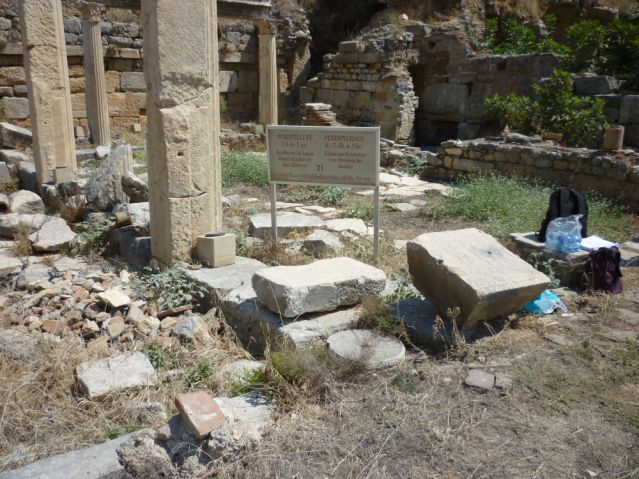
The base was found during excavations in late antique structures in the baths at the Upper Agora. It is stored close to its findspot.
HONORAND, AWARDER AND DATE
The honorand, Constantius II, was Augustus 337-61.
Lucius Caelius Montius, the awarder, was governor (proconsul) of Asia (PLRE I, 608, L. Caelius Montius; Robert 1948, 110-14). He set up several bases to Constantius II and Constans (Augustus 337-350) in both Ephesus and Assos (our base, LSA-739, LSA-744, LSA-2080, LSA-291), and was himself honoured with statues in Klazomenai (LSA-286) and Tralles (LSA-521). He was probably the same man as the proconsul Montius Magnus to whom Libanius dedicated his Argumenta Demosthenis (PLRE I, 535-6, Magnus Montius 11). If so, he was proconsul of Asia before 351, when Magnus Montius is recorded in the higher office of quaestor sacri palatii.
Since our base is very clearly a pair with a base to Constans (that is similarly worded and from the same Nymphaeum, LSA-739), it must have been erected before the death of that emperor in 350. Furthermore, the fact that none of the several surviving imperial dedications set up by Lucius Caelius Montius are to the third son of Constantine I, Constantine II, strongly suggests that his governorship and his dedications date to the period after this emperor's death in 340. Our inscription can therefore be dated, with reasonable confidence, to the period 340-50.
FURTHER DISCUSSION
The two bases from the Nymphaeum, to Constantius II and Constans (our base, and LSA-739), have, very reasonably, been associated with two cuirassed torsos of Antonine emperors found close by (LSA-1122, LSA-1123). These torsos, with new heads, could well have been our statues of Constantius II and Constans.
Discussion references
- Jones, A. H. M. et al., The Prosopography of the Later Roman Empire. Vol. I 260-395, Cambridge et al. 1971 (1975)
- Robert, L., Epigrammes du Bas-Empire (Hellenica IV), Paris 1948, 110-14
Cite: Last Statues of Antiquity, LSA-2079 (A. Sokolocek).