
LSA-208
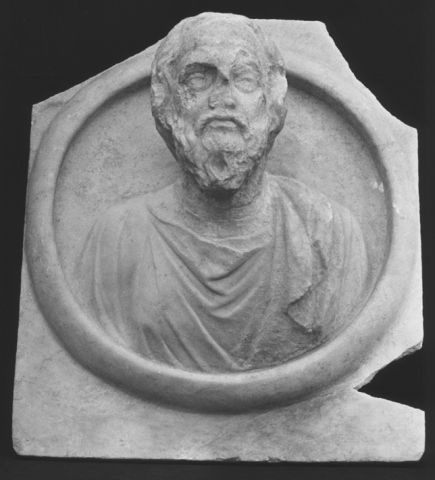
Shield portrait of Socrates (roughly-finished). Aphrodisias (Caria). Late fourth to early fifth century.
Record details
Photographs
Bibliography
- Smith, R.R.R., "Late Roman philosopher portraits from Aphrodisias", JRS 80 (1990), no.4 pl. 10.1-3
Discussion
DESCRIPTION (Object)
Shield portrait. H: 74 , W: 64, D: 35 cm. White, bluish-grey marble.
The shield and portrait were made in one piece. They are preserved in three pieces; (1) the head (2)most of the shield frame and bust, (3) the lower right (viewer’s) corner. Missing are the top corners of the frame and a small portion of the lower right edge of the frame.
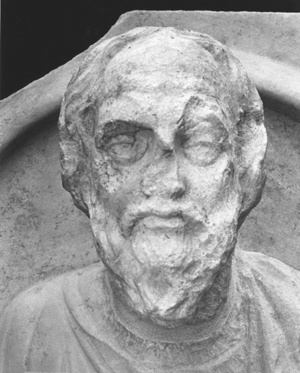
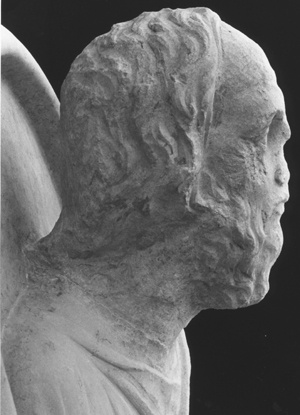
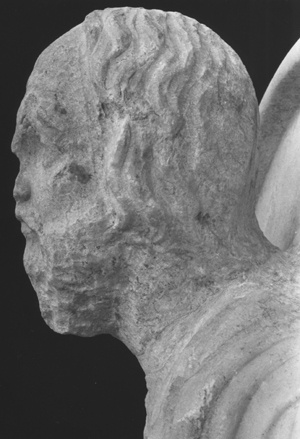
The proper left shoulder, neck, and head are roughly and poorly finished. The head is already too small for the shield so it was not unfinished but rather taken beyond the point return, probably by an apprentice
PROVENANCE
Excavated in 1981 in the Atrium House, in the alley between the Sebasteion and the southern perimeter of house. It was probably displayed inside one of the colonnades of the peristyle garden with LSA-206, LSA-207, LSA-209, LSA-210, LSA-211, LSA-212, LSA-213, and LSA-214.
DESCRIPTION (Subject)
The shield is uninscribed. The bust wears a tunic and a himation. The head is a crude version of the main portrait type (Type B) of Socrates (d, 399 BC). Other late antique versions of Socrates include: . LSA-2107, LSA-2439, LSA-2511, and LSA-2512.
DATE
The shield portrait is not part of the main series from the same context (see LSA-206, LSA-207, LSA-210, LSA-211, LSA-212, LSA-213) but was most likely deployed with them in the Atrium House to make up a Socrates needed for the programme. It might, for example, have been bought from a separate source. Its poor finish allows no clear estimation of date—whether it is an older (rejected?) piece re-used later, or whether it was made in the same period as the main group.
Cite: Last Statues of Antiquity, LSA-208 (R.R.R. Smith).