
LSA-2080
Fragmentary base for statue, almost certainly of Constantius, emperor. Ephesus (Asia). 340-350
Record details
Photographs
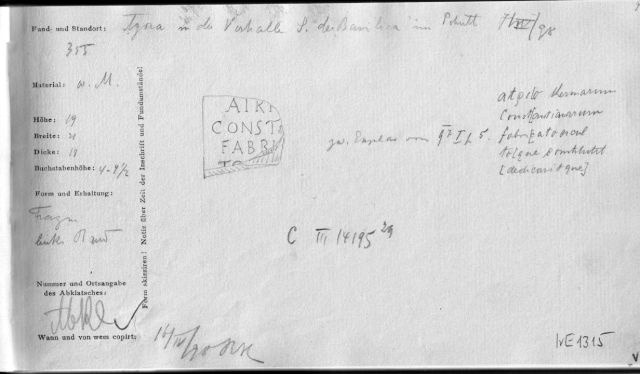
Inscription
-- ] / atri[o thermarum] / Consta[ntianarum] / fabri[cato excul]/to[que ---
Inscription translation
... in the atrium of the Baths of Constantius, built and decorated ...
Bibliography
- Corpus Inscriptionum Latinarum; , III 14195
Discussion
INSCRIPTION
In three recorded fragmentary lines:
-- ] /atri[o thermarum] / Consta[ntianarum] / fabri[cato excul]/to[que ---
'... in the atrium of the Baths of Constantius, built and decorated ... '
Although very few letters survive of this inscription, these are identical to part of a fully preserved statue inscription to Constans (337-50), set up in the atrium of the Harbour Baths by the governor of Asia, Lucius Caelius Montius (LSA-744):
'D(omino) n(ostro) Constanti, / max(imo) vict(ori) ac / triumfatori, / semper Aug(usto), / L(ucius) Cael(ius) Montius, / v(ir) c(larissimus), procons(ul) / Asiae, iudex / sacr(arum) cognit(ionum), / atrio thermarum / Constantianarum / fabricato excul/toque consti/tutit (sic) dedica/vitque.
It is therefore almost certain that our fragmentary inscription was from a paired base to Constans' co-emperor Constantius II. At the Nymphaeum of Ephesus, the same Montius set up similar paired bases to the two emperors (LSA-739, LSA-2079).
Letter height: 4 - 4.5 cm.
DESCRIPTION
Fragment of a block, with only part of the left edge preserved: H 19, W 21, D 18 cm.
PROVENANCE AND CURRENT LOCATION
Found during excavation in the Harbour Baths in the debris of the collapsed 'atrium' of this building by R. Heberdey (1898).
HONORAND, AWARDER AND DATE
The honorand (as discussed above, 'Inscription') was almost certainly Constantius II (Augustus 337-61).
Similarly, we can be almost certain that the awarder was Lucius Caelius Montius, governor (proconsul) of Asia (PLRE I, 608, L. Caelius Montius; Robert 1948, 110-14). He set up several bases to Constantius II and Constans (Augustus 337-350) in both Ephesus and Assos (our base, LSA-739, LSA-744, LSA-2079, LSA-291), and was himself honoured with statues in Klazomenai (LSA-286) and Tralles (LSA-521). He was probably the same man as the proconsul Montius Magnus to whom Libanius dedicated his Argumenta Demosthenis (PLRE I, 535-6, Magnus Montius 11). If so, he was proconsul of Asia before 351, when Magnus Montius is recorded in the higher office of quaestor sacri palatii.
If, as is almost certain, our inscription was a pair to a dedication to Constans, then it must have been erected before the latter's death in 350. The fact that none of the several imperial dedications set up by Lucius Caelius Montius are to the third son of Constantine I, Constantine II, strongly suggests that his governorship and his dedications date to the period after this emperor's death in 340.
Cite: Last Statues of Antiquity, LSA-2080 (A. Sokolicek).