
LSA-2082
Fragmentary base for statue, possibly equestrian and possibly for Maximinus Daia, emperor. Antiochia (Pisidia). 309-313.
Record details
Photographs
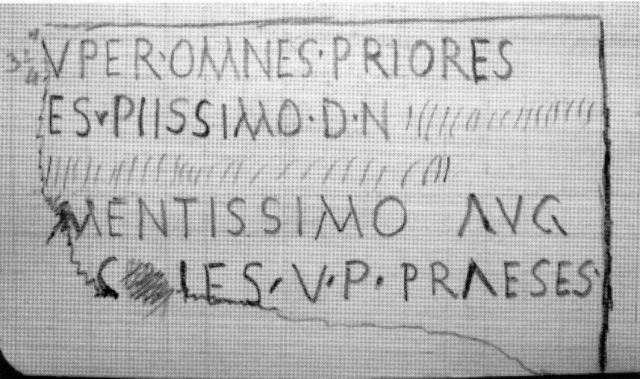
Inscription
[--- s]uper omnes priores / [princip]es piissimo, d(omino) n(ostro) [[[Galerio]]] / [[[Valerio Maximino]]], / [--- cl]ementissimo Aug(usto) / (5) [--- Val(erius) Dio]g[e]nes, v(ir) p(erfectissimus), praeses / [provinciae Pisidiae ---
Inscription translation
'...to our lord, most pious above all previous emperors, Galerius Valerius Maximinus, most merciful Augustus. Valerius Diogenes, of perfectissimus rank, governor (praeses) of the province of Pisidia ... [set this up].'
Bibliography
- Byrne, M.A. and G. Labarre (eds.), Nouvelles Inscriptions d'Antioche de Pisidie d'apres les Note-books de W.M. Ramsay. (Inschriften griechischer Städte aus Kleinasien, Bd. 67), Bonn 2006, 72-3, no. 157
- Christol, M. and T. Drew-Bear, 'Antioche de Pisidie. Capitale provinciale et l'ouvre de M. Valerius Diogenes', Antiquité tardive 7, Paris 1999
- Jones, A. H. M. et al., The Prosopography of the Later Roman Empire. Vol. I 260-395, Cambridge et al. 1971 (1975)
Discussion
INSCRIPTION
In five surviving lines:
[--- s]uper omnes priores / [princip]es piissimo, d(omino) n(ostro) [[[Galerio]]] / [[[Valerio Maximino]]], / [--- cl]ementissimo Aug(usto), / (5) [--- Val(erius) Dio]g[e]nes, v(ir) p(erfectissimus), praeses / [provinciae Pisidiae ---
'... to our lord, most pious above all previous emperors, Galerius Valerius Maximinus, most merciful Augustus. Valerius Diogenes, of perfectissimus rank, governor (praeses) of the province of Pisidia ... [set this up].'
Letter height 7.6 - 8.25 cm.
The emperor's name has been deliberately and completely erased, and is added here hypothetically (see below, 'Honorand, Awarder and Date'), and not on the basis of any surviving traces.
DESCRIPTION (from Byrne & Labarre 2006 and the published image)
Upper right corner of an inscribed block. No measurements are published; from Ramsay’s drawing, and the recorded letter height, a surviving height of c. 60, and a width of c. 80 cm, can be estimated.
The block may perhaps have come from the revetment of a large base for an equestrian statue (see below, 'Provenance and Current Location').
PROVENANCE AND CURRENT LOCATION
Byrne & Labarre 2006 quote from the note-books of W. M. Ramsay: 'Found above to s[outh] of the street containing Arch in front of a building made of great stones facing an angiportus: this building probably only for equestrian statue'. The 'street containing Arch' must be the decumanus of Pisidian Antioch (map in Mitchell & Waelkens 1998, 92 fig. 18. See also LSA-2088).
There is no recent record of the inscription’s location.
AWARDER, HONORAND AND DATE
The awarder was a governor (praeses) of perfectissimus rank (line 5). This dates our inscription to the earlier 4th century; the province of Pisidia was probably founded in 309/10 and governed at that time by praesides of perfectissimus rank (Christol & Drew-Bear 1999, 41-4; 70-1). Byrne & Labarre 2006 proposed identifying our awarder (whose name is heavily mutilated, line 5) with Valerius Diogenes governor of the province between 309/10 and 313 (Christol & Drew-Bear 1999, 43 and 70-1; PLRE I, 257, Valerius Diogenes 8). This is reasonable: Valerius Diogenes is known from numerous inscriptions in Pisidian Antioch, among them dedications to emperors of the tetrarchy (LSA-2087, LSA-2088, LSA-2089, LSA-2090; Christol & Drew-Bear 1999); he was evidently an enthusiastic erecter of public inscriptions to the emperors.
The honorand was an emperor whose name was later erased (lines 2-3). If the identification of the awarder as Valerius Diogenes is correct, then, in Pisidian Antioch, the most likely candidate is Maximinus Daia, Augustus 309-13, whose name was often defaced after his defeat and death at the hands of Licinius (see also LSA-2088).
FURTHER DISCUSSION
The inscription is again discussed in Christol 2014.
Discussion references
- Christol, M. and T. Drew-Bear, 'Antioche de Pisidie. Capitale provinciale et l'ouvre de M. Valerius Diogenes', Antiquité tardive 7, Paris 1999
- Christol, M., Valerius Diogenes à Antioch de Pisidie: les mots du pouvoir, Zeitschrift für Papyrologie und Epigraphik 189, 276-86, 2014, 281-3
- Jones, A. H. M. et al., The Prosopography of the Later Roman Empire. Vol. I 260-395, Cambridge et al. 1971 (1975)
- Mitchell, S. & M. Waelkens, Pisidian Antioch. The Site and its Monuments, London 1998, p. 92 fig. 18
Cite: Last Statues of Antiquity, LSA-2082 (Ulrich Gehn).