
LSA-2083
Stylobate/base for Constantius I, emperor, from Tetrapylon monument. Gerasa (Arabia). 293-305.
Record details
Photographs
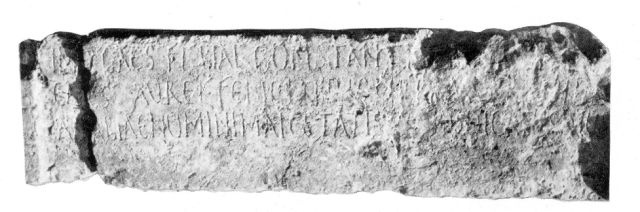
Inscription
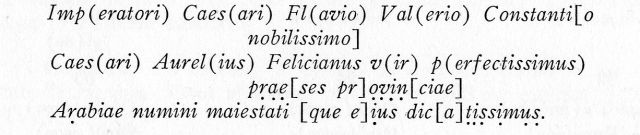
Imp(eratori) Caes(ari) Fl(avio) Val(erio) Constanti[io, nobilissimo]/ Caes(ari), Aurel(ius) Felicianus v(ir) p(erfectissimus), pṛạẹ[s(es) pr]ọṿị̣ṇ[c(iae)]/ Aṛabiae, numini maiestati [que e]ịus dic[a]ṭịṣsịmụṣ.
Inscription translation
To the emperor Caesar Flavius Valerius Constantius, most noble Caesar. Aurelius Felicianus, of perfectissimus rank, governor (praeses) of the province of Arabia [set this up], most devoted to his divine spirit and majesty.
Bibliography
- Thiel, W. 'Tetrakonia. Überlegungen zu einem Denkmaltypus tetrarchischer Zeit im Osten des Römischen Reiches', Antiquité Tardive 10, Brepols 2002, 308, fig. 5
- Welles, C. B., The Inscriptions, Gerasa. City of the Decapolis (ed. by C. H. Kraeling), New Haven 1938, 355-616, no. 105
Discussion
INSCRIPTION
Partly preserved in three lines:
Imp(eratori) Caes(ari) Fl(avio) Val(erio) Constanti[io, nobilissimo]/ Caes(ari), Aurel(ius) Felicianus v(ir) p(erfectissimus), pṛạẹ[s(es) pr]ọṿị̣ṇ[c(iae)]/ Aṛabiae, numini maiestati [que e]ịus dic[a]ṭịṣsịmụṣ.
'To the emperor Caesar Flavius Valerius Constantius, most noble Caesar. Aurelius Felicianus, of perfectissimus rank, praeses of the province of Arabia [set this up], most devoted to his divine spirit and majesty.'
Letter height 5 cm.
The epigraphic formula of this Latin inscription, with the honorand in the dative and the awarder named in the nominative is appropriate for a statue dedication (see below, 'Description' and 'Honorand, Awarder and Date').
DESCRIPTION (from Welles 1938, Thiel 2002, and the published images)
The inscription is carved on a block from the stylobate of the southeast pylon of the so called Tetrakionion (a term introduced by Thiel 2002, earlier sholarship uses the terminus South Tetrapylon) in Gerasa, H 34, W 123 cm. The block has a vertical break line on the left side which destroys a portion of the inscription, and it is damaged on top and left side. The surface is battered in the right half of the block.
The Tetrakionion is a structure of four square podia each standing 6 m apart (see also below, 'Provenance and Current Location'). Each podium is 4.10 m in width and depth, 3.30 m high, with mouldings at top and bottom. All corners are projecting to form pillars; the recesses between the pillars are decorated with small niches, flanked by rosettes. On each podium a stylobate is placed above the upper moulding, on which square bases supporting rose granite columns were set in each corner. The columns were crowned by Corinthian capitals (Kraeling 1938, 104 and pl. XVIII b; Thiel 2002, 302). Kraeling, the first publisher of the monument, assumed that on top of the capitals there were architraves supporting a canopy; no architectural block has been found so far, however, that could be assigned to the roof structure (Thiel 2002, 302-4).
Browning 1982, 138 assumed that a statue was based on the stylobate between the four columns of each podium, an assumption Kraeling 1938 had not made. Thiel 2002 suggested that the statues were to the four tetrarchs, referring to the inscriptions found with two of the podia (see below, 'Honorand, Awarder and Date').
PROVENANCE AND CURRENT LOCATION
Our inscription to Constantius I was found in 1931 by the inner side of the southeast podium of the Tetrakionion. The Tetrakionion was standing on a circular piazza of ca 43.60 m diameter at the crossing of the South Decumanus with the Cardo (for map of Gerasa see Browning 1982, 83).
The inscription was recorded reattached to the southeast podium of the Tetrakionion by Thiel 2002.
HONORAND, AWARDER AND DATE
Constantius I, the honorand, was Caesar 293-305.
Aurelius Felicianus, the awarder, was governor (praeses) of the province of Arabia (PLRE I, 330 Aurel. Felicianus 2). Praesides of equestrian (perfectissimus) rank governed the province after the tetrarchic reforms in the 290s (LSA-1151). There is no evidence, however, to further narrow Aurelius Felicianus’ dates in office .
A man of that name was the husband of the clarissima femina Aurelia Tigris (Corpus Inscriptionum Latinarum VI, 31956); the governor was possibly of Western origin.
FURTHER DISCUSSION
The date of the Tetrakionion remains disputed. Kraeling 1938 had suggested a date in the 2nd century because he assessed the circular piazza and the monument an integral part of the urban development which adorned the Cardo and the South Decumanus of Gerasa with colonnades at that period. The Corinthian capital probably belonging to the Tetrakionion, moreover, has been dated unanimously to the earlier imperial period by scholars (Thiel 2002, 307-8 suggests a reuse on the Tetrakionion).
Thiel 2002 argued that the inscriptions to Constantius I (our inscription) and to Maximian or Galerius (LSA-2094) be part of the original structure of the Tetrarkionion. He moreover suggested that Tetrakionia (which are observable in many cities in the Near East, and which have mostly been dated to the 2nd/3d centuries so far) be an invention of the tetrarchic period and an appropriate form to spread the ideology of the new empire of the tetrarchy. This hypothesis is backed by the tetrarchic inscriptions from the military camp of Luxor (LSA-2621, LSA-2622, LSA-2623, LSA-2624, LSA-2625, LSA-2626, LSA-2627, LSA-2628) which decorated similar monuments.
The statue dedications to Constantius I (our inscription) and to Galerius or Maximian (LSA-2094) were certainly accompanied by similar dedications to the other two tetrarchs.
Discussion references
- Brünnow, R. E. & A. v. Domaszewski, Die Provincia Arabia, auf Grund zweier in den Jahren 1897 und 1898 unternommenen Reisen und der Berichte früherer Reisender beschrieben von Rudolf Ernst Brünnow und Alfred v. Domaszewski. Bd. III, Straßburg 1909
- Jones, A. H. M. et al., The Prosopography of the Later Roman Empire. Vol. I 260-395, Cambridge et al. 1971 (1975)
- Kraeling, C. H., Gerasa. City of the Decapolis, New Haven 1938
Cite: Last Statues of Antiquity, LSA-2083 (Ulrich Gehn).