
LSA-2088
Block from base for statue of emperor, possibly Maximinus Daia. Antiochia (Pisidia). 309-313.
Record details
Photographs
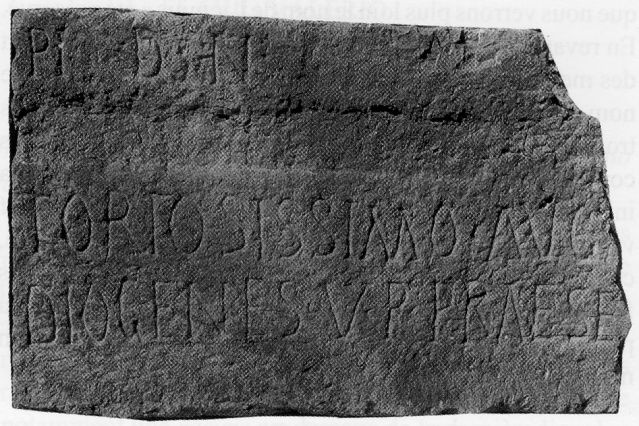
Inscription
--- princi]pi d(omino) n(ostro) [[[----]]] / [[[----]]] / [vic]toriosissimo Aug(usto), / [Val(erius)] Diogenes, v(ir) p(erfectissimus), praese[s ---
Inscription translation
... to the emperor, our lord ... , the most victorious Augustus. Valerius Diogenes, of perfectissimus rank, governor (praeses) ... [set this up].
Bibliography
- Christol, M. and T. Drew-Bear, 'Antioche de Pisidie. Capitale provinciale et l'ouvre de M. Valerius Diogenes', Antiquité tardive 7, Paris 1999, 61-2, no. V, fig. 21
Discussion
INSCRIPTION
In four lines of which the second is erased:
--- princi]pi d(omini) n(ostri) [[[----]]] / [[[----]]] / [vic]toriosissimo Aug(usti) / [ Val(erius)] Diogenes v(ir) p(erfectissimus) praese[s ---
'... to the emperor, our lord ... , the most victorious Augustus. Valerius Diogenes, of perfectissimus rank, governor (praeses) ... [set this up].'
Letter height 8-10 cm.
The inscription was first published by Levick 1967, with obvious misreadings (see Christol & Drew-Bear 1999, 61, whose reading is confirmed by the published image). The imperial name, now erased, was spread over lines 1 (where a slight erasure occurs after ‘d(omini) n(ostri)’) and 2.
DESCRIPTION (from Christol & Drew-Bear 1999, Levick 1967, and the published photo)
Rectangular block of bluish grey limestone, broken at right edge: H 67, W 111, D 39 cm. Christol & Drew-Bear 1999, 61, assume that on the left side, where there is a straight edge, there was originally a second block, bearing the beginning of the inscription. (For another inscription at Pisidian Antioch spread over two blocks, see LSA-2089).
PROVENANCE AND CURRENT LOCATION
The inscription was first recorded by Levick 1967 ‘near the site of the theatre’. Christol & Drew-Bear 1999, 61 recorded it ‘on the way leading to the theatre, on the left hand side’. This is possibly the decumanus of Pisidian Antioch (map in Mitchell & Waelkens 1998, 92 fig. 18. See also LSA-2082)
HONORAND, AWARDER AND DATE
The imperial name is erased. Levick 1967 proposed Galerius as honorand because the superlative ‘victoriosissimo’ re-occurs in an inscription to that emperor in Pisidian Antioch (LSA-2090). However, as Christol & Drew-Bear 1999, 62 point out, Galerius’ name is not erased elsewhere in the epigraphy of Antioch, neither is that of Licinius, another notorious victim of damnatio memoriae. They therefore justifiably assume that the dedication was to Maximinus Daia, Augustus 309-13, whose name was often defaced after his defeat and death at the hands of Licinius.
The awarder was the governor (praeses) of Pisidia Valerius Diogenes who held this office 309/10 – 13 (Christol & Drew-Bear 1999, 43 and 70-1; PLRE I, 257 Valerius Diogenes 8, dating his period of office to 311/12)); he is known both from statue dedications and building inscriptions in Pisidian Antioch (see LSA-2082, LSA-2087, LSA-2089, and LSA-2090). One of these inscriptions (LSA-2082) has also had the name of the honoured emperor erased, and may also have been a dedication to Maximinus Daia.
FURTHER DISCUSSION
If, as seems likely, this dedication was to Maximinus Daia, it may have formed part of a group to the four Augusti, of which three perhaps survive in fragmentary form: to Galerius (LSA-2090), to Licinius, to Constantine I (LSA-2089), and to Maximinus Daia (our inscription).
Discussion references
- Jones, A. H. M. et al., The Prosopography of the Later Roman Empire. Vol. I 260-395, Cambridge et al. 1971 (1975)
- Levick, B., Unpublished Inscriptions from Pisidian Antioch, Anatolian Studies 17, 1967, 101-21, p. 105 no. 8
Cite: Last Statues of Antiquity, LSA-2088 (Julia Lenaghan/ Ulrich Gehn).