
LSA-2089
Fragmentary base for statue of Constantine I, emperor. Antiochia (Pisidia). 310-313
Record details
Photographs
Inscription
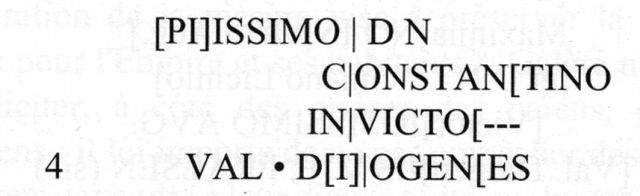
[Pi]issimo d(omino) n(ostro), [Flavio Valerio] / Constan[tino], / invicto [Augusto], / Val(erius) D[i]ogen[es, v(ir) p(erfectissimus), praes(es) ---]
Inscription translation
To our most pious lord, [Flavius Valerius] Constantinus, unconquered Augustus. Valerius Diogenes, of perfectissimus rank, governor (praeses) ... [set this up].
Bibliography
- Corpus Inscriptionum Latinarum; , III, 6806
- Christol, M. and T. Drew-Bear, 'Antioche de Pisidie. Capitale provinciale et l'ouvre de M. Valerius Diogenes', Antiquité tardive 7, Paris 1999, 62-3, no. VI
Discussion
INSCRIPTION
In four lines:
[Pi]issimo d(omino) n(ostro), [Flavio Valerio] / Constan[tino], / invicto [Augusto], / Val(erius) D[i]ogen[es, v(ir) p(erfectissimus), praes(es) --- ].
‘To our most pious lord [Flavius Valerius] Constantine, unconquered Augustus. Valerius Diogenes, of perfectissimus rank, governor (praeses) ... [set this up]’.
We present the inscription with the completions proposed by Christol & Drew-Bear 1999, 62 who reconstructed it from two separately recorded fragments (Corpus Inscriptionum Latinarum III, 6806, and Ramsay 1914, 197 no. 25). These two inscriptions separately read as follows:
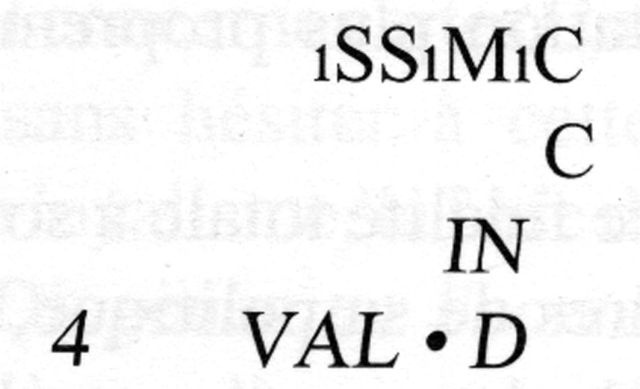
(A) Ramsay 1924 no. 25. In four lines:
ISSIMIC / (space) C / (space) IN / VAL D
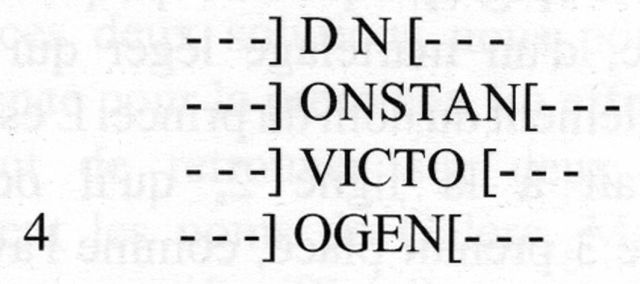
(B) CIL III, 6806. In four lines: :
DN[---] / ONSTAN[---] / (3) VICTO[---] / OGEN[---]
Both inscriptions were found independently of each other in the village of Hisarard, and both consist of four lines. Both appear to be blocks complete on the left side (see below, ‘Description’). Christol & Drew-Bear 1999, 62 hypothesized that these two together formed an honorific inscription to Constantine, as follows (‘|’ indicating the joint between the two blocks):
[PI]ISSIMO | DN /
C | ONSTAN[TINO] /
IN | VICTO[---] /
VAL D[I] | OGEN[ES.
Their hypothesis is very plausible in terms of the preserved letters, which link up nicely, but is impossible to prove without a close examination of the original inscribed blocks, and does face the problem that Ramsay describes Block A, which in Christol and Drew-Bear's reconstruction needs to be tightly fitting on the right against Block B, as 'broken' on the right (see below, 'Description').
DESCRIPTION (from Christol & Drew-Bear 1999)
Two blocks carrying fragments of an inscription. Block B is reproduced by Sterrett 1888 with the letters lined up at the left side whence Christol & Drew-Bear 1999, 62 conclude that the block was intact on that side. Block A is described by Ramsay 1924 as ‘complete on left : broken top, right, and bottom’; the inscription on this block, as reproduced by Ramsay 1924, is indented in lines 2 and 3. For both blocks no measurements are published. There is no published image.
PROVENANCE AND CURRENT LOCATION
Block B (CIL III, 6806) was first recorded by Sterrett in 1888 ‘in the street’ of the village of Hisarard. Block A was first recorded in 1924, likewise in the village of Hisarard. There is no published record of their present location.
The toponym Hisarard means ‘behind the fortress’; the village is situated northeast of the acropolis of Pisidian Antioch, at the foot of the Sultan Dağ mountain which separates Antioch from the territory of Philomelion (Christol & Drew-Bear 1999, 55 n. 72).
HONORAND, AWARDER AND DATE
Constantine I, the honorand, was Augustus 306-37, but fully recognized in the east only in 310. This gives a terminus post quem for the inscription, even though his Augustus-title is not preserved.
The awarder, Valerius Diogenes, was governor (praeses) of the province of Pisidia between 309/10 and 313 (on the date, Christol & Drew-Bear 1999, 43; PLRE I, 257 Valerius Diogenes 8 dates his office to 311/12). He is known from further inscriptions in Antioch, both statue dedications and building inscriptions (LSA-2082, LSA-2087, LSA-2088, and LSA-2090).
FURTHER DISCUSSION
This dedication may have formed part of a group to the four Augusti, of which three perhaps survive in fragmentary form: to Galerius (LSA-2090), to Licinius, to Constantine I (this inscription), and to Maximinus Daia (LSA-2088).
Discussion references
- Ramsay, W. M., , Journal of Roman Studies 14, 1924, p. 197 no. 25
- Sterrett, J. R. S., An Epigraphical Journey to Asia Minor, Papers of the American School of Classical Studies at Athens II, 1888, , p. 147 no. 124
Cite: Last Statues of Antiquity, LSA-2089 (Julia Lenaghan/ Ulrich Gehn).