
LSA-2090
Fragmentary base for statue of Galerius, emperor. Antiochia (Pisidia). 305-311.
Record details
Photographs
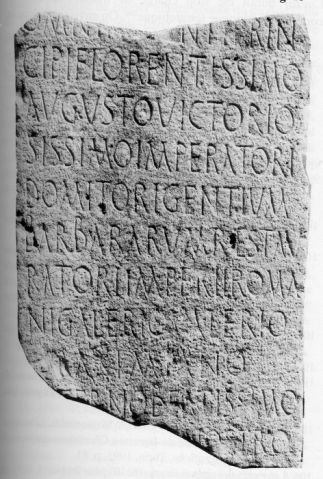
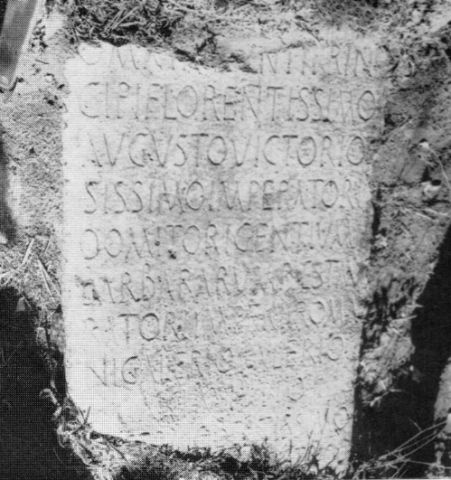
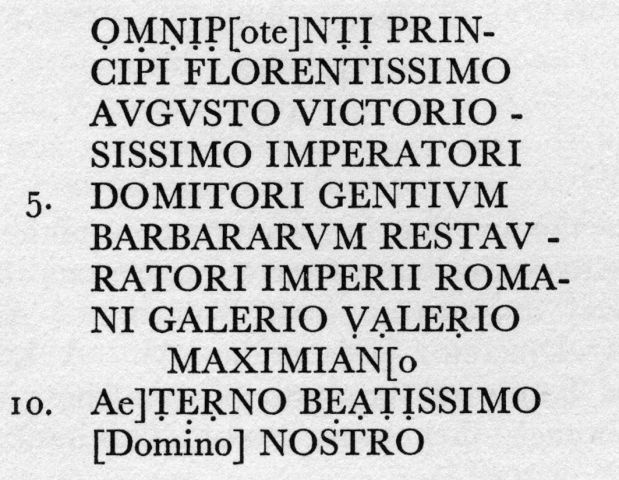
Inscription
omṇ̣̣̣̣ịpotentị̣̣̣̣̣̣̣̣̣ prin/cipi, florentissimo / (3) Augusto, victorio/sissimo imperatori, / domitori gentium / (6) barbararum, restau/ratori imperii Roma/ni, Galerio Valerio / (9) Maximiano / [ae]ṭẹ̣̣̣̣̣̣̣̣̣̣̣rno beatissimo / [-----] nostro [---]̣̣
Inscription translation
...to the all powerful ruler, the most successful Augustus, the most victorious emperor, the tamer of barbarian peoples, the restorer of Roman rule, Galerius Valerius Maximianus, eternal, most blessed ... our ...
Bibliography
- Christol, M. and T. Drew-Bear, 'Antioche de Pisidie. Capitale provinciale et l'ouvre de M. Valerius Diogenes', Antiquité tardive 7, Paris 1999, 65-70, no. X, fig. 25
Discussion
INSCRIPTION
In eleven preserved lines:
[---] omṇ̣̣̣̣ịp[ote]ntị̣̣̣̣̣̣̣̣̣ prin/cipi, florentissimo / Augusto, victorio/sissimo imperatori, / (5) domitori gentium / barbararum, restau/ ratori imperii Roma/ni, Galerio Valerio / Maximiano, / (10) [ae]t ̣̣̣̣̣ẹ ̣̣̣̣̣̣̣̣̣̣̣rno beatissimo / [-----] nostro [---]̣̣
'...to the all powerful ruler, the most successful Augustus, the most victorious emperor, the tamer of barbarian peoples, the restorer of Roman rule, Galerius Valerius Maximianus, eternal, most blessed ... our ...'
Letter height 4.5 - 4.8 cm.
We reproduce the text here as given by Christol & Drew-Bear 1999. The inscription will originally have been extended over more than eleven lines, finishing with the name of the awarder (Christol & Drew-Bear 1999, 66-7 and 69-70).
As Levick 1967, 105 points out, 'the titles are extravagant even for this period'.
DESCRIPTION (from Levick 1967, Christol & Drew-Bear 1999, and the published photo)
Limestone base, broken and lost at top and bottom, H 89 (75 according to Levick 1967, 105), W 50 (Levick: 48), D 49 (Levick: 39) cm.
PROVENANCE AND CURRENT LOCATION
The base had been in use as a kerbstone in Yalvaç and was recorded in the Yalvaç library by Levick in 1967. It is now in the Yalvaç Museum, inv. no. 68.
HONORAND, AWARDER AND DATE
Galerius, the honorand (full name Caius Galerius Valerius Maximianus), was Augustus 305-11.
The name of the awarder is lost, but a very likely candidate is the governor of Pisidia, Valerius Diogenes, who held office between 309/10 and 313 (Christol & Drew-Bear 1999, 43 and 70-1; PLRE I, 257, Valerius Diogenes 8, which dates his term of office to 311/12). He is known from two other statue dedications to emperors in Pisidian Antioch (LSA-2089 to Constantine, and LSA-2088 probably to Maximinus Daia), as well from a further statue dedication to the 'Piety of the Augusti' (LSA-2087). His name, moreover, is connected to a vast public building programme in Pisidian Antioch undertaken during his governorship (Christol & Drew-Bear 1999, 44-59 nos. I-III).
If Valerius Diogenes was responsible for this inscription, it will have been erected between 309 (the earliest possible date for his governorship) and 311 (the death of Galerius); but since the involvement of Diogenes cannot be proven, we have preferred to leave the date range as 305-11 (the reign of Galerius as an Augustus).
Addendum May 2014: In an article, M. Christol has suggested to connect a block with a fragment of an inscription, probably recording the name of Valerius Diogenes governor (praeses) of Pisidia, with our inscription: Christol 2014, 276-81; the block is Byrne and Labarre 2006 no. 151.
FURTHER DISCUSSION
This dedication may have formed part of a group to the four Augusti, of which three perhaps survive in fragmentary form: to Galerius (this inscription), to Licinius, to Constantine I (LSA-2089), and to Maximinus Daia (LSA-2088).
Discussion references
- Byrne, M.A. and G. Labarre (eds.), Nouvelles Inscriptions d'Antioche de Pisidie d'apres les Note-books de W.M. Ramsay. (Inschriften griechischer Städte aus Kleinasien, Bd. 67), Bonn 2006, no. 151
- Christol, M., Valerius Diogenes à Antioch de Pisidie: les mots du pouvoir, Zeitschrift für Papyrologie und Epigraphik 189, 276-86, 2014, 276-81
- Jones, A. H. M. et al., The Prosopography of the Later Roman Empire. Vol. I 260-395, Cambridge et al. 1971 (1975)
- Levick, B., Unpublished Inscriptions from Pisidian Antioch, Anatolian Studies 17, 1967, 101-21, pp. 105-6 no. 9 pl. XI b
Cite: Last Statues of Antiquity, LSA-2090 (Ulrich Gehn).