
LSA-2091
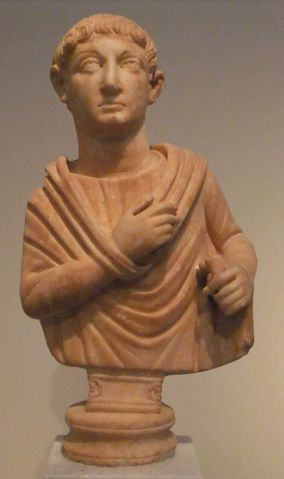
Draped portrait bust of clean-shaven young man. Athens. Earlier fourth century
Record details
Photographs
Bibliography
- Romiopoulou, K., Ellenoromaika Glypta tou Ethnikou Archaiologikou Mouseiou, Athens 1997, 136 no. 149
Discussion
DESCRIPTION (Object)
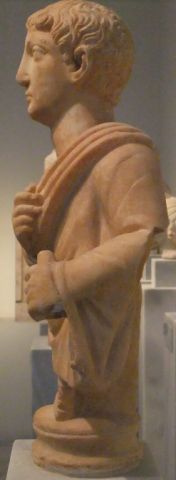
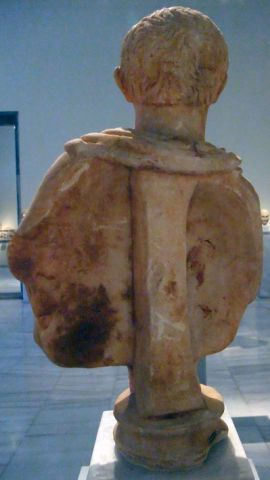
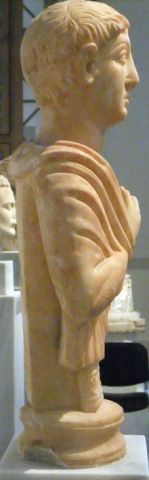
Under life-sized portrait bust of a clean shaven male youth, worked from one piece with profiled circular base and tabula. Pentelic marble, H (overall) 53.1 cm, (head) 15 cm, (face) 10.4 cm; W (head) 14.2 cm; D 14.4 cm (all measurements from Datsoule-Stavride 1981). The bust is in an excellent state of preservation. Only the left elbow and a piece of the base at the back are broken off; there is a chip on the left eyebrow.
The appearance of the bust is of a striking disproportionality. The large neck appears over-sized, the left ear is sticking out. The bridge of the nose is broad in comparison with the narrow nustrils; the nose is straight, but out of the vertical axis. The tabula in its relation to the base is out-centered and sloping to the left; in its relation to the bust, on contrast, it is out-centred to the right, the bust disproportionally sticking out to its left side. The upper part of the bust and the head are leaning to the right as if to counterbalance this shift of weight; the shoulders are markedly sloping to the right.
The surface is smoothly finished. The hair is brushed forward, short strands separating into a fork above the right eye, one strand pointing to the right and two to the left; the adjacent strands roll into snaily curls. The hair is worked out around the face; on the back head, on contrast, only rendered summarily. Around the face, the single strands are separated from each other and subdivided by chisel-work; there is no trace of drill-work here. At the back, however, deeply drilled channels of an earlier use remain despite the fact that a layer of the original substance must have been removed there.
The eyes are wide open, the regularly arching eybrows are standing proud and are indicated by short chisel strokes. The heavy upper eyelid is separated from the fleshy orbital by a drilled line. The eyelids do not meet at the inner angles, whereas at the outer angles the upper overlaps the lower lid. The caruncles are marked by drill points. The pupil is circumscribed by an incised line, the iris given as a shallow round drill hole. The eyeballs are almost half covered by the hanging upper lid.
The folds of the garments are indicated by broad, parallel drill channels. The digit of the left and the thumb of the right hand are separated from the other fingers by cloddish drill lines.
The tabula is moulded at top and bottom, confined by peltae at both sides. It is uncarved, the name of the honorand must once have been pained on it.
PROVENANCE/ LOCATION
There is no published record on the provenance of the bust. Today it is in the National Archaeological Museum of Athens (on display), inv. no. 2235.
DESCRIPTION (Subject)
The bust depicts a clean-shaven young man in chiton and himation. The himation covers both arms to the wrists; the right arm is held in a loop before the breast in a gesture known from the late-classical statue type of Sophocles; the left arm is held angled at the side. In his left hand the depicted holds a short scroll. Both, habit and attribute point to the honorand's education, and possibly his connection with the classical heritage of Athens. They are, however, no more than standard features and can not give any hint on the individuality of the young man.
The uneven features of the face (ears, neck, nose) are rather the result of the late-antique reworking than an artistic reverence to the individuality of the depicted.
DATE
The bust was dated to the severan period (time of Elagabalus) by Datsoule-Stavride 1981. Rhomiopoulou 1997 attributed the hairstyle and the rendering of the eyes to the Constantinian period. In this author's view the marking of the eyes suggests a late antique date; the hairstyles resembles fashion styles visible on the arch of Constantine. This suggests a date in the earlier 4th century.
Cite: Last Statues of Antiquity, LSA-2091 (Ulrich Gehn).