
LSA-2095
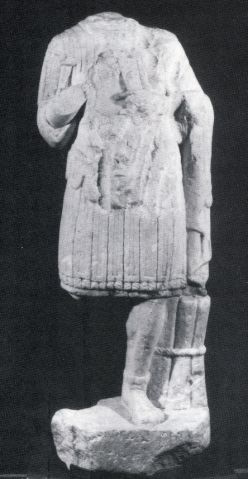
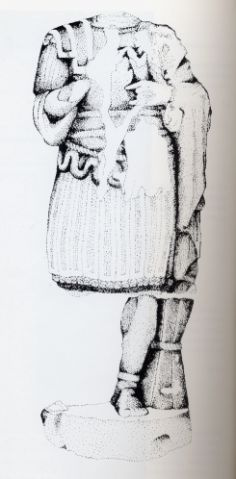
Headless portrait statue in armour. Aquincum (Pannonia Valeria). Late third to earlier fourth century.
Record details
Photographs
Bibliography
- Aquincumi Múzeum, Gods, soldiers and citizens in Aquincum : an exhibition to celebrate the 100 year centennial of the founding of the Aquincum Museum : guide to the exhibition., Budapest 1995, 41, no. 32, fig. 18 (3rd c.)
- Polenz, H. and H. Polenz, Das Römische Budapest : neue Ausgrabungen und Funde in Aquincum , Münster 1986, 214, no. 781, fig. 78 (3rd c.)
Discussion
DESCRIPTION (Object)
Life-size statue. H: 160, W: 63, D: 40 cm. D (of plinth): 17 cm. Marble.
The statue is missing the head, right leg, and right hand. The surface around the left hip is damaged. The head and arms were originally worked in one piece with the body and plinth.
PROVENANCE
The statue was found in zone III of Budapest in Daru Street. This corresponds to the military part of ancient Aquincum and in particular to the southern area of the military camp, the so-called Governor’s palace.
DESCRIPTION (Subject)
The statue shows a man in a variation of Roman military dress. He wears a long sleeved tunic, a metal breast plate with capped sleeves, a double belt with a large buckle, a leather skirt, a cloak over his left arm, sandals. Both cloak and sandals are described in the 1995 catalogue entry but are not clearly visible in the published illustrations. Alongside the weight-bearing left leg are a bundle of scrolls which serve as a statue support. In the left hand is a single scroll. The right held near the right pectoral probably made an open-handed gesture (as, for example, in LSA-1785).
DATE
The statue has several elements which suggest a late date. The broad belt, the long-sleeved tunic, and the breast plate which has shoulder caps are not part of the standard high-imperial military dress. Moreover, the scrolls both in the hand and on the statue support are highly unusual. The position of the right hand across the body and its gesture are equally not recorded in extant armoured statues of the high-imperial period. Similar arm positions do appear on late third century or early fourth century statues (for example, a porphyry statue LSA-1008 and one from Celeia LSA-1785). In addition, the statue from Celeia, LSA-1785, shares the same details of dress and a set of scrolls as a statue support.
HONORAND
Found in the headquarters of the military sector of the city, the statue probably represented in a high-ranking official of the first half of the fourth century.
Cite: Last Statues of Antiquity, LSA-2095 (J. Lenaghan).