
LSA-210
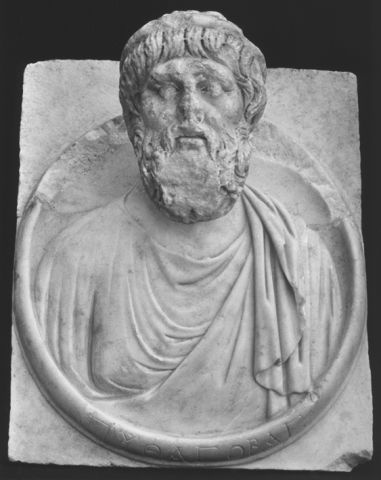
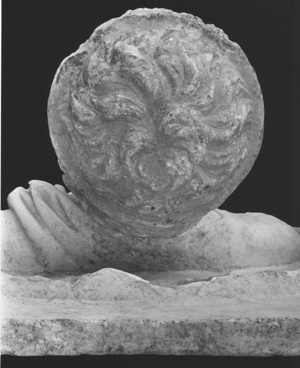
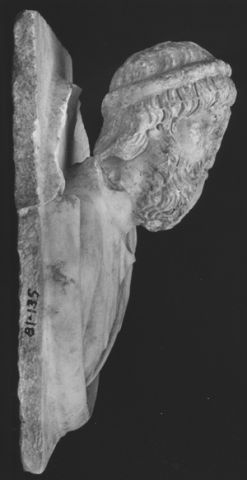
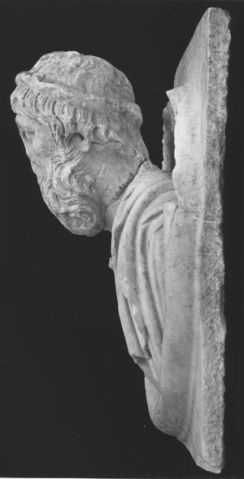
Shield portrait of Pythagoras. Aphrodisias (Caria). Late fourth to early fifth century.
Record details
Photographs
Bibliography
- Smith, R.R.R. 'A new portrait of Pythagoras', Aphrodisias Papers 2. The theatre, a sculptor's workshop, philosophers, and coin types (JRA Supp. 2), Ann Arbor 1991, 159-167, figs. 1-6
Discussion
DESCRIPTION (Object)
Shield portrait. H: 65.5, W: 56 cm. White marble.
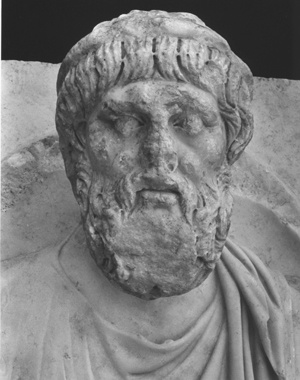
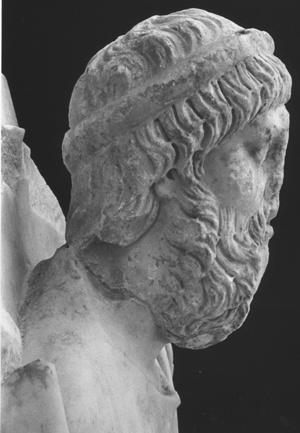
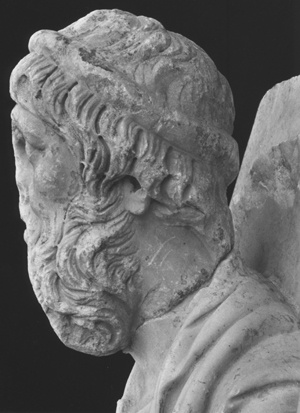
The shield and portrait were made in one piece. It is preserved in three joining pieces. 1) upper part of frame and shield, 2) bust and lower part of frame and shield rim, 3) head. Missing is the upper part of the rim. The head is battered from later use as building material.
PROVENANCE
The shield was excavated in 1981 in the Atrium House, in the alley between the Sebasteion and the southern perimeter of house. It was probably displayed inside one of the colonnades of the peristyle garden with LSA-206, LSA-207, LSA-208, LSA-209, LSA-211, LSA-212, LSA-213, and LSA-214. The head was excavated in 1968 in the fill of the Theatre.
DESCRIPTION (Subject)
An inscribed label on the shield’s lower rim, Pythagoras, identifies the archaic-period philosopher and mathematician. He wears a tunic, himation over his left shoulder, and a rolled fillet around his head (the attribute of priests, seers, and some inspired seer-like poets). The generic, classically formed bearded portrait seems not to have known or used a defined portrait type.
DATE
This shield portrait is part of the the main group of six shield portraits from the same context (LSA-206, LSA-207, LSA-210, LSA-211, LSA-212, LSA-213). Its belongs in the late fourth or early fifth century for reasons of technique and context.
Discussion references
- Smith, R.R.R., "Late Roman philosopher portraits from Aphrodisias", JRS 80 (1990), 141, no. 6 (before the head was discovered to join)
- Smith, R.R.R. 'Late Roman Philosophers', Aphrodisias Papers 2. The theatre, a sculptor's workshop, philosophers, and coin types (JRA Supp. 2), Ann Arbor 1991, 151-3, no. 6, fig. 7
Cite: Last Statues of Antiquity, LSA-210 (R.R.R. Smith).