
LSA-2100
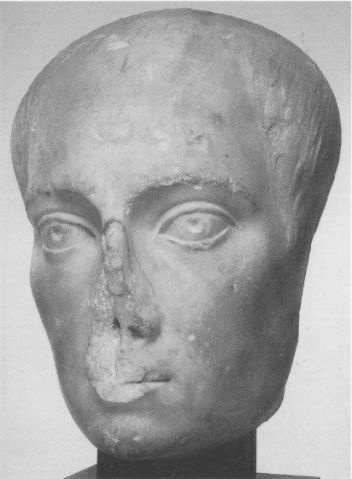
Over life-size portrait head of clean-shaven man with receding hair. From Italy. Mid-fifth century.
Record details
Photographs
Bibliography
- Museum of Fine Arts, Boston. Dept. of Classical Art
, Romans and barbarians , Boston 1976, 152, no. 189
Discussion
DESCRIPTION (Object)
Over life-size head. H: c. 30 cm. The catalogue entry gives the height erroneously as 17.5 cm. Medium-grained white marble; isotope analysis indicates probably from Paros.
The head has been smoothly cut at the top of the neck. The nose and upper lip are missing. Some iron corrosion in the right nostril indicates a repair, possibly eighteenth century. The right upper ear is broken. The left ear is missing and was added separately as part of a repair. Holes for two small iron pins plus a smoothly worked outer surface that runs around a finely clawed inner surface indicate again an eighteenth century repair.
The hair is finely rendered with a flat chisel at the top and sides. The irises are indicated by a finely engraved complete circle; the tear duct of the right eye is also finely engraved. The pupils have been drilled out in a large, heavy, crescent shape in the middle of the eyeball. The rendering of the pupils and the difficulties with the ears suggest that this head has been re-worked from another one. The dome of the head comes sharply inwards above the nape of the neck.
PROVENANCE
Said to have come from the Bardini Collection, Florence. With Pino Donati, Lugano, Switzerland until c. 1970 when it was purchased by John J. Herrmann. On March 2, 1977 John J. Herrmann loaned it to the MFA and on November 19, 1997 he gave it to the MFA.
DESCRIPTION (Subject)
The head depicts a man with short straight hair that recedes. The receding hair is the only sign of age but should indicate a mature adult. The face is rendered in inorganic, blocky areas and is animated by large wide-open eyes.
The brow is tall and unlined. The eyebrows have been etched into an extant ridge in a fine arch. The lower line of the upper lid is broad and emphatic. The pupils are large and float in the middle of the eyeball. The cheek bones project significantly but the skin pulls tautly over the face without any folds. Though damaged, the nose seems to have had a fine ridge. The mouth is small from side to side but has pouting lips and was tucked tightly into the surrounding skin. The upper line of the slightly receding but rounded chin is well-defined.
DATE
The marking of the pupils indicates a date in the fourth century or later. The long clean-shaven face loosely recalls better known works from Rome, such as LSA-906, LSA-907, LSA-1068, and LSA-1069. All of these monuments are usually placed in the late fourth or early fifth century. The finely engraved hair and the long inorganic, clean-shaven faces are generally placed in the late fourth or early fifth century on the basis of comparisons to Theodosian portraits (see, especially, LSA-377.
Discussion references
- Meischner, J., 'Das Porträt der theodosianischen Epoche II (400 bis 460 n. Chr.),' , Jahrbuch des Deutschen Archäologischen Instituts, 106 (1991), 385-407, 402, pl. 91.4
Cite: Last Statues of Antiquity, LSA-2100 (J. Lenaghan).