
LSA-2101
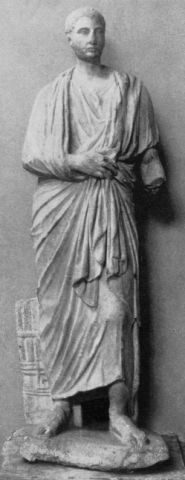
Portrait statue of young man in himation. Alexandria (Aegyptus). Late third or fourth century.
Record details
Photographs
Bibliography
- Adriani, A., Repertorio d'Arte dell'Egitto Greco-Romano. Serie C. Vol. I-II, Palermo 1966, 160 no. 115
- Bonacasa Carra, R.M. 'Statua di letterato del Museo Greco-Romano di Alessandria', Alessandria e il mondo ellenistico-romano : studi in onore di Achille Adriani, Rome 1983, 131-8, pl. 16-17
- Tkaczow, B., The topography of ancient Alexandria (An archaeological map), Warsaw 1993, 243-4 no. 155
Discussion
DESCRIPTION (Object)
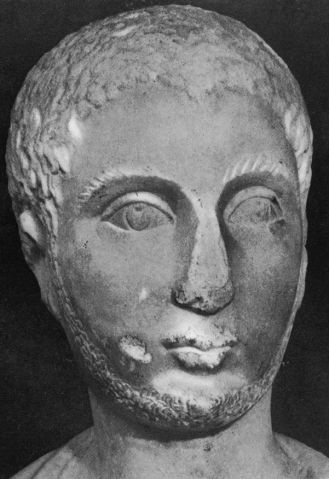
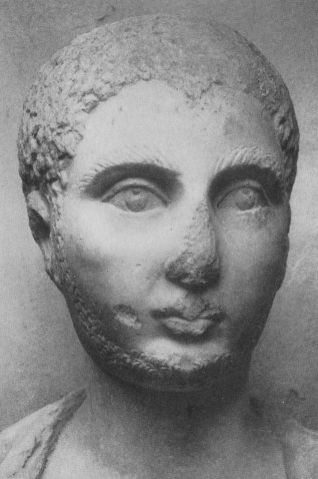
Life-size statue of white marble (possibly Proconnesian); H (total) 195, (plinth) 12, (head) 23 cm. The statue is almost complete, only the left forearm arm with hand are missing. The front edge of the plinth is broken off, and the fingers of the right hand are chipped. In the face there is a chip at the right cheek, and minor chips are scattered. Statue and head are worked from the same block (see below, ‘Date’)
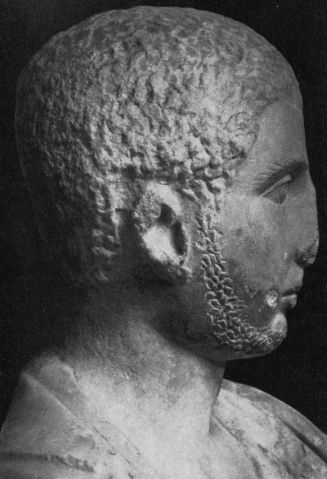
The head is regularly oval shaped. The hair surrounds the skull like a tight fitting cap and is set off the flesh by a clear cut line; it is articulated into knobby locks by shallow chisel strokes. The hairline above the brow has a point above the nose; it thus repeats the line of the high arching eyebrows. The beard is indicated by short irregular chisel strokes scratched into the flesh.
The eyes are enlarged. The eyebrows are high, regular arches and they are articulated by short vertical strokes. The pupil is circumscribed by a circular incised line; the pupil is set close to the upper lid and marked by a triangular chisel stroke.
The plain face is scarcely modeled; the small chin is receding, and the small lips are protruding.
The proportions of the head are too small compared to the body. This is probably the result of a late antique rework; at the same time probably the once longer hair has been cut back, and the beard and eyebrow markings have been cut into the face. The receding chin and protruding mouth are a further indicator of rework.
The folds of the garment have plastic value; their arrangement follows organically the movements of the underlying body (see below, ‘Date’).
PROVENANCE AND CURRENT LOCATION
The statue was found in 1935 in the western part of ancient Alexandria, at the border of the modern quarters of Mint el Bassal and Gabbari (Tkaczow 1993, 40-1, 243 no. 155; plan II), in a Christian necropolis (Tkaczow 1993, 61 site 9). The necropolis is possibly part of a larger necropolis in the area going back to the Hellenistic period and in use through the Roman Imperial period (Tkaczow 1993 sites 4, 9). The statue was found c. one metre above the archeological layer of a large tomb constructed of quarry blocks. No connection between the tomb and the statue could be established; the funerary character of the statue, however, appears secure.
DESCRIPTION (Subject)
The portrayed is a young man; his smooth face is without any wrinkles, his hair is full, and his beard is thin. He is dressed in tunic and himation, his feet clad in sandals. He stands with the weight over his right leg; the left knee is slightly bent. The left arm is bent in the elbow, the missing hand was pointing outwards as if communicating with somebody. The right arm is wrapped into the cloak; it is bent in the elbow, the forearm held horizontally at the body. The head is turned towards the left and thereby stresses the opening of the statue to that side.
At the right leg there is a receptacle (capsa) and a bundle of scrolls placed on top of it. The receptacle is closed with a lid and decorated by two bends wrapped horizontally around its centre. The scroll bundle is wrapped by a plain horizontal bend.
The choice of costume places the portrayed into the world of Greek civic virtue and education (paideia); scroll bundle and receptacle underline the aspect of education. The rich dress signals elevated social status, the gesture of the right arm self-composure. The opening of the figure towards an imaginative counterpart stimulates associations of dialogue or performance, in philosophical exchange, recitation, or delivering a speech.
DATE
The portrait head has been dated to the later 3rd century by Adriani 1940, and to the 4th by Bonacasa 1983. Wrede 1972 took it as the closest parallel to the head of Virius Audentius Aemilianus in Pozzuoli firmly datable to 364/79 (LSA-41, LSA-46), and dated to the Valentinianic era.
The enlarged eyes and the striking technique of indicating iris and pupil indicate a late 3rd or 4th century date to the head. The present state of the portrait head must be the result of a late antique rework (see above, ‘Description (Object)’). The statue body with its plastic values and harmonized proportions, on contrast, indicates a date in the second century (see below, ‘Further Discussion’).
FURTHER DISCUSSION
The apparent contradiction between the head with its stylized features and the statue body with its ‘classical’ features in body-garment interrelation, proportions and plastic values has led earlier scholarship to different solutions. Adriani 1940 suggested that the statue belonged to a ‘classicizing current’ within the 4th century. Such an assumption was considered necessary by Adriani because he was convinced that head and statue body were worked at the same time. His suggestion was confirmed by Bonacasa 1983 who insisted that there were no traces of rework at the head which therefore had to be contemporary with the statue body. Adriani's assumption of a classicizing current in 4th century portrait sculpture was extended by Napoli 1957, the first publisher of the statue monument to Virius Audentius Aemilianus in Puteoli (LSA-41, LSA-46), and by Giuliano 1959 in his discussion of the statue monument of Caius Caelius Saturninus signo Dogmatius in Rome (LSA-903, LSA-1266). Both scholars thought that the respective statue bodies were contemporaneous with the portrait heads (cf. Gehn 2012, 501, 511-13).
In the same spot together with our statue, a female draped statue (Tkaczow 1993 no. 156), a late antique Corinthian capital (Tkaczow 1993 no. 288), and an inscribed column (Inscription illegible, Tkaczow 1993 no. 368) were found.
Discussion references
- Adriani, A., Annuaire du Musée Gréco-Romain 1935-1939, Alexandria 1940, 132-4 pl. 72-3
- Gehn, U., Ehrenstatuen in der Spätantike. Chlamydati und Togati, Wiesbaden 2012
- Giuliano, A., Catalogo dei ritratti romani del Museo Profano Lateranense, Vatican City 1957, 81-2 no. 99 pl. 50-60
- Napoli, M. , 'Statua ritratto di Virio Audenzio Emiliano consolare della Campania', Bollettino d'Arte 44, Milan 1959
- Von Sydow, W., Zur Kunstgeschichte des spätantike Porträts im 4. Jahrhundert. n. Chr, Bonn 1969, 135, fn. 1
- Wrede, H., Die spätantike Hermengalerie von Welschbillig : Untersuchung zur Kunsttradition im 4. Jahrhundert n. Chr. und zur allgemeinen Bedeutung des antiken Hermenmals , Berlin 1972, 93, pl. 59.1
Cite: Last Statues of Antiquity, LSA-2101 (Ulrich Gehn).